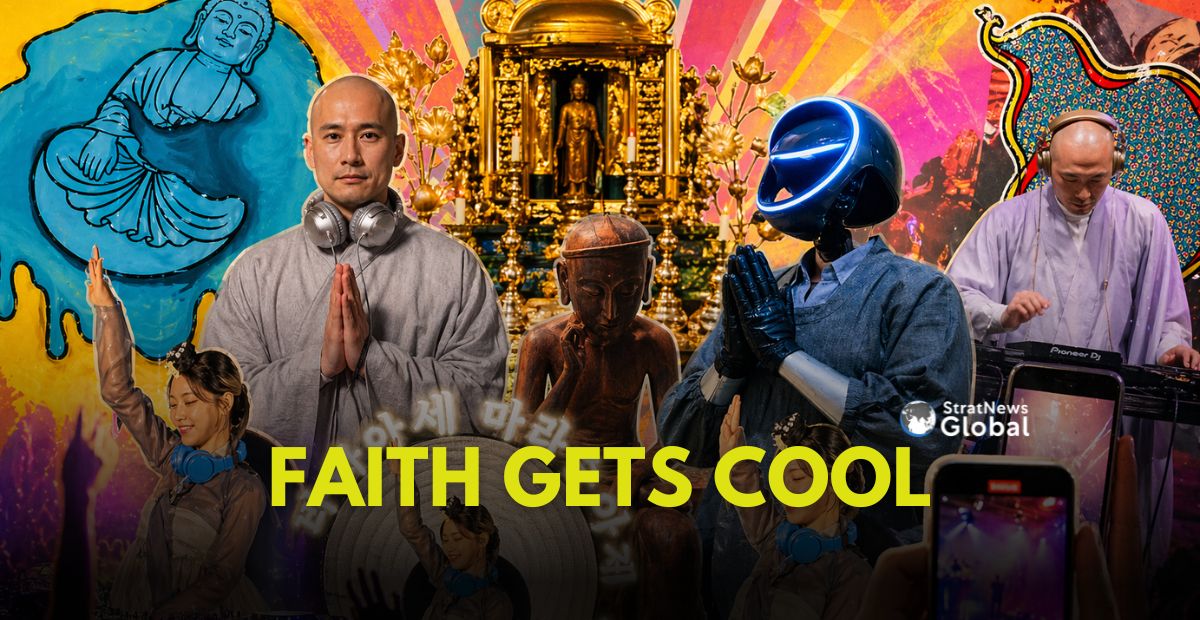
Dancing to a DJ’s beat, LED screens in the background, and chants folding into electronic music, this is how the people of South Korea celebrated during the Seoul International Buddhism Expo.
For the expo, thousands of young visitors gathered for a different kind of Buddhist practice, that is for merchandise, music and mood. There were Buddha-themed photo cards styled like K-pop idols, incense as a luxury fragrance, and streetwear inspired by monastic robes. The scene looked more like a festival audience than a religious gathering.
Youth today is redefining the way to reconnect with religion. What once seemed to be ‘uncool’ is being reworked with a distinctly modern, almost playful twist. Be it bhajan clubbing in India or the rise of “hip Buddhism” in Seoul, faith is no longer confined to quiet rituals or inherited routines.
In India, this shift is more visible in what is popular today as ‘bhajan clubbing’. The concert-like scene with DJ sets, and ambient lights, where people including a large number of youth gather to celebrate religious tunes. The change came subtly through the remixed aartis, aesthetic temple visuals and influencers framing spirituality as part of a daily routine. Even traditional meditation has taken a new term of ‘mindfulness’ to better resonate with contemporary audiences.
The shift is unfolding against traditional religious identity across East Asia. Pew Research Center suggested Buddhism as the only major religion to have shrunk globally, with many young people moving away from the formal affiliation. Yet, a decline in religious affiliation does not necessarily mean a decline in spirituality. Instead, in the digital age, faith is finding new ways to adapt and reappear.
In South Korea, where a growing number of young people identify with no formal religion, Buddhism is finding a second life, not through doctrine, but through design and experience. According to the 2025 Hankook Research, Buddhism stands as the most favourable religion among youth.
In Japan, sermons are given by Buddharoids, humanoid robots working as monks. For younger audiences, raised in a digital-first world, this does not feel strange. It feels accessible, contemporary, and aligned with how they already interact with the world.
In China however, the term religion is understood differently from its traditional sense, it’s more fluid. According to a survey published by Pew Research Center, percentage of Chinese adults who believe in the Buddha or bodhisattvas, those who practice rituals like burning incense, and those who identify as Buddhist varies.
Hence the belief system stands stronger with the younger generation turning to non-traditional forms of spirituality or belief such as meditation and even algorithm-driven practices.
This reimagining of religion is not random. It can be seen as rooted in the realities of being young today. There is anxiety about jobs, identity, and the future. There is also fatigue with rigid systems, whether institutional or ideological.
Yet, the transformation raises questions.
As temples sell branded goods and rituals are turned into events, critics worry about the commercialisation of faith. Some argue that when spirituality is packaged like lifestyle content, does it risk losing depth?