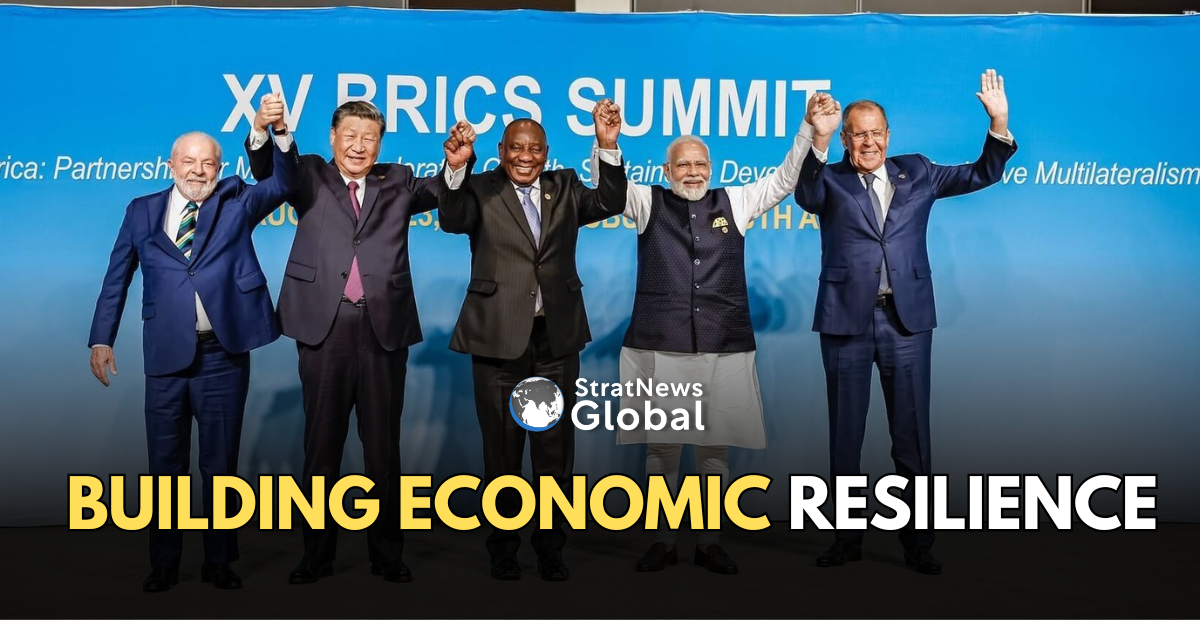
BRICS is exploring how to build economic resilience at a time when the West has weaponised everything from trade at one end to food and even energy at the other.
At the BRICS Academic Forum, hosted by the Observer Research Foundation in Delhi recently, Vladimir Zuev, Head of the Economics and Trade Sector at the BRICS Expert Council, had two suggestions:
“The first solution is doing trade as usual without agreements. The second solution would be concluding sectoral agreements in different areas, the way we’re concluding an agreement on migration”.
He believes that this will make the countries move toward common standards while bypassing the friction of free trade agreements.
Tan Ya of the BRICS Research Centre at Uibe University in China, believes “We must have alternative solutions on land with railways and highways, and we need to make sure that our infrastructure is strong enough to deal with the future natural disasters to promote technological progress and technology cooperation.”
In her view, the BRICS Plus mechanism must be made more functional by allowing it to act as a platform for project-specific cooperation. This involves “welcoming a third country to join in specific mechanism cooperation with BRICS countries… a third country with no other concern just to work on specific projects or mechanisms with BRICS companies as a whole”.
Mai Mohsen of Egypt’s Central Cabinet think tank IDSC says that the grouping must work on enhancing connectivity through infrastructure and systems. She says the New Development Bank must support financial innovation, including digital payment systems, to build a more integrated and resilient economy.
For India, these recommendations will set the stage for the upcoming summit, said Shambhu Hakki, Joint Secretary at the Ministry of External Affairs, and the current sous BRICS Sherpa. He noted that the strength of the grouping lies in its diversity and the complementarity of its capabilities.