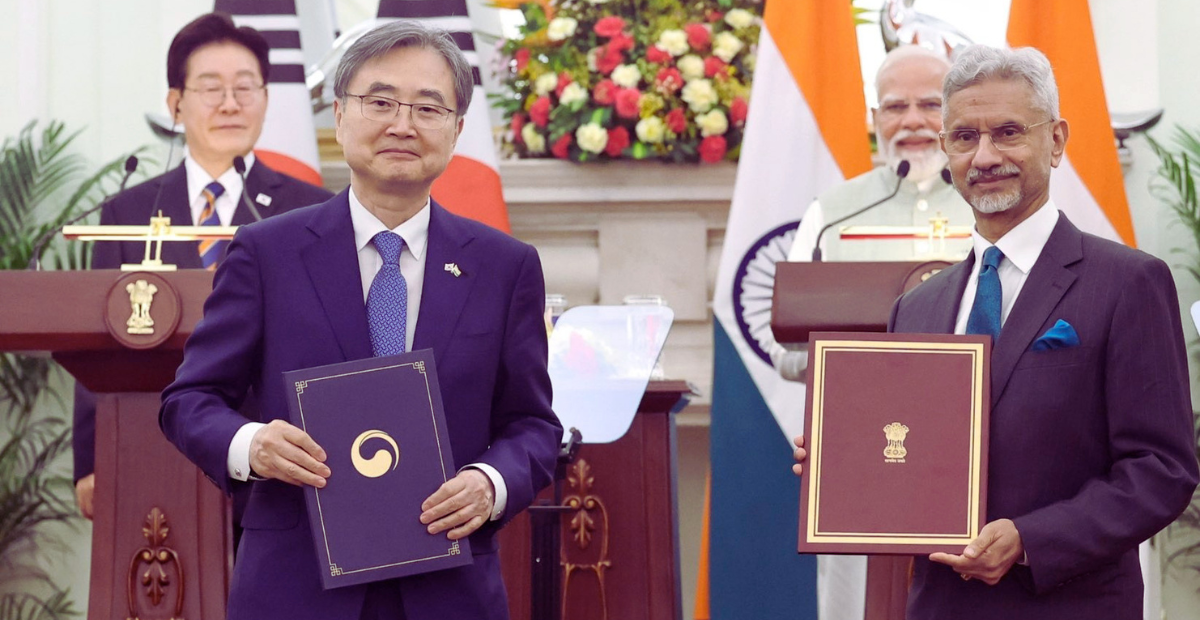
Prime Minister Narendra Modi and visiting South Korean President Lee Jae Myung on Monday agreed to restart negotiations to upgrade their existing trade pact, placing economic cooperation at the centre of a rapidly expanding strategic partnership.
They endorsed an ambitious roadmap to double bilateral trade to $50 billion by 2030 and inked 15 agreements covering digital cooperation, artificial intelligence and small and medium enterprises (SMEs).
Negotiations on upgrading the Comprehensive Economic Partnership Agreement (CEPA), originally implemented in 2010, will seek to address trade imbalances, ease non-tariff barriers and create favourable conditions for businesses on both sides.
At the joint press conference President Lee said, “We agreed to speed up the negotiations to upgrade our CEPA to create more favourable trade and investment conditions,” adding that the goal is to “increase the current $25 billion level of annual trade volume to around $ 50 billion by 2030.”
Modi said the two countries are “laying the foundation for the success story of the next decade,” signalling that trade will be the backbone of future cooperation.
In a detailed briefing following the conclusion of the talks, senior diplomat P. Kumaran said both countries have now launched a ministerial-level Industrial Cooperation Committee. This will serve as a dedicated platform to drive collaboration in trade, investment and priority industries such as semiconductors, critical minerals and energy.
On CEPA negotiations, Kumaran noted that both sides are targeting an “early conclusion,” with a more ambitious timeline than previous rounds.
“There is an acknowledgment that trade needs to be more balanced and must address non-tariff barriers,” he said, adding that the upgraded pact will go beyond tariffs to include supply chains, technology flows and services.
He pointed out that while bilateral trade has grown significantly since 2010, it remains skewed. “There is a need to rebalance trade and find ways to increase India’s exports,” he said, indicating that market access and regulatory hurdles will be key issues in the negotiations. “The two sides are keen to wrap up the negotiations in a year,” he added.
President Lee announced plans to revise the existing cooperation framework for small businesses, noting that increased SME engagement will be critical to sustaining long-term trade growth.
Kumaran echoed that point saying the “second phase” of economic engagement will focus on smaller enterprises and innovation-driven sectors. Both sides are also working to expand Korean business presence in India, with efforts to resolve operational bottlenecks and improve the investment environment.
A bilateral Economic Security Dialogue will seek to diversify trade and strengthen critical technology partnerships. The future of the relationship will rest on AI, semiconductors, clean energy and critical minerals.
Energy security featured prominently in the talks, with both sides agreeing to ensure stable supply of resources such as naphtha amid global uncertainties.