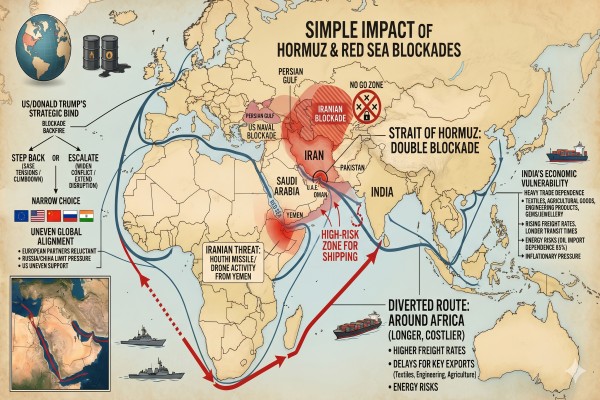
Responding to the US blockade of Hormuz, Iran has threatened to shut down maritime traffic across the Persian Gulf, the Gulf of Oman, and the Red Sea, widening the crisis from an oil chokepoint into a direct threat to one of the world’s busiest trade corridors.
What makes Iran’s Red Sea threat significant is not the need to physically block ships, but the ability to make the route too risky to use, because even limited missile or drone activity can push up insurance costs and force shipping companies to pull back, slowing or halting traffic through a corridor that links Asia to Europe.
This shifts the crisis from being about oil alone to one that affects the full chain of global trade, since the Red Sea connects to the Suez Canal and carries a large share of container traffic, manufactured goods, and time-sensitive exports, meaning disruption here spreads quickly across markets and supply systems.
For the United States and President Donald Trump, the blockade has turned into a strategic bind, as it was meant to pressure Iran but has instead triggered a response that raises the cost of maintaining that pressure while limiting room for compromise.
Washington now faces a narrow choice, where stepping back may ease tensions but appear as a climbdown, while escalation risks widening the conflict across multiple waterways, especially as Iran has made clear it is willing to extend disruption beyond Hormuz into the Red Sea.
This is unfolding in a setting where US support is uneven, with European partners reluctant to engage directly and Russia and China limiting coordinated pressure, leaving Washington to manage a crisis that is spreading both geographically and economically.
China, in particular, is positioned to protect its own interests while watching the situation develop, benefiting from the strain on US resources and retaining the option to step in diplomatically if it sees advantage.
The impact of Iran’s Red Sea threat is most direct for countries like India, where trade flows depend heavily on this corridor, and any disruption quickly translates into higher costs, longer transit times, and uncertainty for exporters.
A large share of India’s exports to Europe moves through the Red Sea, and as vessels divert around Africa, freight rates rise sharply while delivery timelines stretch, affecting sectors such as textiles, agricultural goods, engineering products, and gems and jewellery that depend on predictable shipping cycles.
The exposure is not limited to logistics, because the Gulf region is also a major market for Indian goods, so disruptions affect both the movement of exports and the demand that supports them, creating a dual pressure that is difficult to absorb, especially for small and medium firms.
At the same time, energy risks remain tied to the same geography, as India imports more than 85% of its crude oil, much of it passing through high-risk zones that are now part of the broader threat landscape, which means any sustained disruption or price spike feeds directly into inflation.
Higher oil prices push up transport and production costs, which then spread across the economy, raising the price of goods and services and adding pressure on both businesses and households.
India does have reserves that provide a short-term buffer, but these are limited and not designed to offset a prolonged disruption across multiple sea routes, making the duration of the crisis a key factor in determining its overall impact.
Imports such as fertilisers, edible oils, and industrial inputs are also affected by delays and rising freight costs, adding stress to agriculture and manufacturing in ways that may not be immediate but are likely to build over time.
New Delhi’s response reflects this mix of risks, as it has deployed naval assets to protect Indian shipping while maintaining engagement with both Washington and Tehran, avoiding alignment that could limit access or increase exposure.
This approach is shaped by necessity, because India’s interests span competing partners and multiple routes, and preserving flexibility is central to managing both immediate disruptions and longer-term strategic concerns.
The crisis also highlights a deeper structural issue, which is the dependence of global and Indian trade on a few narrow maritime corridors that can be disrupted without full-scale war, simply by raising the level of risk beyond what commercial operators are willing to accept.
That is why alternative corridors are gaining urgency, as India looks to reduce reliance on vulnerable sea lanes through a mix of maritime and land-based routes, while also maintaining connectivity through Iran toward Central Asia as part of a broader strategy of diversification.
Iran’s Red Sea threat fits into this larger picture by demonstrating how control over key transit points can be used to exert pressure far beyond the immediate conflict, shaping trade flows and economic outcomes without direct confrontation.
For the United States, this raises questions about the limits of coercive tactics in a more fragmented global order, while for India it sharpens the need to build resilience through diversified routes, stronger maritime capabilities, and more secure energy planning.
The immediate outcome will depend on how Washington and Tehran respond. But the larger shift is already clear, as Iran’s Red Sea threat exposes how vulnerable global trade remains, and how quickly those vulnerabilities can be turned into leverage.