There was a time when war felt distant unless you were standing in its path.
It was something you watched on television—columns of smoke rising over oil fields, tracer fire in the night sky, maps with arrows moving across borders. You could locate it, contain it, and, for most people, ignore it.
That distance is disappearing.
In early April 2026, Iran’s Islamic Revolutionary Guard Corps issued a warning that should have sounded abstract, but wasn’t.
Eighteen American companies, it said, were now “legitimate targets.” Not military bases. Not ships. Companies: Microsoft, Google, Apple, Nvidia, among others. Employees were told to leave. People living nearby were advised to move away.
It read like a warning you might scroll past.
And then, quietly, it became real.
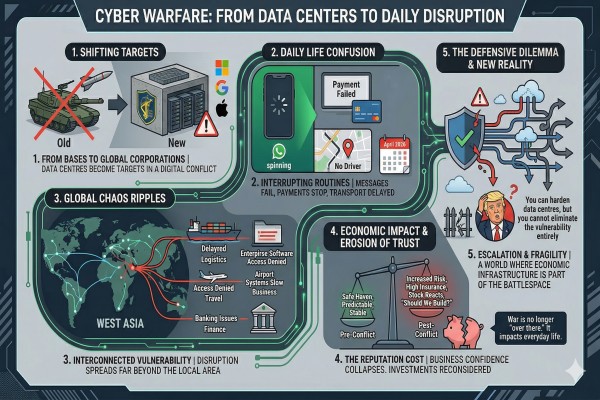
Data centres in the Gulf were hit. Not symbols of power, not visible landmarks—just low, anonymous buildings that most people would never notice. But inside those buildings sat something far more valuable than oil or steel: the systems that keep daily life moving.
The impact did not arrive with explosions. It arrived as confusion.
You wake up, check your phone, and your messages aren’t going through. WhatsApp shows a spinning icon. Instagram won’t refresh. It feels like a network glitch.
Then you try to pay for something.
Your banking app doesn’t load. The payment fails. You try again—nothing. Somewhere, far away, a server you’ve never heard of is down, and suddenly your money is out of reach.
You book a cab—it doesn’t arrive. The app can’t match you with a driver. At the airport, flights begin to delay because backend systems aren’t updating. Check-in slows. Screens freeze. Cargo tracking systems stop syncing, and somewhere else in the world, a shipment doesn’t move.
None of this feels like war. And that is precisely the point.
What Iran has demonstrated is not just the ability to strike infrastructure, but to reach into the fabric of everyday life—into the routines people take for granted—and interrupt them without warning.
Because the modern world does not run on roads or ports alone. It runs on the cloud.
Every message, every payment, every booking, every corporate system flows through a vast, invisible network of data centres. These systems are distributed across regions, interconnected in ways even the companies that depend on them do not fully map.
And crucially, many of those pathways run through the Gulf, which has spent years building itself into a digital crossroads linking Asia, Africa and Europe.
That was the promise.
Data, we were told, is the new oil. The Gulf would not just export energy—it would process information, power artificial intelligence, and anchor the infrastructure of the future.
But unlike oil, data depends on continuity. It depends on trust.
And trust, once shaken, is difficult to restore.
When those data centres were hit, the disruption did not stay local. It spread—through routing systems, cloud dependencies, and software layers—into companies and users who had no idea their data ever passed through Bahrain or the UAE.
A business in Europe loses access to its enterprise software. A logistics firm in Asia cannot track shipments. A financial service somewhere else experiences delays it cannot immediately explain. The system does not fail in one place. It falters everywhere.
This is what makes the economic impact so profound.
It is not just about outages. It is about confidence.
For years, the Gulf sold itself as a safe haven for global business—stable, predictable, insulated from the volatility that defined much of the region. That perception was as valuable as any infrastructure it built. It attracted capital, partnerships, and long-term commitments from the world’s largest companies.
But safety, in global markets, is not a fact. It is a belief.
And belief can change overnight.
If data centres can be targeted, if employees of major firms are being told to evacuate, if civilian infrastructure is drawn into conflict, then the calculation shifts. Investors begin to ask different questions. Not just “Is this profitable?” but “Is this secure?” Not just “Can we build here?” but “Should we?”
That is how reputations erode—not in dramatic exits, but in quiet decisions. A project delayed. An investment reconsidered. A new data centre built somewhere else.
Over time, those decisions add up.
The Gulf’s ambition to become a global AI and digital hub does not collapse overnight. But it begins to carry an asterisk—a recognition that the very infrastructure it is betting on is now part of the battlespace.
And that has consequences far beyond the region.
Because when investors pull back, when companies reroute systems, when risk premiums rise, the effects ripple outward into global markets. Technology stocks react. Insurance costs climb. Supply chains adjust. The cost of doing business in an interconnected world quietly increases.
All of this from a strike that never touched American soil.
Which is why, in Washington, the response is more complicated than it appears.
Donald Trump has issued threats, set deadlines, and spoken in familiar terms about retaliation. But beneath that rhetoric lies a visible caution—a sense that escalation is being weighed not just in military terms, but in systemic ones.
Because this is not a traditional conflict.
If the United States escalates, Iran has already shown where it can respond—not necessarily against bases or ships, but against the infrastructure that underpins global commerce. Against the companies that drive markets. Against the systems that make modern life function.
And those systems are not easily defended.
You can protect a base. You can intercept a missile. But how do you defend a network that spans continents, that routes through multiple jurisdictions, that depends on layers of infrastructure owned by different actors?
You can harden data centres. You can build redundancies. You can deploy defences.
But you cannot eliminate the vulnerability entirely.
That is the dilemma.
Escalate, and you risk inviting further disruption—more outages, more instability, more pressure on the very systems that sustain economic power. Hold back, and you risk accepting a new reality in which corporate infrastructure is fair game in war.
It is a narrow path, and it offers no easy answers.
What is clear is that a threshold has been crossed.
War is no longer something that happens “over there”. It is something that can reach into your phone, your bank account, your next flight, your workplace—without warning, without spectacle, without even being immediately recognised for what it is.
And once you understand that, the question is no longer whether the world has changed. It is whether we are prepared for just how much.