A reported 15-point proposal from US President Donald Trump aimed at halting the ongoing conflict with Iran has run into immediate and fundamental resistance from Tehran, underscoring how far apart the two sides remain.
While Washington has described discussions as “productive”, Iranian officials have publicly denied that any negotiations are underway, calling the US position inconsistent and unreliable.
The proposal, reportedly conveyed through Pakistan, comes at a time when the conflict continues to disrupt global oil supplies, rattle financial markets, and inflict mounting casualties across the region.
Yet, despite the urgency created by these pressures, the structure and substance of the plan reveal why a breakthrough remains distant.
At the core of the US proposal is a 30-day ceasefire designed to create space for formal negotiations. However, the broader framework goes far beyond de-escalation. It seeks sweeping and permanent restrictions on Iran’s nuclear and military capabilities, paired with intrusive international oversight.
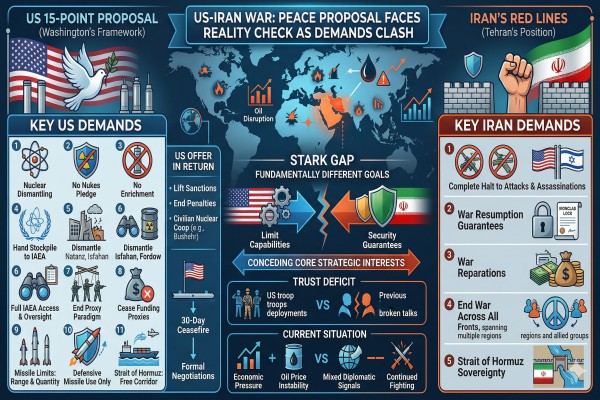
According to details available in the public domain, Washington is demanding the dismantling of Iran’s key nuclear facilities at Natanz, Isfahan, and Fordow. It also expects Tehran to commit permanently to abandoning any pursuit of nuclear weapons, cease all uranium enrichment, and transfer its existing stockpile for international monitoring.
In addition, the plan calls for unrestricted inspections by international agencies, effectively opening Iran’s nuclear infrastructure to full external scrutiny. On the military front, the US is pushing for strict limits on Iran’s missile programme—both in range and quantity—while restricting future use to defensive purposes.
The demands extend beyond Iran’s borders. Washington is also seeking an end to Tehran’s support for allied armed groups across West Asia along with guarantees that it will halt attacks on energy infrastructure and ensure the uninterrupted flow of shipping through the Strait of Hormuz.
In return, the US is offering sanctions relief, removal of international penalties, and cooperation in civilian nuclear energy, particularly at the Bushehr facility.
However, Iran’s position reflects an entirely different set of priorities.
Tehran’s demands centre not on disarmament, but on security guarantees, sovereignty, and compensation. Iranian officials are seeking firm assurances that hostilities will not resume—likely in the form of a binding international agreement. They are also demanding reparations for wartime damage, an issue the US has not addressed.
Beyond this, Iran insists that any ceasefire must apply across all theatres of conflict, including those involving its regional allies. Most significantly, it is pressing for formal recognition of its control over the Strait of Hormuz, a demand that directly contradicts the US insistence on keeping the waterway an open international corridor.
These competing positions highlight a deeper structural problem: both sides are effectively asking the other to concede core strategic interests.
For the US, the objective is clear—curtail Iran’s nuclear capabilities and limit its regional military reach. For Iran, the priority is equally clear—secure regime survival, preserve regional influence, and obtain guarantees against future conflict.
This divergence is compounded by a persistent lack of trust. Iran has pointed to past negotiations that were followed by renewed military pressure, while the US continues to prepare additional troop deployments even as it signals openness to diplomacy.
Despite these obstacles, there are factors that could still push both sides toward dialogue. Economic strain, political pressures, and the destabilising impact of rising oil prices have created incentives for de-escalation. The global consequences of continued conflict—particularly in energy markets—add further urgency.
Yet, the gap between positions remains wide enough to make any comprehensive agreement unlikely in the near term.
For now, the situation remains fluid but unresolved. Diplomatic signals are mixed, military activity continues, and neither side appears willing to retreat from its most critical demands.
The proposal, rather than bridging differences, has instead exposed the depth of the divide—suggesting that any path to peace will be far more complex than a ceasefire framework alone can address.