Picture an elephant and a dragon (leave aside that dragons don’t exist and never have): both are large, ponderous creatures, clumsy, majestic in their own way, best admired from a distance, dangerous when close. Now imagine the two dancing together!
Credit (if you want to call it that) for such framing goes to China’s Foreign Minister Wang Yi who as far back as 2018 said the two must not fight but dance together. Good point on which there can be no disagreement.
But the point here is the imagery: China has always been associated with the dragon, not so India which for long has been associated with the Taj Mahal at one end to ash-smeared sadhus at the other.
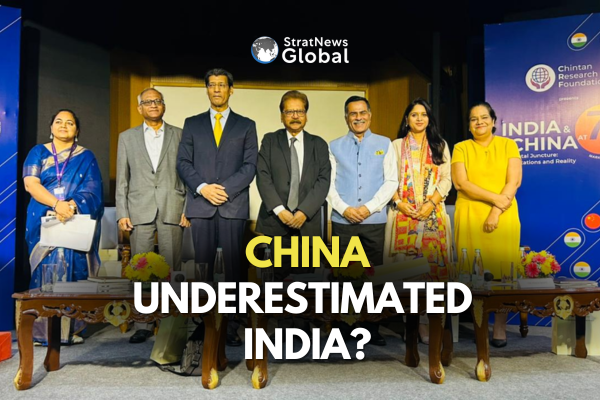
The issue came up during a discussion on India–China relations organised by the Chintan Research Foundation (CRF) in Delhi, in a session titled “Dragon–Elephant in South Asia: Tango to Musical Chairs.” It was generally agreed that showing India as an elephant made it look slow and clumsy, but India’s recent “exchanges” with China have been neither slow nor clumsy.
China experts in India have often raised this concern. At the CRF event, Namrata Hasija from the Centre for China Analysis and Strategy (CCAS) highlighted how such imagery shapes perception.
Columnist and journalist Adil Brar has also pointed out that while the elephant is native to India, it is not the country’s national animal.
In a post on X last year, he noted that India’s national animal is the tiger, whereas the elephant is Thailand’s national symbol. According to him, China’s continued use of the “elephant” metaphor subtly reinforces a narrative of India as slow or sluggish, a seemingly minor detail that reflects how Beijing constructs its narratives.
How does China construct narratives?
Elephant isn’t India’s national animal.
Instead, Thailand’s national animal is an elephant.
India’s national animal is a tiger.
However, China insists on portraying India as somewhat “slow” and “sluggish” by calling it an elephant.
The… pic.twitter.com/QOe45CyS1n
— Aadil Brar (@aadilbrar) March 7, 2025
China may have scored a point when it attacked and killed 20 Indian Army personnel including a colonel in the Galwan Valley in 2020. But India’s subsequent retaliation suggests China was at the receiving end and may have lost double the number of men. It’s something China may never acknowledge for fear of losing face.
At the core is what Prof. Srikanth Kondapalli of JNU has often said, including at the CRF event: China does not see India as an equal partner although official statements may say so. In Chinese Communist Party literature, China is projected as a superpower on par with the US, while India is lower down the pecking order. India’s proximity to the US is viewed with suspicion in Beijing.
He said China’s use of the phrase “win-win situation”, means it tries to win twice, leaving little or no room for genuine mutual benefit. He described the current state of India–China relations as a “positive stalemate” stable for now, but far from resolved.
Prof. Pooja Bhatt of O.P. Jindal Global University made the point that as two rising powers, cooperation may not be something easily realised. While some engagement in multilateral forums is possible, she said there is little room for optimism. On building a stable maritime order together, her answer was clearly unlikely in the near term.
Competition And Distrust Persist
With both countries expanding their strategic and economic footprints at the same time, including in the maritime domain, competition is intensifying and trust remains difficult to build. She also pointed to China’s growing network of ports in the Indian Ocean, which many in India see as strategic encirclement with implications for security and economic interests.
China is closely monitoring India’s efforts to come out of the “South Asian Box” that Beijing is trying to keep it in. India’s burgeoning trade relationships and the deft balancing seen in the Iran war, suggests this is no elephant but something more nimble, surefooted, resembling a tiger perhaps!