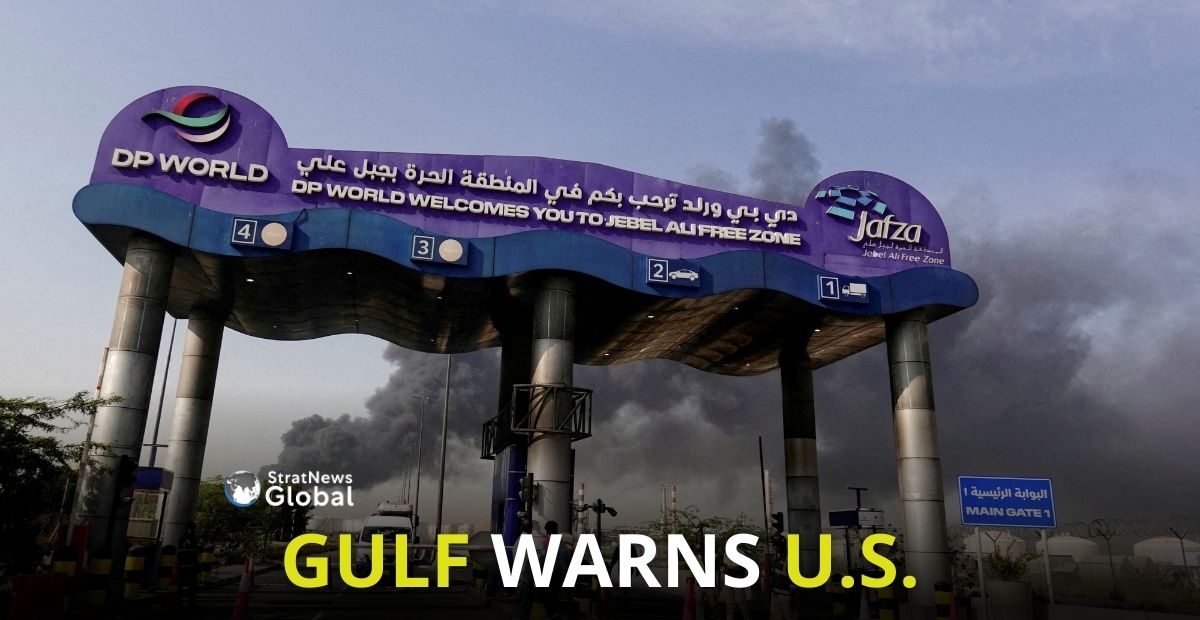
Gulf Arab states did not ask the U.S. to go to war with Iran, but many are now urging it not to stop short by leaving the Islamic Republic still capable of threatening the Gulf’s oil lifeline and the economies that depend on it, three Gulf states told Reuters.
These sources and five Western and Arab diplomats have said that Washington is pressing the Gulf states to join the conflict. According to the sources, U.S. President Donald Trump wants to show regional backing for the campaign, to bolster its international legitimacy as well as domestic support.
Iran’s Strategy
Tehran has already demonstrated its reach by attacking airports, ports, oil facilities and commercial hubs in its regional neighbours with missiles and drones, and disrupting shipping through the Strait of Hormuz—through which 20% of the world’s oil is transported.
The attacks have reinforced fears among Gulf states that leaving Iran with any significant offensive weaponry or arms manufacturing capacity could embolden it to hold the region’s energy lifeline hostage whenever tensions rise.
As the war entered its third week, with the U.S. and Israeli airstrikes intensifying and Iran firing at U.S. bases and civilian targets across West Asia. According to a Gulf source, the prevailing mood amongst leaders was unmistakable: that Trump should comprehensively degrade Iran’s military capacity.
The alternative, the source said, was living under constant threat. Unless Iran is severely weakened, it will continue to hold the region to ransom.
Iran’s Rift With The Gulf States
Predominantly Shi’ite Muslim Iran has always viewed its Sunni Arab neighbours—close allies of the U.S.—with deep suspicion, even if its relations with Qatar and Oman have been less tense.
Over the years, Iran and its regional allies have been accused of attacks on Gulf energy installations, including a 2019 strike on Saudi Arabia’s Abqaiq and Khurais oil facilities that halved Saudi output and shocked energy markets.
In response to questions regarding these concerns, the White House said that the U.S. was “crushing Iran’s ability to shoot these weapons or produce more,” and that Trump was “in close contact with our partners in the Middle East.”
No Military Action From Gulf States
U.S. Defence Secretary Pete Hegseth said last week that Gulf partners were “stepping up even more” and were willing to “go on the offence” while already working with Washington on collective and integrated air defences, though he did not specify what else they might do.
Sources in West Asia have said unilateral military action by any Gulf state remained off the table because collective intervention would avoid exposing individual countries to retaliation. Consensus on this is still elusive. The six member states of the Gulf Cooperation Council have held a single Zoom call, and no Arab summit has been convened to discuss coordinated action.
The Arab states face a strategic dilemma, said Fawz Gerges of the London School of Economics: balancing the immediate threat of Iranian attacks against the far greater risk of being drawn into a war led by the U.S. and Israel.
He said, joining the campaign would add little to Washington’s military superiority while sharply increasing exposure to Iranian reprisals. The result is calculated restraint: defending sovereignty and signalling red lines without entering a war, the Gulf countries neither started nor control.
(With inputs from Reuters)