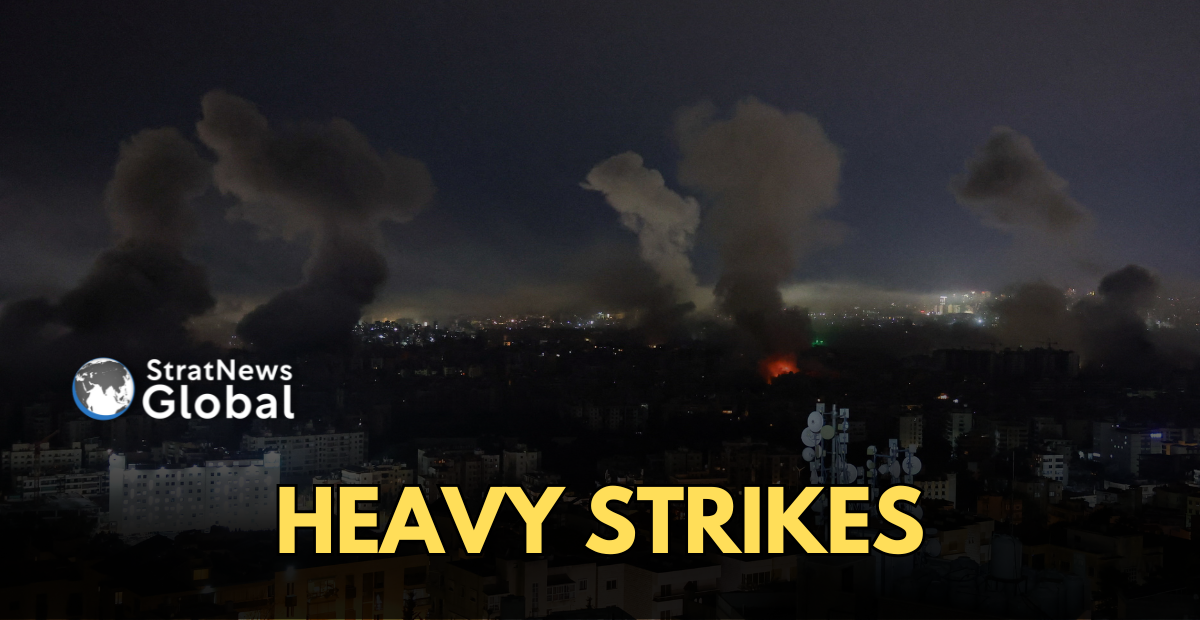
Israeli strikes on Beirut battered the southern suburbs, setting buildings on fire after the Lebanese-armed group Hezbollah launched a volley of rockets into northern Israel.
Israel launched an offensive against the Iran-backed Hezbollah after it opened fire on March 2nd in retaliation for killing Iran’s supreme leader at the beginning of the U.S.-Israeli conflict with Iran. Israeli strikes have killed 634 people, including 91 children, in Lebanon and uprooted 800,000 according to Lebanese authorities.
On Wednesday night, Hezbollah stated that it had launched dozens of rockets into northern Israel as a part of a “series of operations,” implying that there would be more attacks. Lebanese security sources speaking to Reuters said more than 100 rockets were launched.
A senior Israeli defence official said Iran and Hezbollah launched a joint missile attack, describing it as the first coordinated action against Israel since the conflict began.
According to Lebanon’s health ministry, at least eight people were killed in the Israeli strike on Beirut’s Ramlet al-Baida seafront.
Hezbollah’s rocket strike caused two people to be lightly wounded, Israel’s ambulance service said.
No Space In Government Shelters
The Israeli strikes on Beirut’s southern suburb were deployed almost immediately after Hezbollah’s attack. The Israeli military announced that it struck ten Hezbollah structures within 30 minutes, including the headquarters of its elite Radwan unit.
Reuters footage showed Beirut’s skyline covered in thick smoke, and orange flames were visible late into the night at one of the bombed locations.
Israel’s military had sent repeated warnings for evacuation to the residents of the southern suburb over the last week, prompting a displacement crisis as government shelters struggle with overcrowding.
Less than a quarter of the 800,000 displaced residents found space in the government shelters, but even there, the conditions were described as “super rough” by Maureen Philippon, the Norwegian Refugee Council’s Lebanon director.
On Wednesday night, after the strikes began, the Israeli military announced that it would “soon act with overwhelming force” against Hezbollah, and that the residents should evacuate immediately.
Preparing For Possible Invasion
The Israeli military said it has struck hundreds of targets since March 2nd, launching daily airstrikes in the southern suburbs of Beirut and the eastern Bekaa Valley. It ordered reinforcements to the region bordering Lebanon, including the military’s elite Golani Brigade, and has deployed soldiers into Southern Lebanon, establishing new positions there.
Reuters reported on Tuesday that Hezbollah fighters braced themselves for a full-scale Israeli invasion of the south.
Last year, Lebanon claimed it aimed to establish a state monopoly on arms, and last week, the state cabinet outlawed Hezbollah.
But Israel’s ambassador to the United Nations, Danny Danon, said on Wednesday that Beirut needed to take direct action.
“If Hezbollah is being dismantled, what is the evidence? What are the operations against the launch sites? Where are the seizures of their weapons? Where is your military?” Danon said.
(With inputs from Reuters)