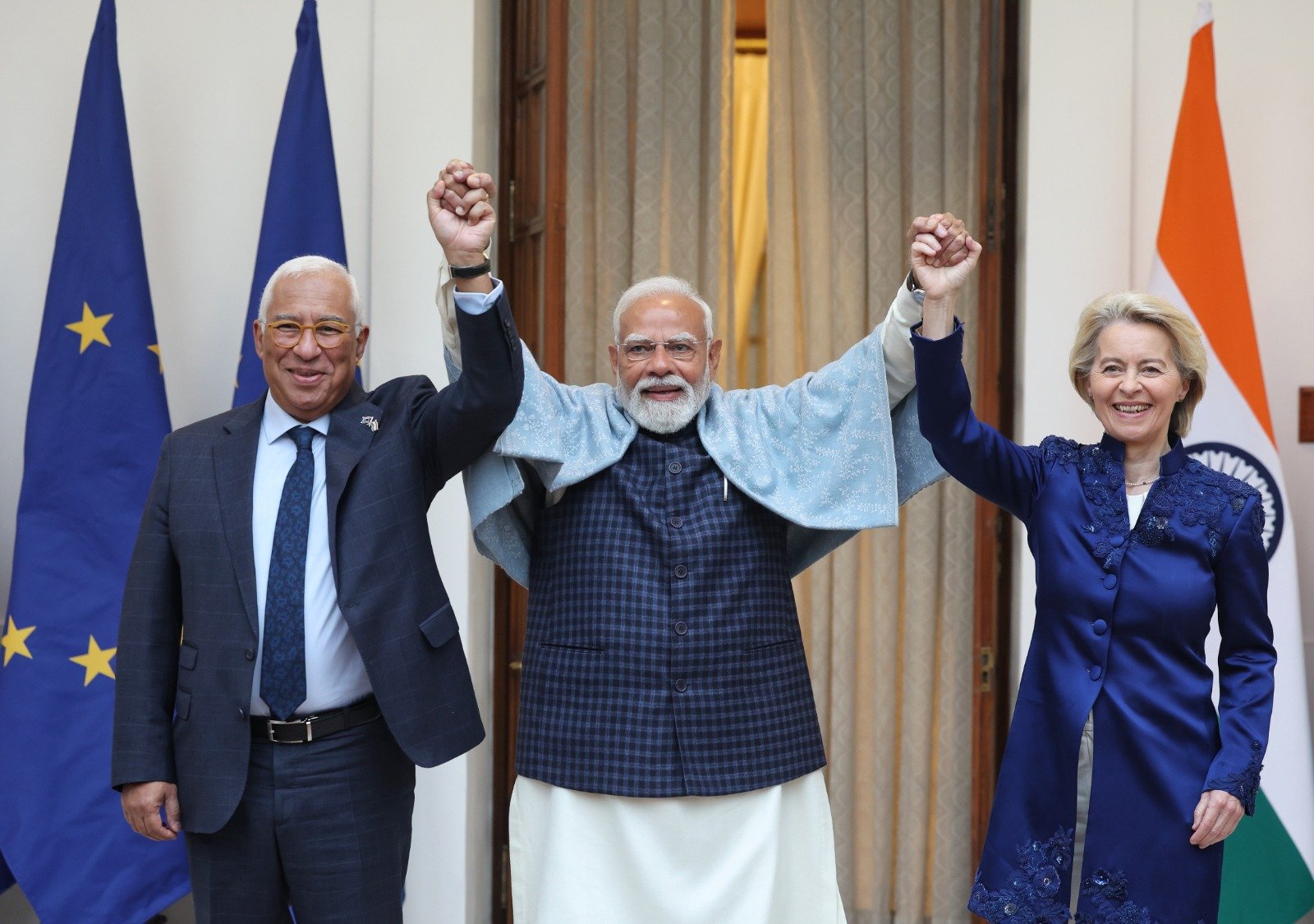
In the span of a single week, India unveiled two of its most consequential trade agreements, one with the European Union and the other with the United States. Together, the deals signal a sharp shift in India’s global trade positioning at a time of slowing world growth, supply-chain realignment and intensifying geopolitical competition.
While both agreements are still moving through formal processes, policymakers and analysts believe they could add as much as $150 billion to India’s exports over the next decade, provided they are implemented smoothly.
India has long been criticised for staying out of large trade blocs and relying on high tariffs to protect domestic industry. The new agreements mark a departure from that approach. They lower trade barriers, improve access to two of the world’s richest consumer markets, and help India avoid being marginalised as global trade reorganises around strategic alliances.
With tensions between the US and China reshaping supply chains, and Europe seeking dependable partners outside its neighbourhood, India has emerged as a viable alternative manufacturing and sourcing hub.
Major Outcomes
The most visible outcome of the India–US agreement is a steep cut in American tariffs on Indian goods, from as high as 50% to 18%. Steel shipments, for instance, dropped sharply after the tariffs were imposed, while exporters of pharmaceuticals, textiles and seafood saw margins erode. The major gains were:
- Manufacturing and exports: Labour-intensive sectors such as garments, footwear, leather, gems and jewellery.
- Pharmaceuticals: Indian generic drug makers.
- Seafood: Exports that had slowed due to a mix of tariffs and dumping duties could rebound, helping a sector that employs large numbers along India’s coastlines.
Officials estimate that trade between the two countries could climb well beyond pre-tariff levels, potentially crossing $300 billion in the near term.
What Remains Unclear?
Several aspects of the deal are yet to be spelled out, including:
- The precise start date for the new tariff regime
- The timeline for India’s reciprocal tariff reductions
- The scope of India’s reported commitment to increase purchases of American energy and technology products
A joint statement outlining the first phase of the agreement is expected in the coming days, followed by a legal pact around mid-March.
The deal has drawn attention due to US President Donald Trump’s claim that India would stop buying Russian crude. Indian officials have not confirmed any such commitment.
Data already show a gradual decline in Russian oil imports, partly due to sanctions and supply constraints, but analysts say an abrupt shift is unlikely.
Existing contracts, refinery compatibility and pricing advantages mean Russian crude is expected to remain part of India’s energy mix in the near term, even as supplies from the US, West Asia and possibly Venezuela increase.
India–EU FTA
If the US deal is about restoring competitiveness, the agreement with the European Union is about scale. Negotiated over nearly two decades, the India–EU FTA promises near-complete duty-free access for Indian exports to Europe over time. Once fully implemented, almost all Indian goods entering the EU will face zero tariffs.
- Several sectors including textiles, leather goods, jewellery and engineering products stand to benefit significantly.
- There would be a significant growth in exports, as various studies suggest bilateral trade could grow by over 40%. There is a likelihood of it doubling up within a decade.
- The EU has committed financial support for India’s green transition.
New Delhi has agreed to gradually lower high tariffs on select European goods. These would include automobiles, wines and spirits, while keeping transition periods to protect domestic producers. And as reported previously, will be staggered over several years.
A common thread across both agreements is what they exclude. India has refused to open agriculture to imports from heavily subsidised producers in the US and EU. This is less about trade math and more about political economy: farming and allied activities support hundreds of millions of livelihoods and remain central to food security.
Both the deals reposition India in global commerce. They strengthen India’s case as a dependable supply-chain partner, reduce vulnerability to sudden tariff shocks, and align the country more closely with Western economic systems without binding it into rigid blocs.