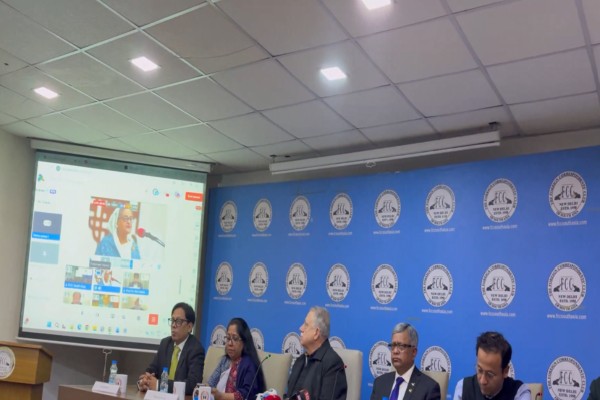
Deposed Bangladesh Prime Minister Sheikh Hasina’s decision to deliver a recorded political address from New Delhi on Friday has raised questions about whether India is sending a message to Dhaka by allowing her to use a prominent media platform in the Indian capital.
Hasina’s recorded audio speech was played before Indian and international journalists at the Foreign Correspondents’ Club Of South Asia (FCC) at an event organised by Awami League leaders and supporters.
It was her first address to an international media audience from India since she left Bangladesh following violent protests in August 2024.
The event came a day after a leaked diplomatic recording put Washington at the centre of fresh accusations over Bangladesh’s 2024 political upheaval, claims now voiced by figures linked to the Awami League.
Her Awami League has been barred from contesting Bangladesh’s February 12 parliamentary elections.
Hasina has previously aired her views from India to supporters inside Bangladesh, drawing protests from the Mohammad Yunus-led interim administration in Dhaka, which has sentenced her to death in absentia.
In Friday’s address, Hasina launched a sustained attack on the interim government, questioning its legitimacy and calling on Bangladeshis to mobilise against what she described as an “illegal, foreign-serving puppet regime.”
“From the day I was forcibly removed, the nation has been plunged into an age of terror,” Hasina said. “Democracy is now in exile.”
Her remarks adopted the tone of a campaign-style address rather than a media interaction. She accused the interim administration of presiding over lawlessness, suppressing dissent and compromising Bangladesh’s sovereignty. At one point, she warned of what she called a “treacherous plot to barter away the land and resources of Bangladesh to foreign interests.”
Directly challenging Chief Adviser Muhammad Yunus’s authority, Hasina said, “Did he come to power through the people’s votes? No. He seized power forcibly. So who gave him legitimacy?”
The venue and timing of the address have drawn attention. The FFC, while not a government body, is a high-profile forum frequently used for diplomatic and political messaging.
Allowing a recorded political speech by an ousted leader to be played there, weeks before a national election in her home country, has prompted questions about whether New Delhi is signalling its stance towards the current dispensation in Bangladesh.
Hasina appeared to underline the symbolism of speaking from India, invoking New Delhi’s role in Bangladesh’s 1971 Liberation War. “India stood with Bangladesh in our darkest hour,” she said, appealing for support from democratic forces and the international community.
She also called on the United Nations to intervene. “Only a new and truly impartial investigation can reveal the truth of what happened,” she said, referring to her removal from office and the unrest that followed.
The speech set out five demands, including the removal of the Yunus-led administration, an end to street violence, guarantees for the safety of women and religious minorities, a halt to what she described as politically motivated legal action against journalists and opposition figures, and a fresh UN-led probe.
Several senior figures associated with the Awami League were present in Delhi, including Engineer Mohammad A. Siddique, Secretary General, Human Rights Watch, and Mohibul Hassan Chowdhury Nowfel, Minister of Education. Former ministers and party leaders, including Prof. Md. Habibe Milat, MP, Md. Ali Arafat, MP and former Minister of Information and Broadcasting, former Foreign Minister Dr. A.K. Abdul Momen, and Prof. Dr. S.M. Masum Billah, addressed journalists virtually.
Indian officials have made no public comment on the event.
Bangladesh’s interim leadership has accused Hasina of attempting to destabilise the country from abroad and has said the elections will proceed as scheduled.