“Moderation, restraint, and good sense will prevail over all other considerations.”
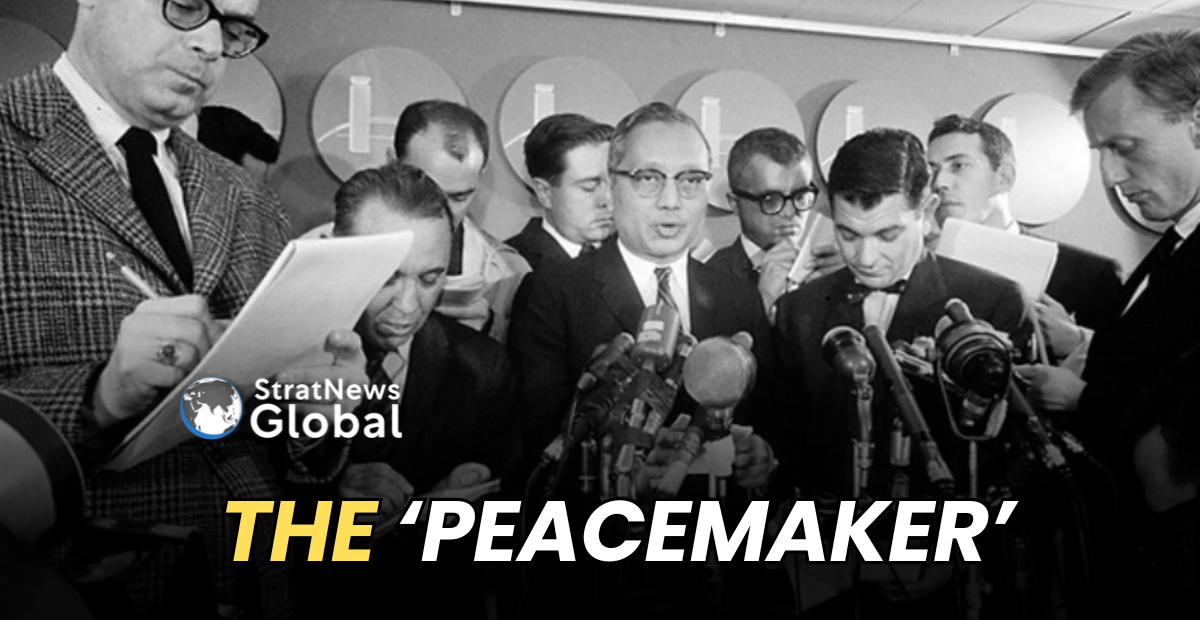
The emotions behind these words, spoken by U Thant, serve as both an opening motif and a guiding philosophy in ‘Peacemaker: U Thant and the Forgotten Quest for a Just World’, a biography released in 2025 that revisits the life and work of the United Nations’ third Secretary-General and its first non-European leader. While U Thant’s name is well known in diplomatic circles—particularly in New York—his story has remained largely outside public attention. The book sets out to correct that absence.
Authored by his grandson, historian Thant Myint-U, The Peacemaker documents U Thant’s role in navigating some of the most consequential crises of the Cold War, including his intervention during a nuclear standoff between the United States and the Soviet Union—still regarded as the most dangerous moment in world history. The book was discussed at a public event in New Delhi in 2025, where Thant Myint-U appeared in conversation with Gautam Mukhopadhyay, former Indian ambassador to Afghanistan, Syria and Myanmar. The discussion ranged across central themes of the book, including the Cuban Missile Crisis, U Thant’s role in Katanga, and the broader pressures facing the United Nations during his tenure.
During the conversation, Thant Myint-U offered insights into his grandfather’s early life. U Thant was born in Pantanaw, a small town in southwestern Burma, into a family of wealthy landowners and rice merchants. That stability did not last. At the age of 15, he lost his father and the family’s wealth, forcing him to abandon early ambitions of becoming a journalist. Instead, he became a schoolteacher and later rose to the position of headmaster.
The Peacemaker traces how this background shaped U Thant’s later trajectory. According to Thant Myint-U, his grandfather inherited his father’s personal library, which included books in English and German. “I think even though he had resigned himself to living in a small town, he was always imagining the rest of the world. And so in the 1920s, 1930s, he wrote lots of op-ed pieces, he translated books, he translated a book on the League of Nations, he wrote about Indian politics, the Simon Commission, Gandhi, everything,” he says.
After Burma’s independence in 1948, U Thant entered the civil service, marking his transition into the policy world. In 1957, he was appointed Burma’s Permanent Representative to the United Nations and moved to New York. By the early 1960s, as Thant Myint-U writes, “the very survival of the UN was uncertain.” At that moment, “the governments of the world put what faith they had in a little-known schoolteacher-turned-diplomat from Burma. U Thant was chosen because of his tact and the respect he demonstrated for all points of view.” Following the death of Dag Hammarskjöld, U Thant assumed the role of Secretary-General.
Once in office, the book records how quickly he was tested. Within a year, U Thant acted as an intermediary during the Cuban Missile Crisis, negotiating between U.S. President John F. Kennedy and Soviet leader Nikita Khrushchev, and travelling to Cuba to meet Fidel Castro. These efforts helped defuse a nuclear standoff. The book also documents his involvement in mediating conflicts in Vietnam, the Six-Day War, the Congo, Bahrain, the Dominican Republic, the 1965 and 1971 Indo-Pakistan wars, and Yemen.
At the New Delhi discussion, Ambassador Mukhopadhyay reflected on the relevance of U Thant’s tenure to contemporary global politics. “With the withdrawal of the United States from several UN and international bodies, surely the UN is in very dire straits. But at the end of the day, the United Nations has always been an association of nations.” He added, “So long as national sovereignty remains supreme, I think we can never have world peace or a world order; but the years of Secretary General U Thant, the way he managed that period, surely should have had many lessons for nations to learn from.”
Similar views were echoed by Member of Parliament and former foreign secretary Harsh Shringla, who also attended the event. In his opening remarks, he said, “In today’s situation, when we face this crisis of multilateral diplomacy. So we need more people like U Thant who can actually make that difference, contribute to situations, and really insert themselves in conflicts in a way that can be appreciated by all parties and welcomed by all parties.”
While highlighting U Thant’s achievements, The Peacemaker also examines the failures of nation-states in responding to conflict. On Vietnam, Thant Myint-U told the panel, “He was very clear that Vietnam was going to be an enormous tragedy for the Vietnamese, for the Americans, and their prestige and standing in the world. In 1964, he told the Americans that if you go to war in Vietnam, you will lose.”
Although President Lyndon B. Johnson later attempted to de-escalate, Thant Myint-U argues that Henry Kissinger undermined these efforts. “Kissinger was wrong to make his own judgment on Vietnam and on the Middle East. He saw the whole world as a global chessboard,” he says.
Beyond crisis diplomacy, the book places strong emphasis on U Thant’s engagement with structural global challenges. Thant Myint-U noted that despite the constant crises of the 1960s and 1970s, his grandfather pushed to make the abolition of colonialism and racism central to the UN agenda. A victim of racism himself, U Thant linked peace, anti-racism, decolonization, and economic development as interdependent goals.
Another major focus of U Thant’s work, as outlined in the book, was the restructuring of the global economy. “He believed this would ensure the newly decolonized countries, newly independent countries would have a chance to develop and industrialize quickly, and that was the best guarantee that they would not lapse into civil war, conflict, or instability by 10-15 years down the road,” Thant Myint-U explains.
The book concludes with a reminder of the contradictions surrounding U Thant’s legacy. Despite his international stature, he was denied military honours by Myanmar’s military junta after his death. As global tensions rise again, The Peacemaker documents a period when diplomacy was shaped not by dominance but by restraint. As Thant Myint-U notes, even then, solutions did not come from a single capital. “The answers came from many other countries and from many other people and from unexpected quarters.”