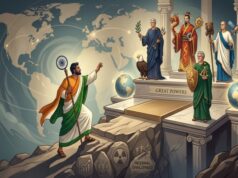
The global order is no longer unipolar, and it is no longer bipolar. Old power structures are breaking down, and no single country is in charge anymore. According to a senior Asian statesman, we are now clearly living in a multipolar world and India has an important role to play in it.
“Trump is accelerating trends which were already underway for some time, which is the crystallization of a multi-polar world”, said the former Singapore Foreign Minister George Yeo Yong-Boon while delivering the CD Deshmukh Memorial Lecture-2026.
The United States, he argued, is slowly pulling back from its global role. Instead of trying to manage conflicts everywhere, Washington is focusing more on its own neighbourhood. “Knowing that the US is overextended, he is engineering a retreat and consolidating his own hemisphere,” he said.
This shift is already being felt elsewhere. Europe, which depended heavily on American leadership after the Ukraine war began, is being forced to stand on its own. “European leaders now know they have to build their own capacity and depend much less on North America,” Mr. George noted.
In Asia, the consequences are even sharper. Countries that once assumed firm US backing are now facing more uncertainty. That is where India’s steady rise becomes important.
Unlike China’s rapid, state-led growth after joining the World Trade Organization, India’s progress has been slower but more rooted. Mr. George, who has worked closely with India over several decades, described what he saw on the ground. “From the movement of freight into India and within India, I could see that this growth is organic,” he said. “It wants to grow.”
Southeast Asia, which has learned how to live with China’s economic power, sees India as an essential balance. “We in ASEAN have learned how to ride China’s rope without being in China’s grasp,” he said. “Naturally, we look to India as a counterbalance.”
India’s refusal to fully align with any one power—whether on Russia, China, or trade blocs—is often criticised in the West. The speaker disagreed. “You can’t show weakness,” he said. “But you also have to be flexible. Reputation matters.”
At the same time, he warned that India’s toughest challenges may come from within. Rapid growth, new technologies like artificial intelligence, and large-scale migration to cities could increase social stress. “The biggest political challenge in India today is how to keep the different parts bound together enough so that economic development is not held back,” he said.
In today’s uncertain world, India’s strength lies in balance—not taking sides, but staying steady. As Mr. George puts it simply, “In the end, economic development is what determines a country’s strength.”