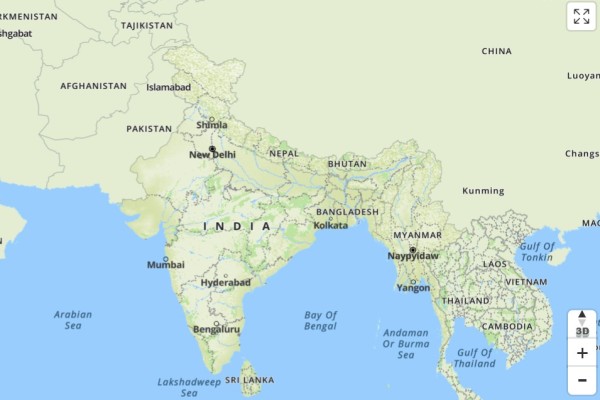
In the swirl of policy debates and big-ticket announcements, it’s easy to lose sight of the nuts and bolts that actually knit countries together. Bridges, roads, power lines, border posts—these are the silent connectors that tell the real story of regional cooperation. Now, thanks to an ambitious new platform, those scattered stories are coming together on one map.
The Sambandh Database and Map: India’s Regional Connectivity Links, created by the Centre for Social and Economic Progress (CSEP), is the first-ever attempt to chart India’s cross-border infrastructure with its neighbours in one place.
Think of it as a living atlas of India’s ties with Bangladesh, Bhutan, China, Maldives, Myanmar, Nepal, Pakistan, and Sri Lanka. From energy grids to waterways, highways to trading points, Sambandh pulls together the hard data and turns it into an accessible, dynamic tool.
Its first phase focuses on Bhutan—a fitting pilot given India’s deep partnership with the Himalayan nation—but the ambition is much wider. The ultimate goal is to track and visualise every major strand of connectivity that India is building across South Asia. In a region notorious for being one of the least integrated in the world, Sambandh’s very existence is a statement of intent.
“This is about more than infrastructure,” says one of the project leads at CSEP. “It’s about reimagining how we understand India’s place in its neighbourhood.”
What makes Sambandh stand out is its cartographic imagination. For the first time, policymakers, scholars, businesses, and even curious citizens can zoom out and see India’s regional network in one frame. Where once data was buried in government files, press releases, or scattered across research papers, Sambandh offers a clean, interactive view of India’s cross-border highways, energy pipelines, border posts, and waterways.
The timing couldn’t be better. With India pushing its “Neighbourhood First” and “Act East” policies, connectivity has become the currency of diplomacy. Each road built into Nepal, each port project in Sri Lanka, each energy line into Bangladesh is not just an engineering feat but a political signal. Sambandh makes those signals legible.
The Sambandh project has clear goals:
- To create a longitudinal database of India’s regional links.
- To visualise infrastructure in four sectors—energy, land, border, and waterways—across six types of connections.
- To support evidence-based decision-making for governments, businesses, and multilateral partners.
Behind the platform is the broader Sambandh Regional Connectivity Initiative, launched in 2020, which explores India’s partnerships across South and Southeast Asia. It’s a scholarly yet deeply practical effort, led by CSEP’s Riya Sinha, Constantino Xavier, and Abhishek Agarwal. Their work doesn’t just catalogue projects—it contextualises them, showing how they fit into India’s Indo-Pacific strategy, and why they matter for regional integration.
For researchers, Sambandh is a treasure trove. For policymakers, it’s a decision-making compass. For businesses, it’s a roadmap of opportunities. And for anyone invested in South Asia’s future, it’s a reminder that the region is slowly but surely stitching itself together.
The beauty of Sambandh is that it tells a story we rarely see: India not just as a rising power, but as a connector. A country whose ambitions are mapped not only in global summits, but in the highways, grids, and ports that quietly but powerfully link millions of lives across borders.