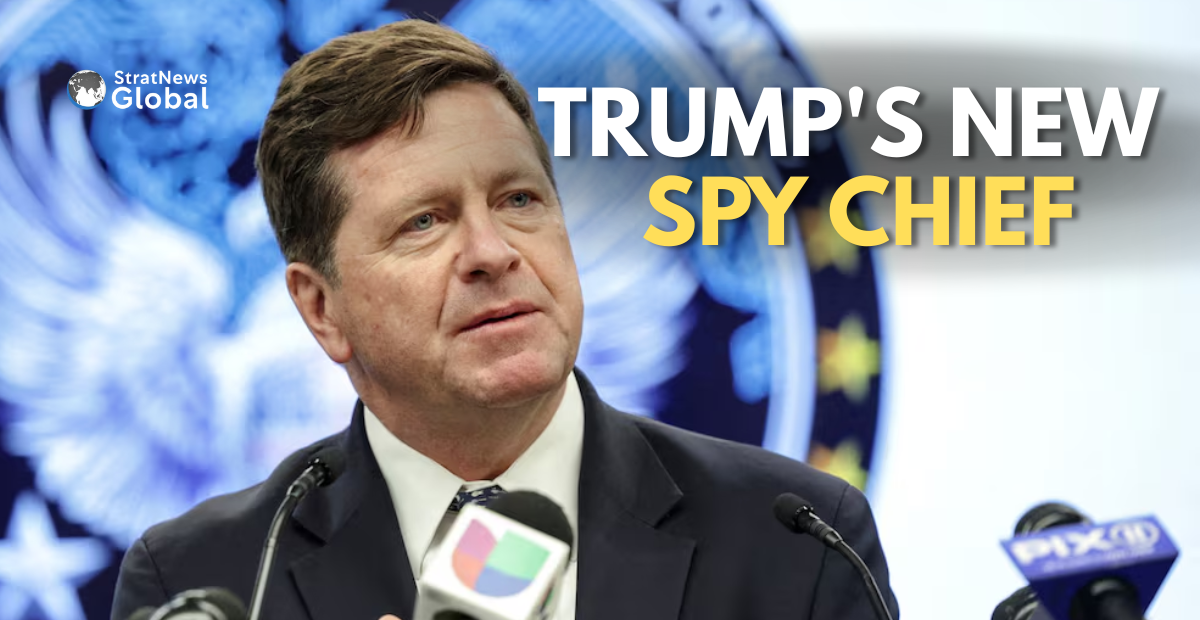
US President Donald Trump has nominated Manhattan’s top federal prosecutor, Jay Clayton, to become the next Director of National Intelligence (DNI), a move that comes amid growing political controversy surrounding the administration’s temporary intelligence leadership.
The nomination is unlikely to resolve a dispute in Congress over the renewal of a key foreign surveillance programme that is due to expire on Friday. Democrats have refused to support an extension unless Trump removes Bill Pulte, a close political ally, from his current role as acting intelligence chief.
Democratic Senate leader Chuck Schumer criticised Pulte’s appointment, arguing that the position requires experienced national security leadership.
“Pulte has to go. He cannot be in the DNI role. Our national security is too important,” Schumer told reporters.
Trump announced Clayton’s nomination on Truth Social, urging the Senate to move swiftly with confirmation proceedings. The White House later formally submitted the nomination, and the Senate Intelligence Committee scheduled a confirmation hearing for next Wednesday.
Speaking to journalists, Trump emphasised that Pulte’s appointment was only temporary.
“He’s only there for a little while… while we get a very talented person, Jay Clayton,” Trump said.
Concerns Over Acting Intelligence Chief
Pulte will continue serving as head of the Federal Housing Finance Agency while simultaneously acting as DNI until Clayton is confirmed.
Democrats have demanded that Pulte undergo a full security clearance review before gaining access to classified intelligence, arguing that he lacked the necessary clearance when his appointment was announced.
The controversy has become entangled with the future of Section 702 of the Foreign Intelligence Surveillance Act (FISA), a major intelligence-gathering authority used by US agencies.
Clayton’s Background
Clayton previously worked as a lawyer at Sullivan & Cromwell, specialising in corporate mergers and capital markets. During Trump’s first term, he chaired the Securities and Exchange Commission (SEC), where he was often viewed as a pragmatic regulator capable of working across party lines.
In April 2025, Trump appointed Clayton as interim US Attorney for the Southern District of New York, one of the country’s most influential prosecutorial positions.
However, Clayton’s professional background contains little direct experience in intelligence or national security matters. The DNI position was established after the September 11 attacks to coordinate America’s intelligence agencies and traditionally requires significant expertise in national security.
Reuters previously reported that Clayton had expressed interest in leading the CIA during discussions about joining a future Trump administration.
Until his nomination is approved, Clayton will continue serving as Manhattan’s chief federal prosecutor.
CIA Director Backed Nomination
According to a person familiar with the matter, CIA Director John Ratcliffe recommended Clayton to Trump after the president sought advice on who should permanently replace Tulsi Gabbard.
The source said Pulte would oversee the Office of the Director of National Intelligence on an interim basis while also carrying out staffing reductions sought by the administration.
Many lawmakers welcomed Clayton’s nomination. However, senior Democrats maintained that they would continue blocking legislation needed to renew Section 702 unless Pulte is removed from the acting role.
Surveillance Programme Faces Uncertain Future
Senator Mark Warner, the leading Democrat on the Senate Intelligence Committee, said support for extending the surveillance authority depended on resolving concerns about Pulte’s position.
“Before the Senate can take up a FISA extension there needs to be a clear guarantee that Mr Pulte will not serve as acting DNI,” Warner said, while describing Clayton as “a capable public servant”.
Republicans currently hold a 53-47 majority in the Senate but would require support from at least seven Democrats to reach the 60-vote threshold needed to advance the legislation.
Fears of Intelligence Being Politicised
Critics from both parties have raised concerns that Pulte could use access to sensitive intelligence information for political purposes.
Lawmakers pointed to his previous use of confidential mortgage-related data to encourage investigations involving figures such as New York Attorney General Letitia James and Senator Adam Schiff. None of those inquiries resulted in criminal charges.
Democrats have also expressed concern that Pulte could use the intelligence position to revisit Trump’s long-disputed claims that the 2020 presidential election was fraudulent.
Trump recently suggested that Pulte might uncover information relating to what he described as “rigged elections”.
Meanwhile, Clayton attracted attention during a CNBC interview this week when discussing Republican allegations of electoral problems in Los Angeles, saying that America faced a “deep, deep problem with voting”.
What Is Section 702?
Section 702 allows US intelligence agencies to collect communications data from foreign nationals located overseas without obtaining individual court warrants. Information gathered under the programme can include emails, text messages and telephone communications, which are stored in a large intelligence database.
Supporters argue that the programme is critical for national security and counterterrorism efforts.
However, opponents from both parties contend that existing safeguards do not adequately protect the privacy of Americans whose communications may be incidentally collected during surveillance operations.
Both the House of Representatives and the Senate rejected temporary extensions of the programme on Thursday, leaving its future uncertain as political disagreements continue.
(with inputs from Reuters)