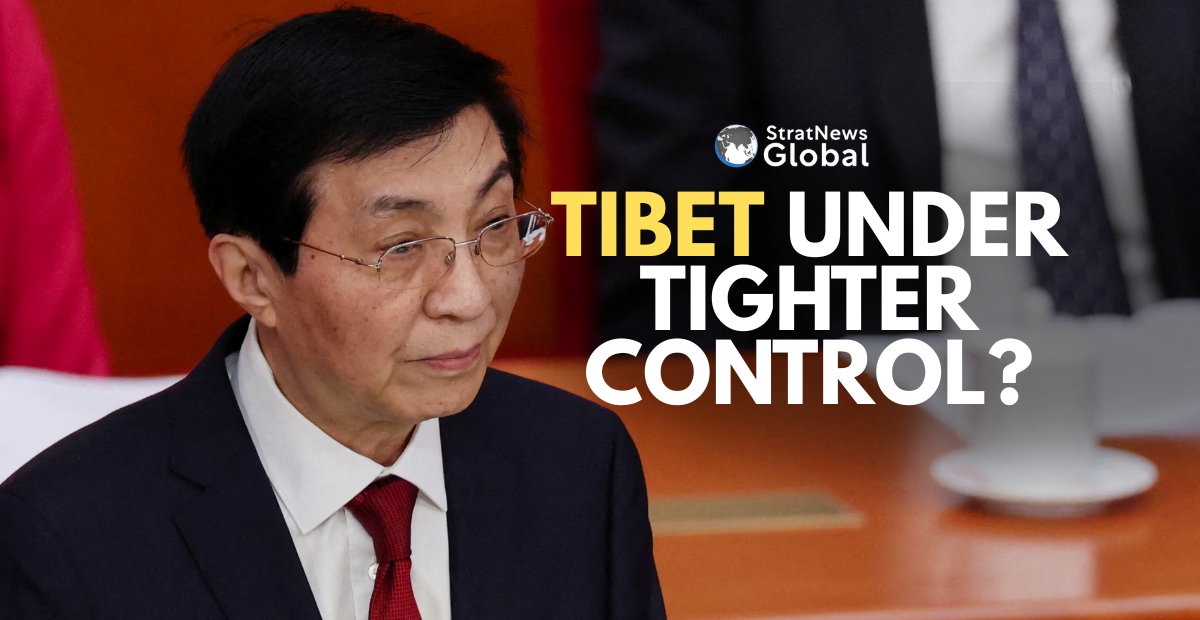
China’s fourth-ranking leader Wang Huning has called for stronger efforts to maintain stability in Tibet, fully enforce Beijing’s new Ethnic Unity Law and further align Tibetan Buddhism with Communist Party ideology during a four-day inspection tour of the autonomous region.
Wang, a member of the Communist Party’s powerful seven-member Politburo Standing Committee, visited Lhasa and Ngari prefecture, which borders India and Nepal, before concluding his trip on Wednesday, according to Chinese state media.
“To govern Tibet is foremost to stabilise Tibet,” Wang said, urging officials to strengthen efforts to preserve “a political and social environment of unity and stability.”
Focus on New Ethnic Unity Law
The visit comes weeks after China’s Ethnic Unity Law came into effect on July 1.
The legislation has drawn criticism from the United States and the European Union for giving Beijing broad powers to act against individuals—including those outside China—accused of undermining “ethnic unity” or promoting separatism.
During his visit, Wang instructed local authorities to ensure the law is fully implemented across Tibet.
His trip also followed the death of a Tibetan man who set himself on fire near the United Nations headquarters in New York earlier this month. Tibetan activist groups identified the man and said the self-immolation was intended as an appeal for Tibetan independence.
‘Sinicise’ Tibetan Buddhism
A major focus of Wang’s visit was religion.
He urged authorities to continue guiding Tibetan Buddhism to “adapt to socialist society” by advancing Beijing’s long-running policy of the Sinicisation of religion—bringing religious practices more closely into line with Chinese culture and Communist Party doctrine.
State broadcaster CCTV showed Wang visiting a Tibetan Buddhist monastery, where exhibition boards promoted the Sinicisation of Tibetan Buddhism while calling for stronger law-based management of monasteries and temples.
He also viewed a Ming Dynasty imperial inscription related to the Buddhist canon, reinforcing Beijing’s narrative that Tibet and Tibetan Buddhism have long-standing historical links with successive Chinese dynasties.
Strengthening National Identity
Wang also stressed the importance of expanding education and publicity campaigns aimed at forging a unified Chinese national identity.
Such efforts, he said, should be carried out “in a tangible, perceptible and effective way” while fully implementing the Communist Party’s strategy for governing Tibet in the “new era.”
A Broader Strategy
The Tibet Autonomous Region was established by China in 1965. While Beijing says the arrangement protects ethnic minority rights and guarantees religious freedom, Tibetan exile groups and international human rights organisations continue to accuse China of restricting religious practices, suppressing Tibetan culture and limiting political freedoms—claims the Chinese government rejects.
Wang’s visit mirrors a similar inspection tour he made to Xinjiang in June, where he likewise emphasised ethnic unity, ideological education and social stability, underscoring Beijing’s continued focus on strengthening Communist Party control in its frontier regions.
(with inputs from Reuters)