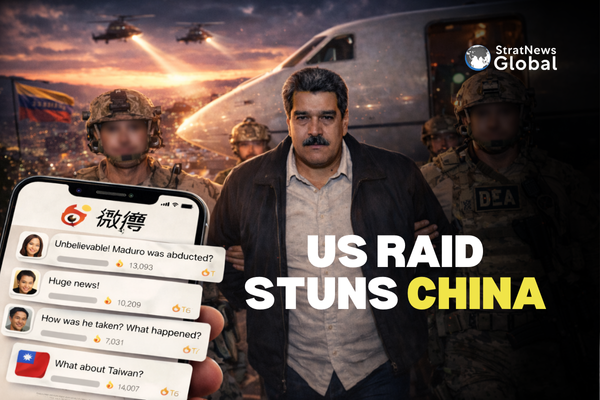
The capture or kidnapping of Venezuelan President Nicolás Maduro by U.S. forces was at the top of Weibo’s trending list, becoming one of the most discussed topics on the platform.
The intensity of the reaction reflected two concerns: China buys more than 70% of Venezuela’s oil accounting for 95% of that country’s revenue. Caracas also owes China $10 billion but has been tardy in payments, forcing Beijing to cut back on further investments.
The other concern is about the risks of underestimating U.S. power or resolve. Venezuela has serious implications when it comes to China’s plans for Taiwan and China’s own security.
Many netizens wondered if Beijing should “learn from the United States” when it comes to dealing with Taiwan. Others went further, describing the U.S. raid as a possible model for a future Chinese military operation against Taiwan.
But the presiding image for netizens was how powerful and decisive the U.S. looked. The idea that American forces could carry out a rapid night-time operation inside another country and capture a sitting president has shocked users.
Some questioned whether such an operation could be stopped if Washington chose to act elsewhere. This fear revealed genuine unease beneath the online bravado.
China’s official response reflected this sense of alarm. The Ministry of Foreign Affairs said it was “deeply shocked” by what it called the U.S. use of force against a sovereign state.
Neil Thomas, who researches and studies Chinese politics at the Asia Society, pointed out on X that the phrase “deeply shocked” (深表震惊) is extremely rare in Chinese official statements. He says Beijing normally reserves this wording for assassinations, terrorism, or major mass-casualty events.
The US military strikes on Venezuela and extraction of Maduro seem to have stunned China, especially if you compare it to Beijing’s reaction to last July’s Iran strike.
MOFA today says Beijing is “deeply shocked” (深表震惊), which per a quick search is a very rare term used only… pic.twitter.com/1ZhtQstgec
— Neil Thomas 牛犇 (@neilthomas123) January 3, 2026
He noted that China accused the U.S. of not only of breaking international law, but of threatening peace and security across Latin America and the Caribbean. He contrasted this with Beijing’s much milder response to last year’s U.S. strike on Iran, which used standard condemnation language and avoided broader claims about sovereignty or regional stability.
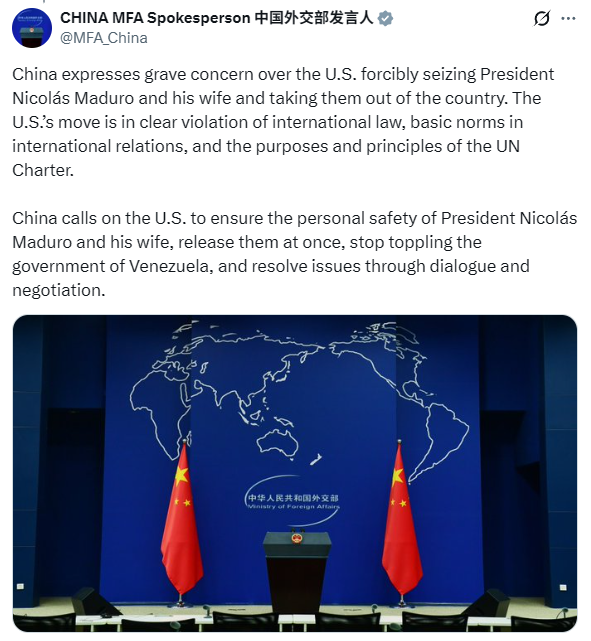
Why China Is Truly Alarmed
For China, Maduro’s removal cuts the ground from under a carefully crafted plan to ensure energy security. China has built up its profile in Venezuela over many years and Maduro’s adversarial relationship with the US helped.
Worrying for Beijing would have been comments on Weibo praising the U.S. action and expressing hope that similar power could one day be used against China’s own leadership.
Although these posts were quickly censored, their brief appearance highlighted how unsettling the news was for China’s tightly controlled online space.
What alarms Beijing is the precedent: a fast, targeted U.S. military operation removing a sitting leader without warning. This feeds into long-standing fears of Western-backed regime change.
Could China do the same in Taiwan? The more jingoistic among Weibo users would like to believe so, but the recent US arms package for the island, at over $11 billion, signals Washington’s commitment. No spoken words were needed.
Beijing’s immediate instinct will be to tighten control over online discussion and use the incident to portray the U.S. as reckless and dangerous. But somewhere it knows that its grand plans for taking over Taiwan would need to be revisited.

Research Associate at StratNewsGlobal, A keen observer of #China and Foreign Affairs. Writer, Weibo Trends, Analyst.
Twitter: @resham_sng