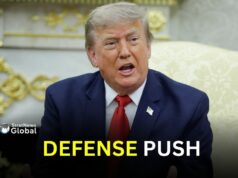
Venezuelan opposition leader Maria Corina Machado presented her Nobel Peace Prize medal to U.S. President Donald Trump during a White House meeting on Thursday, in a symbolic move aimed at shaping his administration’s approach to her country’s political transition.
A White House official confirmed that Trump intends to keep the medal. Later that evening, the president wrote on social media: “Maria presented me with her Nobel Peace Prize for the work I have done. Such a wonderful gesture of mutual respect. Thank you Maria!”
Machado, who described the encounter as “excellent,” said the gift was intended to recognise Trump’s “commitment to the freedom of the Venezuelan people.” The White House released a photograph showing Trump holding a large gold-framed display of the medal, accompanied by a message reading: “To President Donald J. Trump In Gratitude for Your Extraordinary Leadership in Promoting Peace through Strength.”
The Norwegian Nobel Institute later clarified that although Machado had given Trump the medal itself, the award remains hers and cannot be transferred, shared or revoked.
Political Context and Trump’s Response
Machado’s meeting came shortly after Trump dismissed the idea of installing her as Venezuela’s leader following the capture of former President Nicolas Maduro. The lunch meeting, lasting just over an hour, was their first face-to-face discussion.
Despite her gesture, Trump reiterated in a Reuters interview that he had not sought Machado’s prize. “No, I didn’t say that. She won the Nobel Peace Prize,” he said. The Republican president has long expressed an interest in the award and has linked it to his foreign policy initiatives.
White House press secretary Karoline Leavitt said Trump welcomed the meeting but maintained his “realistic” view that Machado currently lacks the support to lead Venezuela. Following her White House visit, Machado met more than a dozen senators on Capitol Hill, finding stronger backing from members of both parties.
Machado, who fled Venezuela in a daring maritime escape in December, continues to lobby for a role in the nation’s political future as Washington navigates post-Maduro relations.
Democratic Hopes and Challenges
After the U.S. captured Maduro earlier this month, opposition figures expressed renewed hope for a democratic transition. However, some U.S. lawmakers remain sceptical. Senator Chris Murphy of Connecticut said Machado had warned senators that repression in Venezuela remained unchanged under interim President Delcy Rodriguez.
Murphy described Rodriguez as a “smooth operator” who was consolidating power with Trump’s support. “I hope elections happen, but I’m sceptical,” he said.
Trump, meanwhile, has praised Rodriguez, calling her “very good to deal with,” and said his priority was to secure U.S. access to Venezuelan oil while helping rebuild the nation’s economy.
Machado was barred from running in Venezuela’s 2024 election by a pro-Maduro court. Independent observers believe opposition candidate Edmundo Gonzalez, whom she supported, won by a wide margin, though Maduro claimed victory.
While Rodriguez’s government has freed dozens of political prisoners in recent weeks, human rights groups say the scale of releases has been overstated. In her recent address to lawmakers, Rodriguez said she would continue diplomacy with the United States and pledged reforms to attract more foreign investment in Venezuela’s oil sector.
with inputs from Reuters