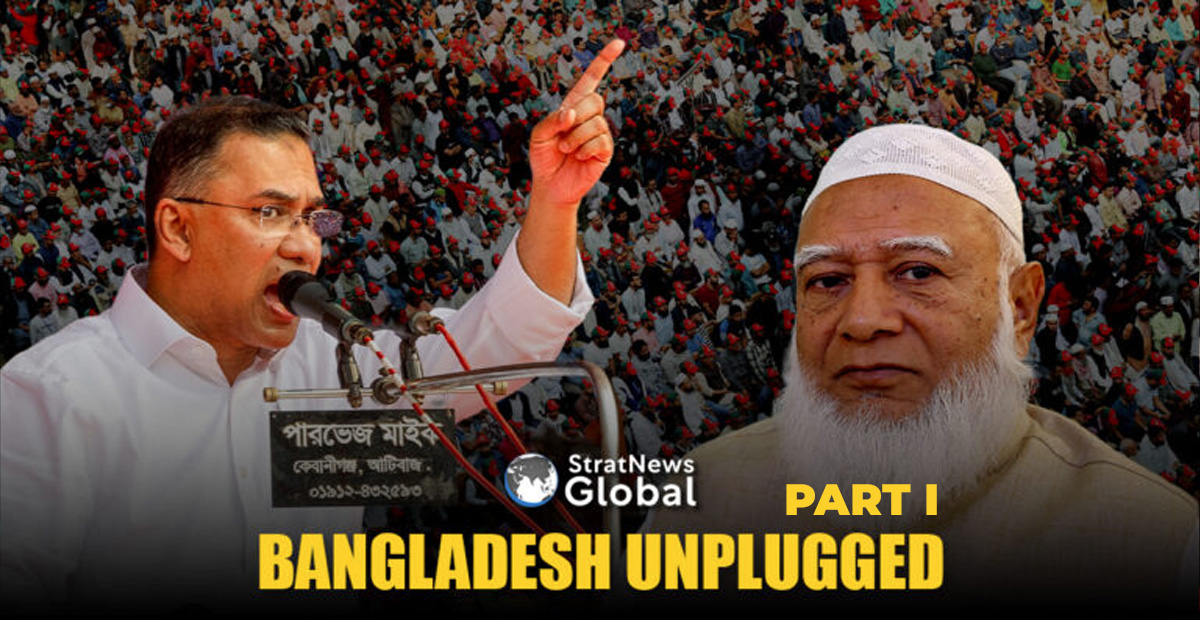
The news from Bangladesh is that the BNP or Bangladesh Nationalist Party is the front runner in the elections on February 12. But the headlines are dominated by the resurgence of the Jamaat-e-Islami, a right-wing religion-based political entity which had so far remained on the periphery of electoral politics in this nation of 12 crore voters.
Erstwhile coalition partners, BNP and Jamaat (they were together in a government way back in 2001-06 period), are now rival contenders in absence of the country’s oldest political party, the Awami League, banned by the current Interim Administration after Awami leader and Bangladesh’s longest serving Prime Minister, Shiekh Hasina was forced to flee the country in the wake of the upheaval against her government in August 2024.
Jamaat, a cadre-based, tightly run organisation was so far known more for opposing Bangladesh’s liberation struggle in 1971 and for having collaborated with the Pakistani Army during its brutal crackdown on the civilian population in 1971.
Fifty-five years later, the party has successfully rebranded itself as a viable second force if not an outright alternative to the more centrist and long-established political force such as the BNP, thanks to multiple mistakes committed by the Awami League over the past 15 years and the BNP’s inability to fully convince the large and restless young population of its ability to provide them a secure and prosperous future.
Long conversations with a range of opinion makers in Dhaka this week tells me that Jamaat, with its sleek campaign, door-to-door outreach and an appealing pitch has captured the imagination of the young demographic, creating unease among the more experienced and secular Bangladeshis, who have never been comfortable with the Islamist tenets preached and practiced by the Jamaat.
De-registered and briefly banned between 2018 and 2024, Jamaat started working on its comeback immediately after the uprising of August 5, 2024 by reaching out to university students, women and the poor by organising medical camps, undertaking flood relief and convincing the youth of a new beginning.
“They appeal to the voters to give them a chance. You have seen and experienced other parties, their rampant corruption and misgovernance, the Jamaat leaders proclaim at rallies. We will give you a clean, non-corrupt and people-oriented government. We also don’t believe in dynastic politics, is the Jamaat’s pitch,” points out a long-time political observer in Dhaka.
A well-knit, disciplined cadre at the grassroots helps spread a uniform message to the masses across the country, making Jamaat a formidable force.
One indication of the Jamaat’s re-emergence as an electoral force came last year when its youth wing swept students elections in Dhaka University, considered the bellwether for the country’s political mood. It of course has its own past sins to answer for. Despite repeated calls the Jamaat has not apologised unequivocally for its role in the 1971 genocide, although some party leaders did say they seek forgiveness for any past mistakes.
Moreover, the Jamaat’s known stand to disallow women in leadership roles is considered politically incorrect in a country which has had two strong women prime ministers in the past 30 years. And yet, its rural network and systematic outreach to women and under-privileged is finding better-than-before traction, making it a serious challenger.
Contrast this with BNP, the top contender for power. Tarique Rahman, the heir apparent, now seeking coronation, following his mother’s demise in December 2025, is making an all-out effort to project BNP as the best option for the people of Bangladesh, promising them security and corruption-free governance.
“Anyone who breaks the law or obstructs development plans because of corruption will not be spared,” he said at a meeting in Chattogram (Chittagong), the city where his father, Gen Ziaur Rahman, then a Major in the Pakistani Army, first declared Independence for Bangladesh in 1971, much before the liberation war began.
Rahman, now the Chairman of the BNP, lived in exile in London for 17 years until he returned to Dhaka on December 25 last year, to a tumultuous welcome. The large crowds that are seen in his rallies are part based on curiosity and part because of the New Deal he promises.
Dhaka will neither favour Pindi (Rawalpindi, the GHQ of Pakistani army) nor New Delhi, he tells people, talking about a balanced foreign policy, observed another astute analyst. Most business leaders and social observers are hoping that the large crowds at his public meetings would also vote in droves for Rahman’s party.
Seen as run by a tired and dispirited old guard until Rahman’s return electrified it, the BNP is also facing internal rebellion in different constituencies across the country, diverting the leadership’s energies in containing disgruntled aspirants. The party also hopes that a large section of Awami League supporters would automatically vote for the BNP since they may regard Jamaat as an undesirable alternative.
There is however a flip side to this theory too. In the wake of the August 2024 uprising, many BNP cadres filed several cases against known Awami league supporters for extortion and political violence over the years. Now, the Jamaat is promising protection to the Awami League workers facing harassment, if voted to power, creating confusion amongst substantial Awami voters. Eventually, the hardcore Awami League supporters will perhaps back candidates who appear to have a better chance of winning irrespective of their party affiliation to ‘buy’ protection after the elections.
The race is hotting up with less than a fortnight to go but one common sentiment I heard is how for the first time majority of voters will be able to cast their votes freely, implying that the three previous elections were rigged and unfair, a charge that the Awami League has not been able to live down.
(Part II: The Foreign Hand)