Australia and the Solomon Islands have jointly criticised China’s recent ballistic missile test in the Pacific, describing it as a provocative act that threatens regional stability and adds to growing strategic tensions across the Indo-Pacific.
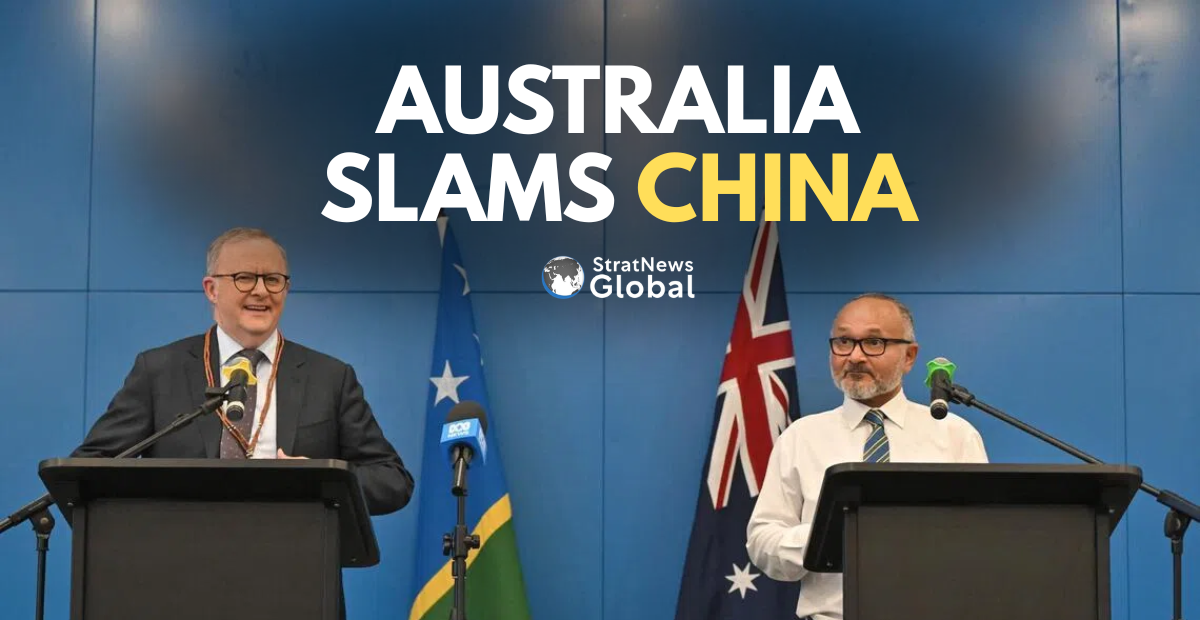
Australian Prime Minister Anthony Albanese, during a visit to Honiara, met Solomon Islands Prime Minister Matthew Wale, with the two leaders reaffirming their commitment to closer bilateral ties while expressing concern over Beijing’s military activity.
“There is no doubt that this is a provocative act by China, which does destabilise the region,” Albanese said during a joint press conference.
He criticised Beijing for failing to provide the customary 48-hour advance notification before the launch and said the greater concern was that the missile had been fired from a nuclear-powered submarine, signalling a significant escalation in China’s military capabilities.
According to China’s state-run Xinhua News Agency, the missile, carrying a dummy warhead, was launched from a People’s Liberation Army Navy submarine on Monday and landed in designated international waters in the Pacific.
The launch has already drawn criticism from the United States, Japan, Australia, New Zealand and Taiwan, while China’s Foreign Ministry urged countries not to “over-interpret” the exercise.
Solomon Islands Also Voices Concern
Prime Minister Matthew Wale, whose government has pledged to review the Solomon Islands’ security agreement with China, said the missile test was inconsistent with the behaviour expected from a partner.
“China is a good friend of Solomon Islands, but this is not something a friend does,” Wale said.
“We don’t want anybody—China, America or anyone else—testing intercontinental ballistic missiles in the Pacific. Be our friend, but don’t threaten us.”
The Solomon Islands has been at the centre of geopolitical competition since signing a security pact with China in 2022, prompting Australia and the United States to intensify diplomatic engagement across the Pacific.
Taiwan Calls China A ‘Bully’
Taiwan also condemned the launch.
National Security Council Secretary-General Joseph Wu shared what he said was the missile’s flight path, claiming it passed over the Philippines before landing between Tonga and Nauru.
“China just proved itself again to be a bully on the block,” Wu wrote on social media.
Long-range Chinese missile tests into the Pacific remain relatively rare, with the previous publicly known intercontinental ballistic missile launch taking place in 2024.
Australia Seeks Stronger Pacific Partnerships
Alongside the security concerns, Australia and the Solomon Islands agreed to accelerate negotiations on a comprehensive bilateral treaty covering security and broader cooperation.
The discussions follow Australia’s recent strategic agreements with Fiji and Vanuatu, reflecting Canberra’s continued effort to strengthen partnerships across the Pacific as competition with China intensifies.
Albanese said Australia was keen to conclude a comprehensive agreement with the Solomon Islands but stressed that quality negotiations remained more important than speed.
The latest developments underscore the Pacific’s growing importance in the strategic rivalry between China and Western allies, with island nations increasingly seeking to balance economic partnerships against regional security concerns.
(with inputs from Reuters)