

Support us by contributing to StratNewsGlobal on the following UPI ID
ultramodern@hdfcbank

Strategic affairs is our game, South Asia and beyond our playground. Put together by an experienced team led by Nitin A. Gokhale. Our focus is on strategic affairs, foreign policy and international relations, with higher quality reportage, analysis and commentary with new tie-ups across the South Asian region.
You can support our endeavours. Visit us at www.stratnewsglobal.com and follow us on YouTube, Twitter, Facebook and Instagram.
र 500 per month
र 1000 per month
र 5000 per year
र 10000 per year
Donate an amount of your choice
र 500 per month
Donate र 500 per month

र 1000 per month
Donate र 1000 per month
र 5000 per year
Donate र 5,000 per year
र 10000 per year
Donate र 10,000 per year
Donate an amount of your choice
Donate an amount of your choice
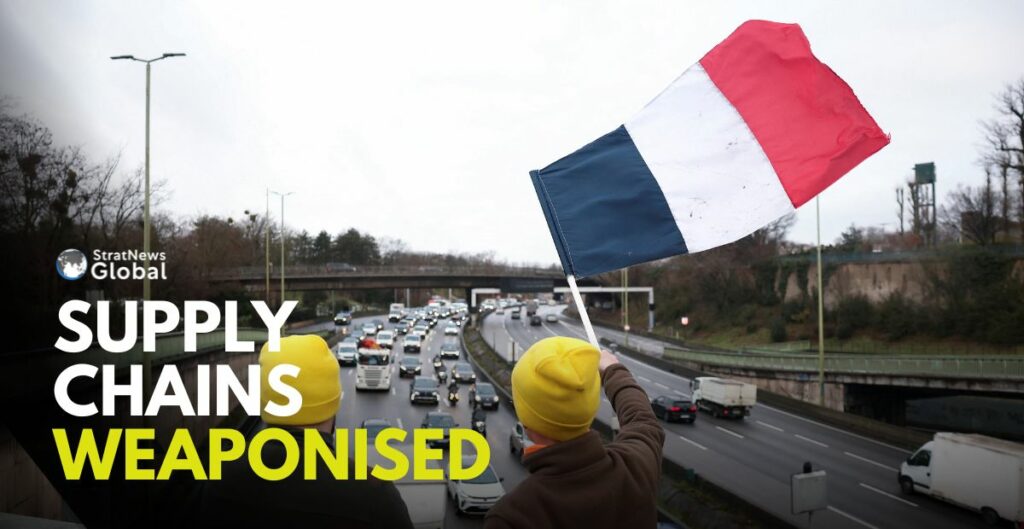




French Aerospace Sounds Alarm On Supply Chain Weaponization
On Thursday, France’s aerospace sector voiced alarm over the growing “weaponization” of global supply chains amid the geopolitical maneuvering of major powers, cautioning that rare earths continue to pose a potential vulnerability despite the U.S.-China trade truce.
Olivier Andries, president of France’s GIFAS aerospace association and CEO of engine maker Safran, said 90% of the industry’s needs for the rare elements were supplied by China, which is at odds with Washington over trade.
“There is a trend towards the weaponization of the supply chain, towards using the dependency on critical supplies to create a geopolitical advantage. That is particularly the case for rare earths, which is a very sensitive topic,” he said.
Rare earths or the magnets that they are sometimes made into can be found in small but significant quantities in many modern products, including jet engines.
Budget Challenges
Andries, speaking at a GIFAS briefing on a day when France’s deeply divided parliament was returning from its end-year break, said he was also concerned over the continued lack of a domestic budget for 2026, adding parliamentarians had “lost direction”.
French Prime Minister Sebastien Lecornu is making a fresh attempt to pass the budget after lawmakers passed emergency legislation.
So far, France’s defence plans are on track, Andries said, as Europe boosts spending in the face of U.S. political pressure and the ongoing conflict in Ukraine.
Asked about the future of a Franco-German-Spanish fighter project, which is engulfed in disputes between Airbus and Dassault Aviation, Andries said: “There is a very strong political will at the highest level in France and Germany to go ahead. But for things to advance, you also need to have agreements and the manufacturers accepting to work together”.
(With inputs from Reuters)
Greenland: Why Trump Wants It, What He Could Do With It
President Donald Trump’s renewed push to acquire Greenland reflects a deeper transformation in how the United States views power, territory, and global competition. Greenland sits at the centre of an intensifying geopolitical struggle involving the United States, China, and Russia.
His obsession about Greenland combines military strategy, economic security, resource control, and most importantly preventing rivals from gaining a foothold in the rapidly changing Arctic.
Strategic Geography
Greenland occupies a commanding location between North America and Eurasia, directly astride the shortest routes for intercontinental missiles, military aircraft, and Arctic shipping.
During the Cold War, this geography made Greenland indispensable to US missile-warning systems. Today, as polar ice retreats and Arctic access expand, that same geography has become even more valuable.
However, for Washington, Greenland is not just territory, it is a platform:
- A forward military buffer against Russia
- A monitoring point for missile launches and space activity
- A gatekeeper to Arctic sea lanes
- A territorial anchor in a region where sovereignty claims are sharpening
Trump has repeatedly claimed that Denmark lacks the capacity to defend Greenland against foreign encroachment.
Military Imperatives
The US already maintains a significant military presence in Greenland through the Pituffik Space Base (formerly Thule). This supports missile detection, space surveillance, and early-warning systems. As Russia modernises its Arctic bases and China expands its polar research and naval capabilities, US defence planners increasingly view Greenland as indispensable to maintaining strategic parity.
His administration has openly suggested that military force cannot be ruled out, a statement that has deeply alarmed NATO allies. An attack or coercive seizure of Greenland, which is part of the Kingdom of Denmark, would directly challenge the principle that NATO members do not threaten one another.
European leaders have warned that such an action would fundamentally undermine the alliance. Critics argue that this alone makes Trump’s position dangerously destabilising. Supporters counter that Arctic competition has already outgrown NATO’s old assumptions.
Keeping China Out
Greenland holds significant reserves of minerals essential for modern and green technologies, including: Rare earth elements; Lithium; Cobalt; Nickel; and Copper.
These materials are critical for electric vehicles, renewable energy infrastructure, batteries, defence systems, and advanced electronics. China currently dominates global rare earth processing and companies have already shown interest in Greenlandic mining and infrastructure projects. This has raised an alarm within US security circles.
By acquiring Greenland US hopes to block Chinese access to Arctic mineral reserves and Secure long-term resource independence for green and military technologies.
Economic Possibilities
Climate change has transformed Greenland from a frozen periphery into a zone of economic possibility. With the ice sheets melting land and seabeds are being exposed and these were previously inaccessible.
This has several consequences: New mining opportunities for critical minerals; Renewed interest in oil and gas exploration (despite Greenland halting new licences in 2021); and expanded access to Arctic shipping routes.
Although Greenland’s government has taken a cautious stance on fossil fuels, future economic pressures could reopen debates about extraction. The US sees early control as a way to shape how, and by whom these resources are developed.
Arctic Shipping Lanes
Melting sea ice is opening new Arctic maritime corridors that dramatically shorten travel between Europe and Asia, cutting journey times by up to 40–50% compared with the Suez Canal route.
Both Russia and China have agreed to cooperate on developing these northern shipping routes. What will US gain?
Once it takes over Greenland, it will have leverage over: Maritime surveillance; Major transit chokepoints; Port development; and Search-and-rescue infrastructure.
In strategic terms, whoever dominates Arctic logistics gains both economic advantage and military reach.
U.S. Seizes Venezuela-Linked Oil Tankers Amid Rising Tensions
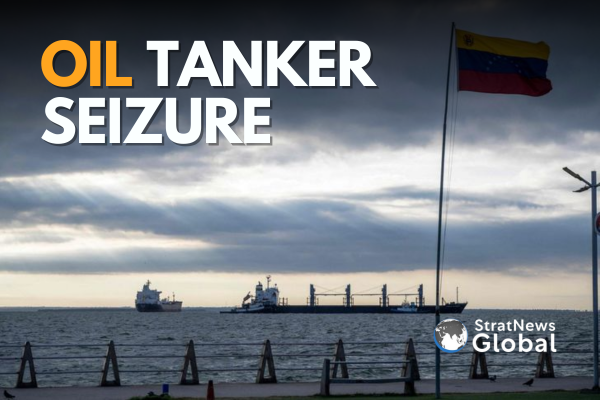
The United States seized two Venezuela-linked oil tankers in the Atlantic Ocean on Wednesday, one of which was sailing under Russia’s flag. The operation marks a sharp escalation in President Donald Trump’s strategy to reshape oil flows in the Americas and force Venezuela’s socialist leadership into cooperation with Washington.
The move follows the dramatic capture of Venezuelan President Nicolas Maduro in a military raid on Caracas over the weekend. With Maduro now in U.S. custody, the Trump administration has intensified its maritime blockade, targeting vessels under sanctions that continue to operate in or out of the South American nation, a member of the OPEC oil producers group.
Coast Guard Operations and Rising Tensions with Russia
After a weeks-long pursuit across the Atlantic, U.S. Coast Guard and military special forces boarded and seized the crude oil tanker Marinera on Wednesday morning. Officials said the ship had previously resisted inspection before switching to a Russian flag. The operation, conducted under a judicial seizure warrant, unfolded with Russian naval vessels and a submarine nearby, heightening the risk of confrontation.
U.S. Vice President JD Vance described the Marinera as “a fake Russian oil tanker” created to evade sanctions. Earlier the same day, the Coast Guard intercepted another vessel, the Panama-flagged M Sophia, near the northeastern coast of South America. Records from Venezuela’s state oil company, PDVSA, indicated that the M Sophia was carrying a full cargo of crude oil.
According to U.S. authorities, both ships were part of a “shadow fleet” used to transport sanctioned oil from Venezuela and Iran. Deputy White House Chief of Staff Stephen Miller said that only maritime trade consistent with U.S. law and national security would now be permitted.
China Condemns U.S. ‘Bullying’
The Trump administration is also negotiating with Venezuelan officials to redirect crude oil supplies intended for China and allow U.S. companies access to approximately $2 billion worth of Venezuelan oil. Beijing denounced the seizures, calling them “acts of bullying.” Chinese Foreign Ministry spokesperson Mao Ning criticised Washington’s “brazen use of force” and its “America First” approach to foreign energy markets.
Trump has repeatedly stated his intention to gain control of Venezuela’s vast oil reserves. Following Maduro’s arrest, he announced that oil revenues from forthcoming U.S.-Venezuela deals would fund purchases of American goods, including agricultural and medical supplies. Meanwhile, Acting President Delcy Rodriguez said Venezuela remained open to new energy partnerships “where all parties benefit,” even as she condemned the capture of Maduro as a “kidnapping.”
U.S. Plans to Refine and Sell Venezuelan Oil
On Tuesday, Trump declared that the U.S. would refine and sell up to 50 million barrels of Venezuelan crude that had been frozen under sanctions since 2019. White House Press Secretary Karoline Leavitt confirmed that some restrictions were being “selectively rolled back” to enable the new trade. PDVSA confirmed ongoing negotiations, describing them as “commercial transactions under legal and transparent terms.”
However, reports suggest that U.S. oil companies remain wary. According to the Financial Times, industry executives plan to demand strong assurances from Washington before investing, citing Trump’s unpredictable foreign policy.
Global oil prices dipped on Wednesday in response to expectations of increased supply from the new arrangement. Meanwhile, China, Russia, and Venezuela’s leftist allies condemned the U.S. operation that led to Maduro’s arrest, which Caracas officials claim left 100 people dead.
Washington’s allies have also voiced unease at the precedent set by seizing a sitting foreign leader, while Trump has warned of further “energy actions” across the hemisphere to secure U.S. interests.
with inputs from Reuters
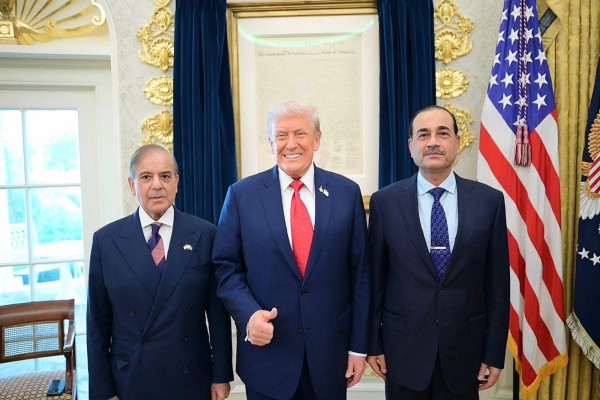
Pakistan Files Pahalgam Alibi In Washington
Pakistan did not merely issue statements after the Pahalgam massacre. It did something far more deliberate, far more revealing, and far more expensive.
It filed paperwork in Washington.
In the weeks following the April 22 killing of 26 civilians in Pahalgam—and India’s subsequent retaliatory strikes—Pakistan’s representatives submitted a series of documents under the Foreign Agents Registration Act (FARA), lodged with the US Department of Justice. These filings, made by U.S. law and lobbying firms retained by Islamabad, are formally classified as “Informational Materials” and Supplemental Statements.
Translated from bureaucratic English, this means:
Pakistan paid a staggering $ 5 million to American firms to circulate its version of events to U.S. officials, lawmakers, think tanks, and influencers—and was legally required to disclose what it was saying. This from a nation that has difficulty feeding its own people and depends on the IMF and other donors for its budgetary needs. While its military brass cavorts in five-star luxury.
Those disclosures are now public. And they are extraordinary.
They do not argue law. They do not present evidence. And they do not engage facts.
The documents, uploaded to the DOJ’s FARA e-file system, set out Pakistan’s “position” on four things: the Pahalgam attack, India’s response, Pakistan’s role (or lack thereof), and why Washington should remain sympathetic. They are not internal memos or diplomatic cables. They are advocacy material distributed in America, on Pakistan’s behalf, under penalty of U.S. law.
This matters because these filings are not denials shouted into the void. They are formal narrative exports, stamped, logged, and archived by the U.S. government.
And what do they say?
First, that Pakistan is deeply committed to peace, de-escalation, and regional stability. (It could just as well have said the moon is made of green cheese). This is always Step One. Pakistan’s desire for peace is never preventative, only retrospective. Calm is discovered only after violence has already been executed by groups Islamabad insists it does not control.
Second, the filings assert Pakistan’s total innocence in the Pahalgam massacre and call for an “independent, impartial international investigation”. This is presented not as a tactic but as proof of confidence.
An investigation, when demanded by a state that controls access, witnesses, and evidence, is not transparency. It shifts the burden of proof entirely onto India while allowing Pakistan to continue its favourite posture: cooperative victim.
Third, the documents characterise India’s retaliation as reckless, escalatory, and destabilising. The strikes are framed as the real danger to regional peace, while the massacre itself is treated as an unfortunate background event—tragic, yes, but strategically inconvenient to dwell on.
This inversion is the filing’s central trick. Terrorism becomes routine, atmospheric. Response becomes criminal.
Fourth, the filings dismiss allegations of Pakistan’s involvement in cross-border terrorism as Indian “disinformation”. This is where advocacy tips into parody. The links between Pakistan-based militant groups and violence in Jammu and Kashmir are not Indian inventions. They appear in UN monitoring reports, U.S. Treasury sanctions, and Western intelligence assessments.
By filing this claim with the U.S. Justice Department, Pakistan is not arguing with India. It is arguing with the American state itself—politely, of course, and through lawyers.
Fifth, Pakistan highlights its counter-terrorism cooperation with the United States. Arrests are mentioned. Intelligence sharing is emphasised. The implication is clear: gratitude is expected.
What the filings do not say is that this cooperation reliably coincides with pressure—from sanctions regimes, financial watchdogs like the FATF, or diplomatic isolation—and reliably fades once attention shifts elsewhere.
Naturally, the documents also accuse India of sponsoring terrorism inside Pakistan, with Balochistan making its ritual appearance. Evidence is not provided. It never is. The asymmetry is the point. On Kashmir-related terrorism, Pakistan demands forensic proof, international inquiries, and neutral adjudicators. On its own allegations, assertion suffices.
Standards, like militants, are clearly context-dependent.
Perhaps the most revealing passage is the call for U.S. mediation. Pakistan urges Washington to play a stabilising role between India and Pakistan. This strategy reframes terrorism as a bilateral misunderstanding, responsibility as shared ambiguity, and retaliation as emotional excess.
India’s rejection of third-party mediation is well known. Pakistan is not appealing to New Delhi. It is appealing to Washington’s reflexive instinct to “balance” narratives—even when balance erases causality.
Finally, the filings insist that Pakistan seeks a mature, bilateral relationship with the United States, independent of regional frictions. This would be more convincing if the documents themselves were not obsessively India-centric. Kashmir, retaliation, Indian narratives, Indian intentions—every grievance loops back to the same axis.
You cannot ask for independence from neighbours while filing grievance literature about them with the U.S. Justice Department.
Taken together, these FARA filings are not diplomacy. Pakistan is not merely denying involvement; it is exporting denial under U.S. law, paying American professionals to ensure its version of events circulates in Washington with a straight face and a legal receipt.
That is the real story here—not just what Pakistan claims, but where it chose to claim it, how it chose to claim it, and whom it paid to do so.
The dark comedy lies in the contradiction. Pakistan asks to be taken at face value while insisting that no one else’s face value should be trusted. It demands investigations it will never enable, dialogue it will never depoliticise, and peace it discovers only after consequences arrive.
In Washington, this counts as advocacy. In South Asia, it counts as routine.
Until Pakistan replaces paperwork with real action, the innocence industry and Pakistan’s putrid perfidy will continue to hum—professionally filed, legally disclosed, and completely detached from reality.
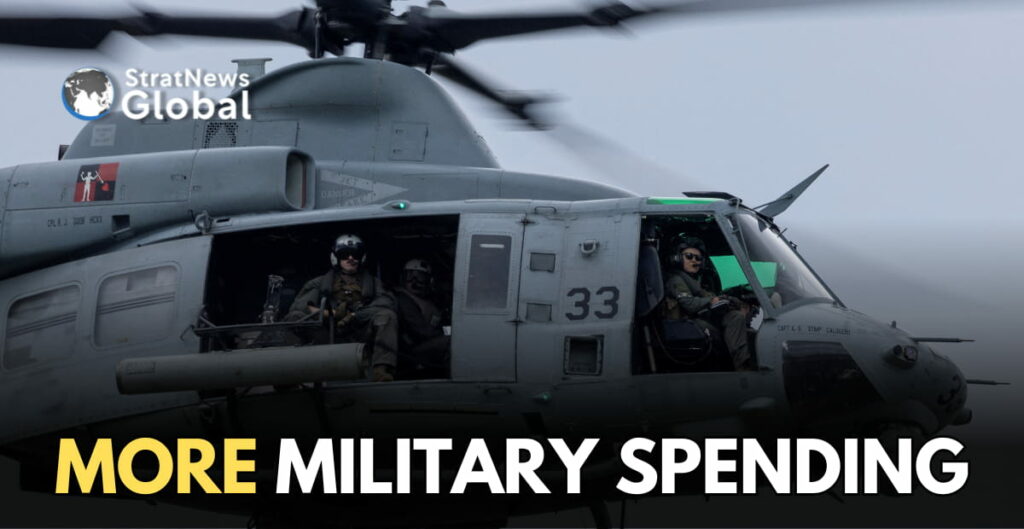
Trump Hikes US Military Spending From $901Bln To $1.5 Trillion In 2027
President Donald Trump said on Wednesday that the 2027 military budget should be $1.5 trillion, significantly higher than the $901 billion approved by Congress for 2026, boosting defence stocks, but sparking scepticism among budget experts.
Any such increase in the military budget would require congressional authorisation, which could pose a challenge, although Trump’s Republicans, who hold slim majorities in both the Senate and House of Representatives, have shown little appetite for objecting to Trump’s spending plans.
Trump said in a Truth Social post that he made the decision on 2027 military spending “after long and difficult negotiations with Senators, Congressmen, Secretaries, and other Political Representatives… especially in these very troubled and dangerous times.”
In just the last few days, U.S. forces seized Venezuela’s Nicolas Maduro from his country, toppling him from power. The White House has also said that Trump is discussing options for acquiring Greenland, including potential use of the U.S. military. Trump has also deployed U.S. troops to police a number of cities across the country.
The news followed a separate Truth Social post from Trump blasting defence companies for producing weapons too slowly. In it, he pledged to block defence contractors from paying dividends or buying back shares until they accelerated production.
Extra Spending
Trump said the extra spending would be covered by revenues generated by tariffs he has imposed on nearly every country and many industrial sectors, and the U.S. would still be able to reduce its debt and send dividend checks to “moderate income” Americans.
The Committee for a Responsible Federal Budget, a nonpartisan think tank, estimated the proposal would cost $5 trillion through 2035, while adding $5.8 trillion to the U.S. debt with interest. It said only half the cost could be covered by tariffs in place now, noting that the Supreme Court could rule that a large set of tariffs was illegal.
The Bipartisan Policy Centre estimates that combined tariffs raised $288 billion in 2025, well below Trump’s own estimates, which have fluctuated around $600 billion in recent days.
Byron Callan, a defence analyst with Capital Alpha Partners, said Trump’s post raised questions about where the funds would be directed and whether they could even be absorbed by the defence sector.
He said the last time the U.S. Defence Department saw an increase higher than 50% was in 1951 during the Korean War, with even huge surges in military spending under former President Ronald Reagan in 1981 and 1982, amounting to 25% and 20%.
In trading after the market closed, shares in the biggest defence firms rose on the news as investors bet a surge in spending would bolster profits.
Lockheed Martin was up 6.2%, General Dynamics GD.N rose 4.4% and RTX added 3.5%.
(with inputs from Reuters)
China Hacks Emails Of U.S. Congressional Committee Staffers
A hacking group from China has compromised emails used by staff members of powerful committees in the U.S. House of Representatives, the Financial Times reported on Wednesday, citing people familiar with the matter.
The group, nicknamed Salt Typhoon, accessed email systems used by some staffers on the House China committee as well as aides on panels covering foreign affairs, intelligence and the armed services, the report said. It did not identify which specific staffers were targeted.
Reuters could not immediately verify the report. Chinese Embassy spokesman Liu Pengyu condemned what he called “unfounded speculation and accusations,” while the Federal Bureau of Investigation declined to comment. The White House and the offices of the four committees reportedly targeted in the surveillance sweep did not immediately respond to requests for comment.
The FT cited a person familiar with the campaign as saying it was unclear whether the attackers had accessed lawmakers’ emails in the intrusions, which were detected in December.
U.S. lawmakers and their aides, especially those who oversee America’s sprawling military and intelligence agencies, have long been top targets for cyberespionage and reports of hacks or attempted hacks have surfaced periodically.
In November, the Senate Sergeant at Arms notified multiple congressional offices of a “cyber incident,” where hackers may have accessed communications between the nonpartisan Congressional Budget Office, which provides key financial research data to lawmakers, and some Senate offices. In 2023, the Washington Post reported that two senior U.S. lawmakers were among the targets of a Vietnam-linked hacking operation.
The Salt Typhoon of China, a company known to hack in particular, has long rattled the US intelligence community, as it did with the emails this time. The spies – alleged to be working for Chinese intelligence – stand accused of gathering data on wide swathes of Americans’ telephone and email communications and intercepted conversations, including those between prominent U.S. politicians and government officials.
Beijing has repeatedly denied being behind the spying.
Early last year, the U.S. imposed sanctions on alleged hacker Yin Kecheng and cybersecurity company Sichuan Juxinhe Network Technology, accusing both of being involved in Salt Typhoon.
(with inputs from Reuters)
ICE Kills Woman In Minneapolis, Mother Of Victim Says ‘She Was Compassionate’
A U.S. immigration agent shot and killed a 37-year-old woman in her car in Minneapolis on Wednesday during an immigration enforcement surge, according to local and federal officials, the latest violence in President Donald Trump’s nationwide crackdown on migrants.
Minneapolis Mayor Jacob Frey adamantly rejected the Trump administration’s assertion that the agent fired in self-defence, saying video of the shooting directly contradicted what he called the government’s “garbage narrative.”
“They’re already trying to spin this as an act of self-defence,” a visibly angry Frey said at a press conference. “Having seen the video myself, I want to tell everybody directly – that is bullshit.”
Frey blamed federal immigration agents for sowing chaos in the city, telling ICE: “Get the fuck out of Minneapolis.” But he also urged residents to remain calm, as Democratic leaders in Minnesota, Washington and elsewhere called the ICE operation an unnecessary provocation that resulted in tragedy.
The Minnesota City Council identified the dead woman as Renee Nicole Good and said she was “out caring for her neighbours this morning and her life was taken today at the hands of the federal government.” The council statement also demanded that the immigration enforcement agency leave Minneapolis immediately.
As night fell, a crowd that appeared thousands strong gathered at the site of the shooting in a residential area of the city’s Central neighbourhood, aerial TV images showed. Candles placed at the site lighted up the winter night. Earlier, some protesters were met by heavily armed federal agents wearing gas masks who fired chemical irritants.
Opponents of Trump called for protests in several American cities, raising the risk that the killing could become a national flashpoint over his deployment of federal officers to Democratic-led cities and states.
What Happened?
Kristi Noem, secretary of the Department of Homeland Security, told a press conference that Immigration and Customs Enforcement officers were responding to a vehicle stuck in the snow in Minneapolis when they were harassed by a “mob of agitators.”
One of the protesters, later identified as Good, followed agents all day, Noem said. Good blocked their vehicle and refused orders to move out of the way, she said.
“She then proceeded to weaponise her vehicle, and she attempted to run a law enforcement officer over,” Noem told a news conference, saying the car struck the officer.
She characterised that as domestic terrorism and said the act was under investigation by the FBI. State officials said they would launch their own investigation.
Videos of the shooting posted on social media and verified by Reuters raised doubts about the government’s account. One widely shared video showed a maroon Honda SUV partially blocking the road. As the clip begins, the driver inches forward before stopping to let another car pass.
The driver, with the window down, then appears to gesture to an approaching pickup truck to go ahead as well. Instead, the truck stops, and two officers exit and approach the car on foot.
As one of the officers orders the driver out of the SUV and grabs the door handle, the vehicle reverses briefly, and a third agent moves to the front of the car from the passenger side.
The driver then advances, steering to the right in what appears to be an effort to drive away from the officers. The agent in front of the car pulls his weapon, steps back and fires as the moving car’s left front bumper comes close to his legs.
He fires three shots, with at least one shot after the car’s front bumper had passed him. It was not clear from the video whether the car made contact with the officer, who stayed on his feet throughout the encounter.
After the shots, the car accelerates and crashes into parked cars and a utility pole.
Noem said the officer was experienced and “followed his training.” He was treated by a doctor at a hospital and released.
Victim ‘Compassionate’
Good’s mother told the Minnesota Star Tribune that her daughter was “extremely compassionate,” and she said Good was not the type of person to confront ICE agents.
“She’s taken care of people all her life,” her mother, Donna Ganger, told the newspaper. “She was loving, forgiving and affectionate.”
The police chief said Good, who was married, was not a target of immigration operations. A witness whose home is nearby told CNN that Good lived in the neighbourhood.
The Department of Homeland Security has said it is conducting the “largest DHS operation ever” in Minnesota with 2,000 officers deployed to arrest “fraudsters, murderers, rapists, and gang members.” The surge follows allegations of wide-scale welfare fraud involving Somali immigrants, whom Trump has called “garbage.” Noem said authorities had arrested 1,500 people in recent weeks.
Trump’s Statement
Democratic Governor Tim Walz, who ran for U.S. vice president in the 2024 election won by Trump, also rejected the federal government’s account and placed the blame for the shooting on the Trump administration. He told a press conference that he had put the National Guard on alert for possible deployment.
“What we are seeing is the consequences of governance designed to generate fear, headlines and conflict,” Walz said. “…Today, that recklessness costs someone their life.”
In a social media post, Trump said the video showed the woman “violently, willfully, and viciously ran over the ICE Officer, who seems to have shot her in self-defence.”
The competing narratives highlighted U.S. political polarisation, in which Trump’s supporters enthusiastically endorse his version of events while opponents contend his assertions are often provably false.
(with inputs from Reuters)
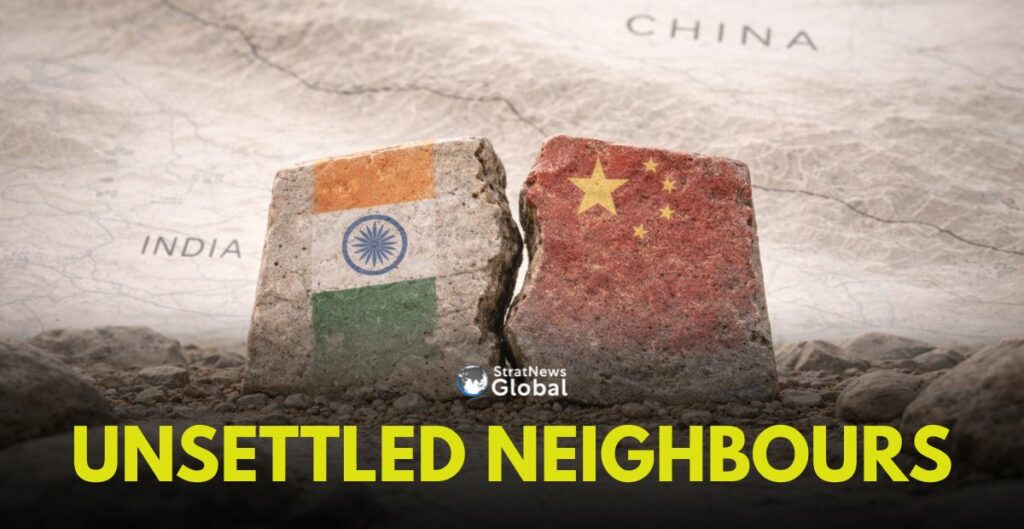
Why Managing The Tough India-China Relationship Is Tougher
Did you know that Arunachal Pradesh is a “Core Interest” of China’s? According to the US War Department’s annual report to Congress at the close of 2025, China’s conceptualisation of “Core Interest” now includes Arunachal Pradesh.
This brings to four the number of China’s “Core Interests”: they include Taiwan since 2003, and broadened in 2008 to cover Tibet after then French President Sarkozy met the Dalai Lama. The third was Japan’s Senkaku islands that China refers to as Diaoyu.
Arunachal has been steadily rising on China’s radar since the 2000s when the then Chinese ambassador described the whole of the state as part of his country. There followed stapled visas for people from Arunachal and then a serious incident in Dec 2022 when Beijing tried to militarily change the status quo in Yang-tse, in the Tawang sector.
Along with other issues including the attacks in the Galwan Valley, it underscored the point that China views India as its “primary long-term competitor” in Asia. It explained Beijing’s refusal to settle the boundary dispute, encouraging Pakistan’s anti-India policies and seeking to “box it” into the South Asian enclosure.
It is also offering no concession on trade, no relaxing the non-tariff barriers that keep out Indian goods despite friendly noises by China’s ambassador in Delhi. No softening on the supply of critical minerals either, forcing India to look elsewhere. In other words, China is not going to help India’s rise.
Foreign Minister Wang Yi’s recent claim of mediating between India and Pakistan in the wake of Operation Sindoor, is meant to drive home the point that India is alone, has no diplomatiic support and therefore carries no weight in international circles.
He also referred to India and the US in competition with each other, which made no sense at all given America’s $30 trillion GDP against India’s $4 trillion.
Important here to understand how each side uses terminology. When China talks about peace, it may imply acceptance of a regional order that reflects its growing influence. India sees peace as mutual respect, equality, and adherence to agreements both sides have signed. This difference in interpretation makes communication har67der.
As China’s power grows, the boundary dispute recedes in importance, it is something to be managed. For India, the border is deeply tied to sovereignty and national dignity. So, even though troops have stepped back, it has only created physical distance not a real reassurance.
Today, most of the relationship is handled through military meetings and procedures, while political talks are limited and very careful. This approach keeps things stable and avoids tension, but it does not bring clarity, and it does not build trust.
Their widely divergent political systems adds complexity to the relationship. Their wider contested geopolitics is another issue: both countries seek leadership in the Global South and participate in forums like the SCO and BRICS, where cooperation exists alongside hidden competition.
India focuses on mutual respect and strategic independence, while China often calls to counter ‘Cold War mentalities.’ These messages are interpreted differently in New Delhi, which aims for a multipolar world where a no single power has too much influence.
Recent diplomatic moves like the resumption of direct flights after five years, issue of tourist visas, and renewed SCO engagements, signal a desire to reset the relationship’s tone. These steps, however, are often symbolic rather than strategic breakthroughs.
Leaders meet and agree to cooperate, but such cooperation are often shared interests rather than shared principles. And while India seeks a balanced foreign policy that hedges between great powers, China continues to press for positions that reflect its own security and status considerations.
Today, India and China remain two civilizations with overlapping vocabularies but distinct political grammars, and until that deeper difference is acknowledged and addressed, their relationship will endure, but not reconcile.
Indian Air Force’s China Challenge In Ladakh And A Slice Of Tibet
The Indian Air Force’s Leh base. The challenge from the China and Pakistan two-front threat. Protecting India’s borders from Chinese aggression. And preserving Tibet’s Buddhism from Chinese repression. These are the subjects of this documentary. In ‘The Himalayan Frontier’ Part VII here’s a look at Shakti & Shanti (Power & Peace) in Ladakh. We record a day in the life of the Indian Air Force’s Air Warriors at the Air Force Station (AFS), Leh in Ladakh. The AFS is at the frontline of dealing with the China and Pakistan two-front threat.
Air Force Station Leh
Continuing our series, a StratNews Global team of Amitabh P. Revi, Rohit Pandita and Karan Marwaha document the IAF Mig-29, Sukhoi-MKI and Rafale fighter jets. As well as the C-17 Globemaster, Il-76 and, An-32 transport aircraft. Last but not least, we film the Cheetals of the ‘Siachen Pioneers’ 114 Helicopter Unit. Watch their operations at, to and from the Indian Air Force’s AFS, Leh.
India has ramped up its military posture along the Northern borders. This came after the deadly 2020 Galwan clashes with China’s People’s Liberation Army (PLA) forces. And the Indian Air Force’s AFS Leh plays a significant role in that defence posture.
‘The Himalayan Frontier’ Part VII
Specifically, we film the Indian Air Force’s Mig-29, Su-MKI and Rafale fighter jets. The C-17, Il-76 and An-32 transport aircraft. As well as the IAF and Indian Army Advanced Light Helicopter (ALH) Dhruv & Rudra. The Cheetal helicopters also conduct critical sorties.
We speak to the Air Officer Commanding (AOC), the Commanding Officer (CO) of the 114 Helicopter Unit (HU), Mig-29 and Cheetal pilots and the Engineering Officer, 114 HU. Watch this episode as we document the Indian Air Force’s operations in the northern Himalayan frontier. Their role is crucial all along the Line of Actual Control (LAC) with China in Eastern and Southern Ladakh. As well as along China-occupied Tibet. And in the Siachen Glacier along the Line of Control (LoC) and the Actual Ground Position Line (AGPL) with Pakistan.
Finally, we also travel to the Thiksey Gompa or Monastery. It is modeled on the Potala Palace in Lhasa, Tibet. We find priceless Buddhist religious literature, documents and thangkas at the Gompa. They were secretly brought out of Tibet to preserve them from Chinese repression.
Northern Front Ground Reports
In earlier episodes of this series, in Part VI, we interview Air Commodore D.S.Handa, AOC of the Indian Air Force’s AFS, Leh on how the IAF is dealing with the two-front China and Pakistan threat in Ladakh. SNG’s team documents its journey to Leh on the strategic third, alternate axis—the Darcha-Padam-Nimu (NPD) Road, in episode III and episode IV. The route provides critical connectivity. In episode V, Lt Gen Raghu Srinivasan, the DG, BRO in an interview on the frozen Zanskar River Chadar Trail at Chiling near Leh in Ladakh notes “the impetus for connectivity and the surge in Ladakh”.
In part II of this series, the Indian Army Chief, General Manoj Pande tells StratNews Global Editor-in-Chief Nitin A. Gokhale in an exclusive interview, that talks with China are continuing at both military and diplomatic levels. But India is maintaining a robust posture along the LAC. Then Northern Army Commander, now Vice Chief of the Army Staff, Lt Gen. Upendra Dwivedi also tells Nitin Gokhale in Part I, that the “situation is stable but sensitive and not normal”.
Editor’s Note:
This episode was first published on February 16, 2024, and hit 300,000+ views on YouTube on March 3, 2024. It crossed the 400,000+ mark on April 1. 500,000+ on June 29. And crossed 600,000+ views on October 3, 2024. And hit 700,000+ views on May 22, 2025. The episode has over 8 lakh views on January 8, 2026.
Also See:
Pakistani Scholar’s Rant Against His Govt. Goes Viral But Did He Mean It?
An article critical of Pakistan’s military-political establishment that went viral after it was published in The Express Tribune, was quickly taken down within hours. But enough people had downloaded it for the article to be distributed and discussed.
The article by US-based Ph.D scholar Zorain Nizamani, was published on New Year’s Day and began thus:
“For the older men and women in power, it’s over. The young generation isn’t buying any of what you are trying to sell to them. No matter how many talks and seminars you arrange in schools and colleges trying to promote patriotism, it isn’t working.
“Patriotism comes naturally when there is equal opportunity, sound infrastructure and efficient mechanisms in place. When you provide your people with basic necessities and ensure people get their rights, you won’t have to go to schools and colleges to tell students they have to love their country.
“Thanks to the internet, to whatever little education we have left, despite your best efforts at keeping the masses as illiterate as possible, you have failed.”
Zorain is the son of celebrity actors Fazila and Qaiser Nizamani, and clearly belongs to the upper crust of Pakistani society. His mother said the piece was a general commentary on youth perceptions and not aimed at any specific institution.
The son also clarified that he had no political affiliation and whatever he wrote was based on his views and his observations. In a rambling recording posted on X, he said “I have always encouraged thinking, questioning, learning for yourself and reading … the message has always been to think critically for yourself .. question what is being fed to you what is being taught to you by parents, by government by anyone.”
The recording contained nothing critical of the Pakistani government or establishment, in fact it was far removed from what he had written. So it left the question whether he meant what he wrote or not.
In the recording he says “i was having fun when I wrote that, messing around, not thinking a lot.”
Did he mean what he wrote? That remained unclear. Was the recording meant to soothe the powers that be and protect his parents who remain in Pakistan? We may never know but Nizamani’s written piece reflected Pakistan’s painful reality:
Given the dominance of the army and its favoured political proteges, every institution has had to bend to the current order. The economy is not doing well, unemployment is rising and this year according to Dawn, there was a 31% increase in Pakistan’s unemployed.
Official data shows more than 5,000 doctors and 11,000 engineers left the country in the past two years, part of an accelerating talent exodus. The powers that be remain unmoved