

Support us by contributing to StratNewsGlobal on the following UPI ID
ultramodern@hdfcbank

Strategic affairs is our game, South Asia and beyond our playground. Put together by an experienced team led by Nitin A. Gokhale. Our focus is on strategic affairs, foreign policy and international relations, with higher quality reportage, analysis and commentary with new tie-ups across the South Asian region.
You can support our endeavours. Visit us at www.stratnewsglobal.com and follow us on YouTube, Twitter, Facebook and Instagram.
र 500 per month
र 1000 per month
र 5000 per year
र 10000 per year
Donate an amount of your choice
र 500 per month
Donate र 500 per month

र 1000 per month
Donate र 1000 per month
र 5000 per year
Donate र 5,000 per year
र 10000 per year
Donate र 10,000 per year
Donate an amount of your choice
Donate an amount of your choice
As India-US Ties Nosedive, Are India-China Warming Up?
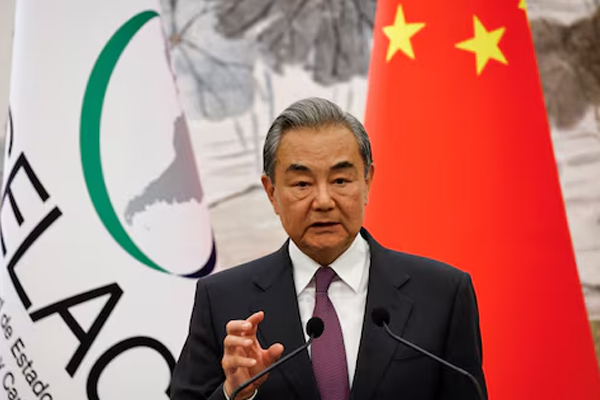
Conspiracy theorists may see a link in Air India’s decision suspending flights to Washington DC from Sept 1, to the recent downturn in the India-US relationship and the need to send a “subtle signal” to China, given Foreign Minister Wang Yi’s visit on Monday.
But the reality is more mundane: the suspension is primarily driven by the planned shortfall in Air India’s fleet as the airline commenced retrofitting 26 Boeing 787-8 aircraft last month, the company said in a statement. Incidentally, Air India is the only Indian airline flying to DC.
As for the downturn in India’s US relationship, it’s been evident ever since President Donald Trump’s jibes earlier this month about “dead economy” and the announcement of 25% tariff (now up by another 25%).
Trump’s claims of mediating between India and Pakistan in the wake of Operation Sindoor, a point repeated many times, was another disaster.
Even as that relationship nosedived, India and China have been exploring ways to end the impasse since the Galwan clashes in June 2020. In November last year, there was an agreement on disengagement of troops along the Line of Actual Control followed by resumption of patrolling in the Depsang Plains and Demchok.
External Affairs Minister S Jaishankar was in Beijing in July for the SCO foreign ministers meeting. So, clearly SCO will be on the agenda during Wang Yi’s three-day visit.
“It’s a good move,” said Jayadeva Ranade, head of the Centre for China Analysis & Strategy, a think tank, “Modi’s visit to the SCO was being discussed, not being decided. But after Trump’s tariffs, it’s a signal that India has options.”
Important to note that Wang Yi will be here in his capacity as special representative on the boundary issue. So NSA Ajit Doval will be the point person at this meeting.
Lt Gen S L Narasimhan (Retd), former head of the MEA think tank on China, CCCS (Centre for Contemporary Chinese Studies), told StratNewsGlobal that “On the boundary, there is unlikely to be any major development. There is likely to be focus on direct flights, border trade resumption and exchange of journalists.”
India has already told the airlines they would need to start flights at short notice, and visas are being issued to Chinese tourists.
“There is definitely a thaw,” echoed Jayadeva Ranade, head of the Centre for China Analysis & Strategy, a Delhi-based think tank, “but let’s be clear, China is under pressure and needs markets at a time when its economy is not doing well. India is a large market.”
“Our private sector wants access to China’s market but China has not been responding favourably and there is unlikely to be a major change in that stance,” Narasimhan said adding, “They would have noted Modi’s reference to Atmanirbharta during his Independence Day address and may not want to help that effort.”
India’s need for fertiliser is being accommodated, notes Gen Narasimhan, but he does not expect they will relent on export of rare earths to India. The ban will stay but batteries for electric vehicles are being allowed.
In that sense, apart from a few areas, a lot of this visit will be about optics, which suits both countries as they seek to balance the Trump Storm.
‘No First Use Doctrine Needs Revision’
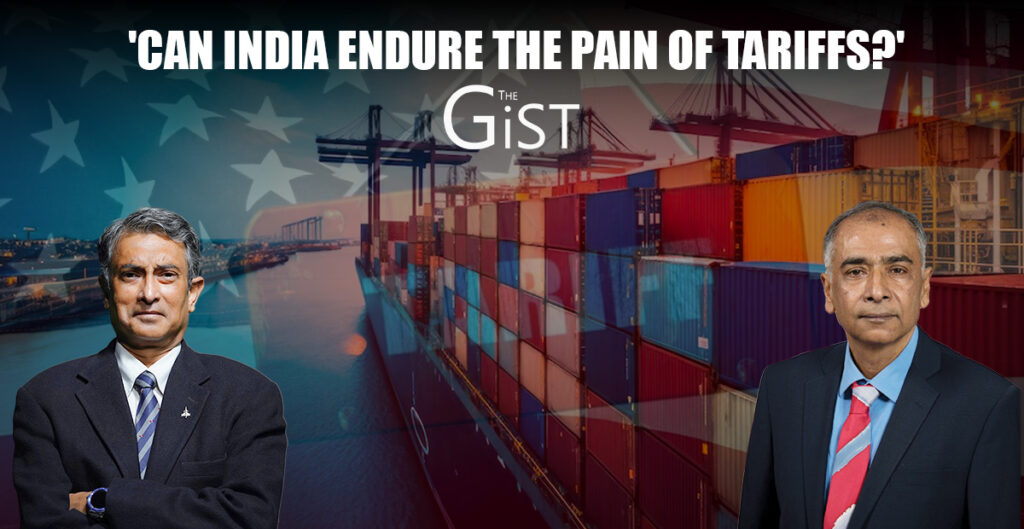
India faces a sobering question as Washington sharpens its trade weapons under President Trump: does New Delhi have the resilience to absorb the pain of tariffs? For Professor Amit Gupta, Senior Adviser at the Forum of Federations, the problem goes beyond trade. He argues that India must even rethink its national security posture, including the “obsolete” no-first-use nuclear doctrine. “Why keep saying after you hit us, we will hit you?” Gupta asks, suggesting that India adopt a more flexible stance to deter adversaries like Pakistan.
On the economic front, Gupta warns that New Delhi’s confidence in managing Trump was “misplaced” from the start. “Trump is not a friend of India,” he said, pointing out that while Israel receives blanket American backing, India would be told to “exercise restraint” in any crisis. The trade standoff is already fraught: agriculture is a key stumbling block, but Trump’s deeper frustration is that India offers far less than what he has extracted from Japan, Korea and the EU.
The real test, Gupta insists, is not retaliation but endurance. “The issue is not putting tariffs. The issue is, can you sustain pain? China has taken pain. Russia has taken pain. Lula in Brazil has taken pain. Are you willing to do that?”
That pain could be severe. Indian pharmaceuticals—vital to American consumers—could see costs spike. Worse, Trump might cut H-1B or student visas, hitting the 300,000 Indians in U.S. universities and straining India’s IT sector, already under pressure from AI-driven layoffs.
Strategically, India has left itself exposed by refusing to join the ASEAN-led RCEP pact and failing to deepen ties with Brazil, South Africa, or ASEAN markets. The oft-repeated notion of India as a vast consumer economy is also exaggerated: Mercedes sells only 8,000 cars a year in India compared to 700,000 in China.
Gupta’s prescription is blunt: diversify partnerships with Brazil, South Africa and the UAE, work with trusted defence suppliers like Russia and France, and even cautiously reopen economic doors to China. Above all, India must brace itself. Projecting strength requires the willingness to endure pain—on tariffs, on trade, and perhaps even in nuclear doctrine.
Israeli Military Plans To Relocate Gaza Residents South For Safety
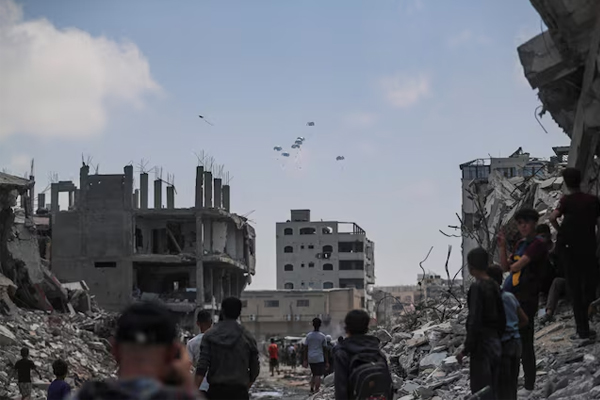
The Israeli military said Saturday it will begin providing tents and shelter supplies on Sunday to relocate Gaza residents from combat zones to the south of the enclave “to ensure their safety”.
This comes days after Israel said it intended to launch a new offensive to seize control of northern Gaza City, the enclave’s largest urban centre, in a plan that raised international alarm over the fate of the demolished strip, home to about 2.2 million people.
Hamas’ Last Stronghold
Israeli Prime Minister Benjamin Netanyahu last Sunday said that before launching the offensive, the civilian population will be evacuated to what he described as “safe zones” from Gaza City, which he called Hamas’ last stronghold.
The shelter equipment will be transferred via the Kerem Shalom crossing in southern Gaza by the United Nations and other international relief organisations after being inspected by defence ministry personnel, the military said.
A spokesperson for the United Nations Office for the Coordination of Humanitarian Affairs expressed concern over Israel’s plans to relocate people to southern Gaza, saying it would only increase suffering.
But the U.N. body welcomed Israel’s recognition that shelter is a desperate need and that tents and other shelter equipment will be allowed again into Gaza. “The UN and its partners will seize the opportunity this opens,” the spokesperson said.
The U.N. warned on Thursday that thousands of families already enduring appalling humanitarian conditions could be pushed over the edge if the Gaza City plan moves ahead.
Palestinian and United Nations officials have said no place in the enclave is safe, including areas in southern Gaza where Israel has been ordering residents to move to.
The military declined to comment when asked whether the shelter equipment was intended for Gaza City’s population, estimated at around one million people presently, and whether the site to which they will be relocated in southern Gaza would be the area of Rafah, which borders Egypt.
Israel’s Defence Minister Israel Katz said on Saturday that the plans for the new offensive were still being formulated.
The Palestinian militant faction Islamic Jihad, an ally of Hamas, said that the military’s announcement “as part of its brutal attack to occupy Gaza City is a blatant and brazen mockery of international conventions.”
However, Israeli forces have already increased operations on the outskirts of Gaza City over the past week. Residents in the neighbourhoods of Zeitoun and Shejaia have reported heavy Israeli aerial and tank fire.
Residents there have also reported explosions throughout the day, resulting from Israeli tank shelling against homes in the eastern parts of the neighbourhood.
The Israeli military on Friday said that it had begun a new operation in Zeitoun to locate explosives, destroy tunnels and kill militants in the area.
War Enters Day 681
The war began when Hamas attacked southern Israel on October 7, 2023, killing 1,200 people and taking 251 hostages, according to Israeli authorities, and 20 of the remaining 50 hostages in Gaza are still alive.
Israel’s subsequent military assault against Hamas has killed over 61,000 Palestinians, Gaza’s health ministry says. It has also caused a hunger crisis, internally displaced most of Gaza’s population and left much of the enclave in ruins.
Protests calling for a hostage release and an end to the war were expected throughout Israel on Sunday, with many businesses, municipalities and universities saying they will support employees striking for the day.
Negotiations to secure a U.S.-backed 60-day ceasefire and hostage release ended in deadlock last month, and mediators Egypt and Qatar have been trying to revive them.
(With inputs from Reuters)
Putin’s Ukraine Peace Terms Surface After Alaska Summit
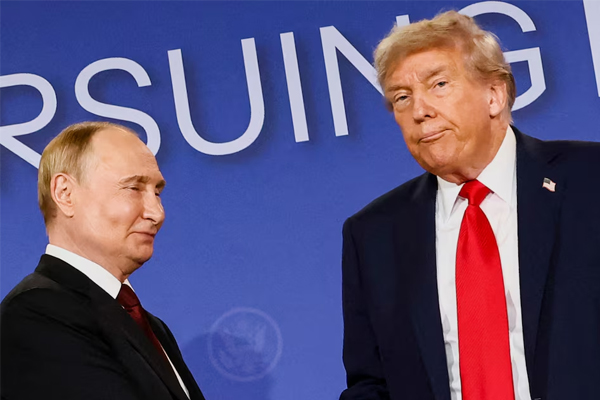
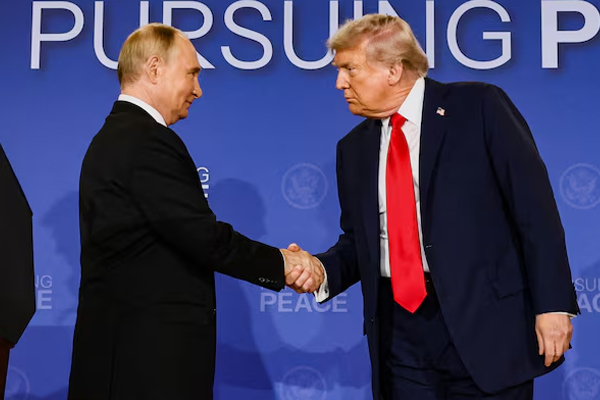
Russia would give up small areas of occupied Ukraine in exchange for Kyiv ceding large parts of its eastern territory, under proposals floated by Vladimir Putin during his Alaska summit with Donald Trump, according to sources briefed on Moscow’s thinking.
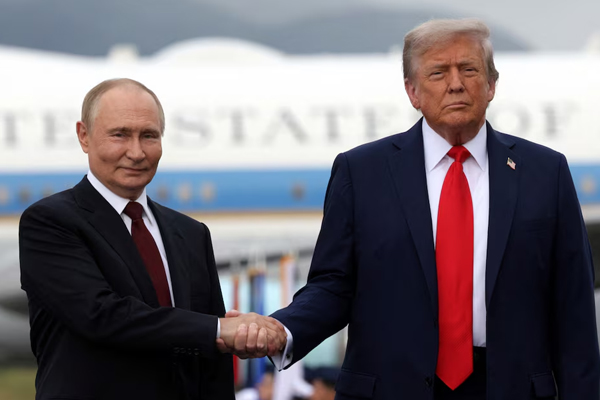
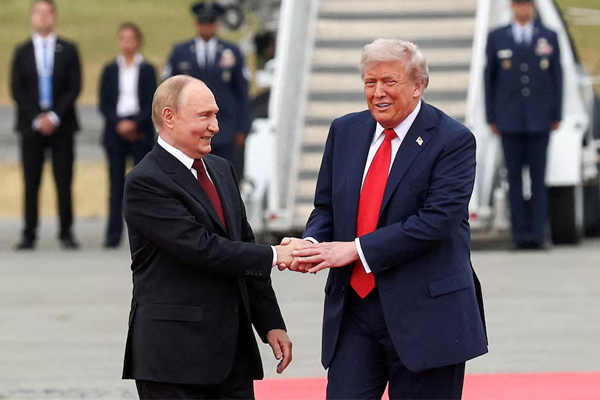
The account emerged the day after Trump and Putin met at an airforce base in Alaska, the first encounter between a U.S. president and the Kremlin chief since before the start of the Ukraine conflict.
Ukrainian President Volodymyr Zelenskyy is due to travel to Washington on Monday to discuss with Trump a possible settlement of the full-scale war, which Putin launched in February 2022.
Although the summit failed to secure the ceasefire he said he had wanted, Trump said in an interview with Fox News’ Sean Hannity that he and Putin had discussed land transfers and security guarantees for Ukraine and had “largely agreed”.
“I think we’re pretty close to a deal,” he said, adding, “Ukraine has to agree to it.” Maybe they’ll say ‘no’.”
The two sources, who requested anonymity to discuss sensitive matters, said their knowledge of Putin’s proposals was mostly based on discussions between leaders in Europe, the U.S. and Ukraine and noted it was not complete.
Trump briefed Zelenskyy and European leaders on his summit discussions early on Saturday.
It was not immediately clear if the proposals by Putin were an opening gambit to serve as a starting point for negotiations or more like a final offer that was not subject to discussion.
Ukrainian Land For Peace
At face value, at least some of the demands would present huge challenges for Ukraine’s leadership to accept.
Putin’s offer ruled out a ceasefire until a comprehensive deal is reached, blocking a key demand of Zelenskyy, whose country is hit daily by Russian drones and ballistic missiles.
Under the proposed Russian deal, Kyiv would fully withdraw from the eastern Donetsk and Luhansk regions in return for a Russian pledge to freeze the front lines in the southern regions of Kherson and Zaporizhzhia, the sources said.
Ukraine has already rejected any retreat from Ukrainian land, such as the Donetsk region, where its troops are dug in and which Kyiv says serves as a crucial defensive structure to prevent Russian attacks deeper into its territory.
Russia would be prepared to return comparatively small tracts of Ukrainian land it has occupied in the northern Sumy and northeastern Kharkiv regions, the sources said.
Russia holds pockets of the Sumy and Kharkiv regions that total around 440 square km, according to Ukraine’s Deep State battlefield mapping project. Ukraine controls around 6,600 square km of Donbas, which comprises the Donetsk and Luhansk regions and is claimed by Russia.
Although the Americans have not spelt this out, the sources said they knew Russia’s leader was also seeking – at the very least – formal recognition of Russian sovereignty over Crimea, which Moscow seized from Ukraine in 2014.
It was not clear if that meant recognition by the U.S. government or, for instance, all Western powers and Ukraine. Kyiv and its European allies reject formal recognition of Moscow’s rule in the peninsula.
They said Putin would also expect the lifting of at least some of the array of sanctions on Russia. However, they could not say if this applied to U.S. as well as European sanctions.
Trump said on Friday he did not immediately need to consider retaliatory tariffs on countries such as China for buying Russian oil – which is subject to a range of Western sanctions – but might have to “in two or three weeks”.
Ukraine would also be barred from joining the NATO military alliance, though Putin seemed to be open to Ukraine receiving some kind of security guarantees, the sources said.
However, they added that it was unclear what this meant in practice. European leaders said Trump had discussed security guarantees for Ukraine during their conversation on Saturday and also broached an idea for an “Article 5”-style guarantee outside the NATO military alliance.
NATO regards any attack launched on one of its 32 members as an attack on all under its Article 5 clause.
Joining the Atlantic alliance is a strategic objective for Kyiv that is enshrined in the country’s constitution.
Russia would also demand official status for the Russian language inside parts of, or across, Ukraine, as well as the right of the Russian Orthodox Church to operate freely, the sources said.
Ukraine’s security agency accuses the Moscow-linked church of abetting Russia’s war on Ukraine by spreading pro-Russian propaganda and housing spies, something denied by the church which says it has cut canonical ties with Moscow.
Ukraine has passed a law banning Russia-linked religious organisations, of which it considers the church to be one. However, it has not yet started enforcing the ban.
(With inputs from Reuters)
Trump Urges Ukraine To Cut Deal As Putin Presses For More Land
President Donald Trump on Saturday told Ukrainian leader Volodymyr Zelenskyy to strike a deal with Russia, warning that “Russia is a very big power, and they’re not,” after a summit where Vladimir Putin was reported to have pressed for more Ukrainian territory.
After the two leaders met in Alaska on Friday, Trump told Ukrainian President Volodymyr Zelenskyy that Putin had offered to freeze most front lines if Kyiv ceded all of Donetsk, the industrial region that is one of Moscow’s main targets, a source familiar with the matter said.
Zelenskyy rejected the demand, the source said. Russia already controls a fifth of Ukraine, including about three-quarters of Donetsk province, which it first entered in 2014.
Trump also said he agreed with Putin that a peace deal should be sought without the prior ceasefire that Ukraine and its European allies had demanded. That was a change from his position before the summit, when he said he would not be happy unless a ceasefire was agreed on.
“It was determined by all that the best way to end the horrific war between Russia and Ukraine is to go directly to a peace agreement, which would end the war, and not a mere ceasefire agreement, which oftentimes does not hold up,” Trump posted on Truth Social.
Zelenskiy said Russia’s unwillingness to pause the fighting would complicate efforts to forge a lasting peace. “Stopping the killing is a key element of stopping the war,” he said on X.
Nevertheless, Zelenskyy said he would meet Trump in Washington on Monday.
That will evoke memories of a meeting in the White House Oval Office in February, where Trump and Vice President JD Vance gave Zelenskiy a brutal public dressing-down. Trump said a three-way meeting with Putin and Zelenskiy could follow.
Kyiv’s European allies welcomed Trump’s efforts but vowed to back Ukraine and tighten sanctions on Russia. European leaders might join Monday’s White House meeting as well, German Foreign Minister Johann Wadephul said.
Russia launched a full-scale invasion of Ukraine in February 2022 and has been gradually advancing for months. The war – the deadliest in Europe for 80 years – has killed or wounded well over a million people from both sides, including thousands of mostly Ukrainian civilians, according to analysts.
Russia Likely To Welcome Trump’s Comments
Trump’s various comments on the three-hour meeting with Putin mostly aligned with the public positions of Moscow, which says a full settlement will be complex because positions are “diametrically opposed”.
Putin signalled no movement in Russia’s long-held demands, which also include a veto on Kyiv’s desired membership in the NATO alliance. He made no mention in public of meeting Zelenskyy. Kremlin aide Yuri Ushakov said a three-way summit had not been discussed.
In an interview with Fox News’ Sean Hannity, Trump signalled that he and Putin had discussed land transfers and security guarantees for Ukraine and had “largely agreed”.
“I think we’re pretty close to a deal,” he said, adding, “Ukraine has to agree to it.” Maybe they’ll say ‘no’.”
Asked what he would advise Zelenskiy to do, Trump said, “Gotta make a deal.”
“Look, Russia is a very big power, and they’re not,” he added.
Need For Security Guarantees For Ukraine
Zelenskyy has consistently said he cannot concede territory without changes to Ukraine’s constitution, and Kyiv sees Donetsk’s “fortress cities”, such as Sloviansk and Kramatorsk, as a bulwark against further Russian advances.
Zelenskyy has also insisted on security guarantees to deter Russia from invading again. He said he and Trump had discussed “positive signals” on the U.S. taking part and that Ukraine needed a lasting peace, not “just another pause” between Russian invasions.
Canadian Prime Minister Mark Carney welcomed what he described as Trump’s openness to providing security guarantees to Ukraine under a peace deal. He said security guarantees were “essential to any just and lasting peace”.
Putin, who has opposed involving foreign ground forces, said he agreed with Trump that Ukraine’s security must be “ensured”.
For Putin, just sitting down with Trump represented a victory. He had been ostracised by Western leaders since the start of the war and just a week earlier had faced a threat of new sanctions from Trump.
‘1-0 For Putin’
Trump spoke to European leaders after returning to Washington. Several stressed the need to keep pressure on Russia.
British Prime Minister Keir Starmer said an end to the war was closer than ever, thanks to Trump, but said he would impose more sanctions on Russia if the war continues.
European leaders said in a statement that Ukraine must have “ironclad” security guarantees and no limits should be placed on its armed forces or right to seek NATO membership, as Russia has sought.
Some European commentators were scathing about the summit.
“Putin got his red carpet treatment with Trump, while Trump got nothing,” Wolfgang Ischinger, former German ambassador to Washington, posted on X.
Both Russia and Ukraine carried out overnight air attacks, a daily occurrence, while fighting raged on the front.
Trump told Fox he would postpone imposing tariffs on China for buying Russian oil, but he might have to “think about it” in two or three weeks.
He ended his remarks after the summit by telling Putin, “We’ll speak to you very soon and probably see you again very soon.”
“Next time in Moscow,” a smiling Putin responded in English.
(With inputs from Reuters)
Ukrainians Decry Alaska Summit After Ceasefire Push Collapses
Ukrainians voiced anger Saturday after the Trump-Putin summit in Alaska ended without agreement on a truce, saying the spectacle of Donald Trump’s red-carpet welcome for Vladimir Putin deepened their sense of betrayal as the war grinds on.
Trump urged Ukraine to make a deal to end the war because “Russia is a very big power”.
Trump also said he agreed with Putin that the sides should focus on an overall peace settlement, not via a ceasefire, as Kyiv and its European allies have been demanding – until now with U.S. support.
“He (Putin) won. Trump showed his attitude towards him and, at the same time, towards us. “This meeting did not end well for Ukraine,” said a 26-year-old soldier who gave only his call sign, “Dzha”.
“… we need to end the war. We need to really sit down at the negotiating table and talk, come to an agreement, because every day fighters die and get injured.”
“Dzha” was serving as godfather at a baptism in a church in Zaporizhzhia, southeastern Ukraine, one of four regions Russia claims to have annexed, though it does not fully control them.
‘Bombs Will Keep Falling On Us’
“They (Putin and Trump) made some agreements for their states,” said Viktor Tkach, the chaplain conducting the baptism. “And here in Ukraine, in Zaporizhzhia, in the Zaporizhzhia region, we will keep suffering; glide bombs will keep falling on us.”
Some were outraged that Trump had invited Putin to the U.S. and treated him with such respect, as an equal.
Putin has been ostracised by Western leaders since launching the full-scale invasion of Ukraine in February 2022 and is wanted by the International Criminal Court, accused of the war crime of deporting hundreds of children from Ukraine, which he denies.
“Literally yesterday, a ballistic missile was launched at Sumy. And this animal (Putin) flies to Alaska where people applaud him, and the red carpet is rolled out in front of him,” said Hanna Kucherenko, a 25-year-old model, in Kyiv. “How is that even possible now?”
A manipulated image of Trump and Putin shaking hands on the airport tarmac against the backdrop of bombed residential apartment blocks in Ukraine circulated widely online.
“I do not know what Trump is even thinking about. I have an impression that he is just the same (as Putin),” said Kyiv pensioner Tetiana Vorobei. “They are identical.”
(With inputs from Reuters)
Putin Secures Ukraine Concessions But Falls Short Of Economic Goals
Russian President Vladimir Putin emerged from his Alaska summit with Donald Trump claiming major gains on Ukraine, including a U.S. shift away from backing a ceasefire, but left without the sweeping economic reset he had sought to ease the strain of war and sanctions.
Outside Russia, Putin was widely hailed as the victor of the Alaska summit, while at home, Russian state media cast the U.S. president as a prudent statesman, even as critics in the West accused him of being out of his depth.
Russian state media made much of the fact that Putin was afforded a military flyover, that Trump waited for him on the red carpet, and then let the Russian president ride with him in the back of the “Big Beast”, the U.S. presidential limousine.
“Western media are in a state that could be described as derangement verging on complete insanity,” said Maria Zakharova, Russia’s foreign minister spokeswoman.
“For three years, they talked about Russia’s isolation, and today they saw the red carpet rolled out to welcome the Russian president to the United States,” she said.
But Putin’s biggest summit wins related to the war in Ukraine, where he appears to have persuaded Trump, at least in part, to embrace Russia’s vision of how a deal should be done.
Trump had gone into the meeting saying he wanted a quick ceasefire and had threatened Putin and Russia’s biggest buyer of its crude oil – China – with sanctions.
Afterwards, Trump said he had agreed with Putin that negotiators should go straight to a peace settlement and not via a ceasefire as Ukraine and its European allies had been demanding – previously with U.S. support.
“The U.S. president’s position has changed after talks with Putin, and now the discussion will focus not on a truce but on the end of the war. And a new world order. Just as Moscow wanted,” Olga Skabeyeva, one of Russian state TV’s most prominent talkshow hosts, said on Telegram.
Russia launched its full-scale invasion of Ukraine in February 2022, saying Kyiv’s embrace of the West had become a threat to its security, something Ukraine has dismissed as a false pretext for what it calls a colonial-style land grab.
The war – the deadliest in Europe for 80 years – has killed or wounded well over a million people from both sides, including thousands of mostly Ukrainian civilians, according to analysts.
No Economic Reset
The fact that the summit even took place was a win for Putin before it even started, given how it brought him in from the diplomatic cold with such pomp.
Putin is wanted by the International Criminal Court, accused of the war crime of deporting hundreds of children from Ukraine.
Russia denies any wrongdoing, saying it acted to remove unaccompanied children from a conflict zone. Neither Russia nor the United States are members of the court.
Dmitry Medvedev, Russia’s former president and a close Putin ally, said the summit had achieved a major breakthrough when it came to restoring U.S.-Russia relations, which Putin had lamented were at their lowest level since the Cold War.
“The mechanism for high-level meetings between Russia and the United States has been restored in its entirety,” he said.
But Putin did not get everything he wanted and it’s unclear how durable his gains will be.
For one, Trump did not hand him the economic reset he wanted – something that would boost the Russian president at a time when his economy is showing signs of strain after more than three years of war and increasingly tough Western sanctions.
Yuri Ushakov, Putin’s foreign policy aide, said before the summit that the talks would touch on trade and economic issues.
Putin had brought his finance minister and the head of Russia’s sovereign wealth fund all the way to Alaska with a view to discussing potential deals on the Arctic, energy, space and the technology sector.
In the end, though, they didn’t get a look in. Trump told reporters on Air Force One before the summit started that there would be no business done until the war in Ukraine was settled.
It’s also unclear how long the sanctions reprieve that Putin won will last.
Trump said it would probably be two or three weeks before he would need to return to the question of thinking about imposing secondary sanctions on China to hurt financing for Moscow’s war machine.
Nor did Trump – judging by information that has so far been made public – do what some Ukrainian and European politicians had feared the most and sell Kyiv out by doing a deal over the head of Ukrainian President Volodymyr Zelenskyy.
Trump made clear that it was up to Zelenskyy as to whether he would agree – or not – with ideas of land swaps and other elements for a peace settlement that the U.S. president had discussed with Putin in Alaska.
Although, as Trump’s bruising Oval Office encounter with Zelenskyy showed earlier this year, if Trump thinks the Ukrainian leader is not engaging constructively, he can quickly turn on him.
Indeed, Trump was quick to start piling pressure on Zelenskyy, who is expected in Washington on Monday, saying after the summit that Ukraine had to make a deal because “Russia is a very big power, and they’re not.”
“The main point is that both sides have directly placed responsibility on Kyiv and Europe for achieving future results in the negotiations,” said Medvedev, who added that the summit showed it was possible to negotiate and fight at the same time.
Donbas Demand
While deliberations continue, Russian forces are slowly but steadily advancing on the battlefield and threatening a series of Ukrainian towns and cities whose fall could speed up Moscow’s quest to take complete control of the eastern region of Donetsk, one of four Ukrainian regions Russia claims as its own.
Donetsk, some 25% of which remains beyond Russia’s control, and the Luhansk region together make up the industrial Donbas region, which Putin has made clear he wants in its entirety.
Putin told Trump he’d be ready to freeze the front lines in Zaporizhzhia and Kherson, two of the other regions he claims, if Kyiv agreed to withdraw from both Donetsk and Luhansk, a person familiar with the matter told Reuters.
Zelenskyy rejected the demand, the source said.
According to The New York Times, Trump told European leaders that Ukrainian recognition of Donbas as Russian would help get a deal done. And the U.S. is ready to be part of security guarantees for Ukraine, German Chancellor Friedrich Merz said.
Some Kremlin critics said it would be a mistake to credit Putin with too much success at this stage.
“Russia has re-established its status and got dialogue with the U.S.,” said Michel Duclos, a French diplomat who formerly served in Moscow and who is an analyst at the Institut Montaigne think tank. “But when you have a war on your hands and your economy is collapsing, these are limited gains.”
Russian officials deny the economy, which has been put on a war footing and has proved more resilient than the West forecast despite heavy sanctions, is collapsing. But they have acknowledged signs of overheating and have said the economy could enter recession next year unless policies are adjusted.
“For Putin, economic problems are secondary to his goals, but he understands our vulnerability and the costs involved,” said one source familiar with Kremlin thinking.
“Both sides will have to make concessions. The question is to what extent?. The alternative, if we want to defeat them militarily, is to mobilise resources more deeply and use them more skilfully, but we are not going down that road for various reasons,” the person said.
“It will be Trump’s job to pressure Ukraine to recognise the agreements.”
(With inputs from Reuters)
Central Asia Finally Gets Its Act Together
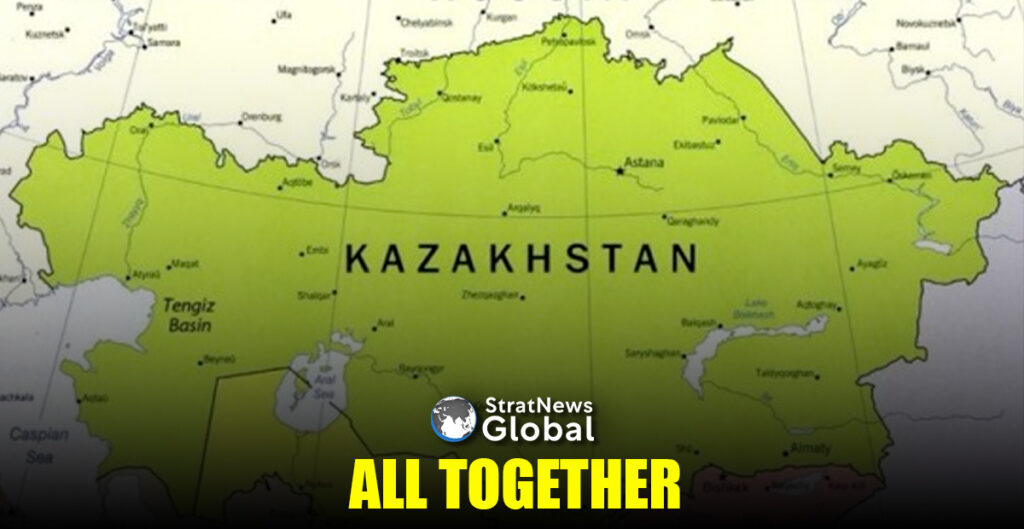
The steady but deliberate knitting together of Central Asia’s five former Soviet republics into a more cohesive political, economic, and cultural bloc marks the region’s most consequential political shift in decades
The region is moving from ad-hoc cooperation toward more permanent, multi-layered institutions that connect presidents, ministers, parliaments, and civil societies, giving Central Asia a louder and more unified voice in global affairs, writes Svante E. Cornell in an August 11, 2025, analysis for the Central Asia–Caucasus Institute.
This is being driven by yearly presidential consultative meetings, growing ministerial engagement, expanding parliamentary forums, and targeted bilateral and trilateral partnerships, says the report, titled Layers of Cooperation: The Gradual Institutionalization of Central Asian Cooperation.
Early attempts in the 1990s, such as the Central Asian Union, faltered under geopolitical pressure and clashing national priorities. Now, with more mature statehood, stronger sovereignty, and a geopolitical climate that encourages unity rather than division, the process is accelerating.
Kazakhstan and Uzbekistan form the “inner core” of this effort, playing a role similar to the Franco-German axis in Europe. They are joined by trilateral groupings like Kyrgyzstan–Tajikistan–Uzbekistan in the Ferghana Valley, and Azerbaijan–Kazakhstan–Uzbekistan across the Caspian.
Cornell notes that identity underpins the shift. Religious ties, Eurasianism, or purely linguistic bonds have all failed to unite the region. Instead, a slow rediscovery of shared history, inclusive civic nationalism, and visible acts of solidarity is taking root.
Leaders like Uzbekistan’s late Islam Karimov and Kazakhstan’s Kassym-Jomart Tokayev have framed cultural luminaries and heritage as common assets, helping soften divisions despite unresolved disputes. International recognition of a Central Asian identity has grown through the C5+ formats, starting with Japan in 2004, followed by the EU, the United States, and later Russia and China. These mechanisms force great powers to engage the region collectively rather than bilaterally, subtly shifting the balance in Central Asia’s favour.
By 2023, U.S. President Joe Biden hosted all five leaders in New York; in 2025, the EU held its first top-level summit with the bloc.
Purely intra-Central Asian meetings have also been revived since 2018, producing cooperation roadmaps and industrial action plans. The 2023 creation of a Council of National Coordinators could be the embryo of a formal regional structure. The 2024 “Central Asia 2040” vision broadened cooperation to include parliaments, ministries, businesses, civil society, and think tanks.
Parliamentary forums in Kazakhstan and Uzbekistan have begun exploring legislative harmonisation and oversight for regional agreements. At the bilateral level, Kazakhstan and Uzbekistan signed a Treaty on Allied Relations in 2021, created a Supreme Interstate Council, and launched a 2024–2034 strategic program. This aims to raise trade to $10 billion while coordinating foreign policy positions in multilateral bodies—a model Cornell suggests could be scaled to the whole region.
The Ferghana Valley trilateral has turned a once-volatile hotspot into a case study in conflict resolution. Years of border demarcation work culminated in the 2025 Khujand Declaration, following agreements that eased restrictions and resolved disputes, including sensitive exclave issues. To the west, Kazakhstan, Uzbekistan, and Azerbaijan have built a trilateral partnership focused on a “green energy corridor” and integrated electricity markets.
Such projects show that Greater Central Asia’s middle powers can pool influence to shape infrastructure and trade flows, potentially reducing dependence on external powers.
But challenges remain. Security threats from great power rivalries, violent extremism, and narcotics trafficking persist, with Afghanistan still a key variable. Environmental pressures—especially over water management—are urgent despite progress on joint hydropower and energy projects.
Cornell warns that without stronger institutions, summit pledges risk stalling, particularly once the easiest agreements are implemented. Differences in enthusiasm could slow progress: Astana and Tashkent lead, Bishkek joins readily, while Ashgabat and Dushanbe prefer caution. Yet turbulence among neighbouring powers gives Central Asia a rare chance to lock in cooperation frameworks that can support security, sustainable growth, and environmental management.
Unlike many parts of the world now splintering, Central Asia is weaving together multiple layers of cooperation—and the moment to turn momentum into lasting institutions is now, Cornell concludes.
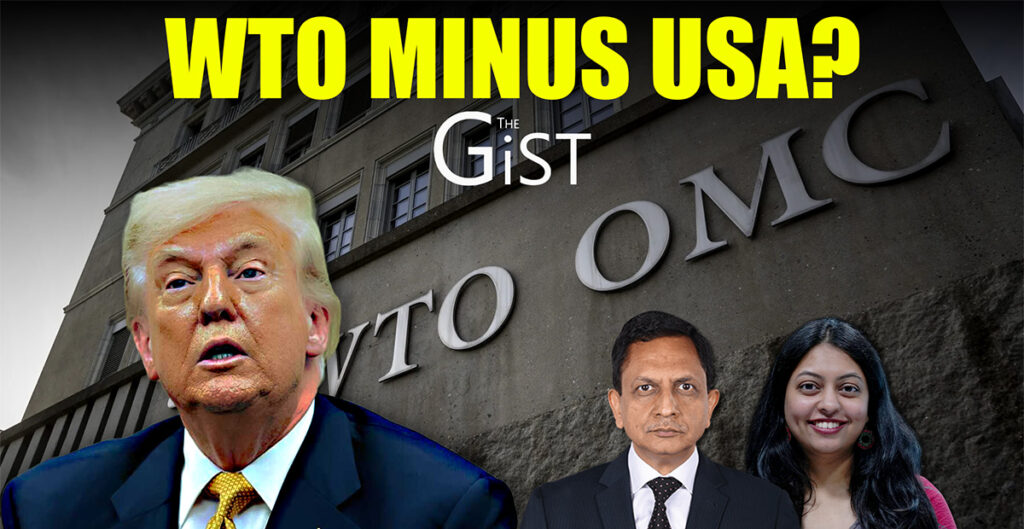
‘WTO May Have to Function Without U.S.’
The escalating trade tensions triggered by U.S. President Donald Trump’s tariff regime have left the global trading system reeling, with questions now being raised over whether the World Trade Organisation (WTO) can continue to function with Washington in open defiance of its rules.
Shishir Priyadarshi, former WTO Director and now President of the Chintan Research Foundation, said the tariffs, in place since April 2, have disproportionately hurt U.S. consumers, despite Trump’s repeated claims that “billions of dollars will flow in” from other countries.
Illustrating the impact, Priyadarshi noted with an example that an Indian shirt priced at $10, once subject to a 10% tariff, would sell for $11 in the U.S. compared to a Guatemalan shirt priced at $13.20. But under a 50% tariff on Indian goods, the Indian shirt would shoot up to $15, making the Guatemalan product more competitive. “In effect, it is the U.S. consumer who pays more,” he said.
The stakes for India are serious. A 50% tariff, Priyadarshi warned, could shave off 1% of GDP and lead to widespread job losses in export-oriented industries. He urged Indian industry to become more competitive and resilient, while also calling for broader economic reforms to weather the storm.
But the crisis extends beyond India. The former WTO official admitted the global trade body is under “extraordinary pressure,” describing it as “in the ICU” due to U.S. tariffs. Two options are now being debated: waiting out the Trump presidency in hopes of a reset, or forming a “WTO without the U.S.” where members continue to trade under agreed rules while dealing with Washington separately.
“Could you have a World Trade Organisation which doesn’t have the biggest trading nation in the world? That is hard to imagine,” Priyadarshi cautioned.
Even so, he said the turmoil could present an opportunity for overdue reforms in the WTO, offering the chance to reimagine a fairer, more resilient trading system.
Oil Prices Steady After Trump-Putin Talks In Alaska
Oil prices are expected to show a muted reaction when markets open on Sunday, following the Trump-Putin meeting in Alaska, where US President Donald Trump said the goal was a full peace deal for Ukraine, not just a ceasefire.
Trump said he had agreed with Putin that negotiators should go straight to a peace settlement – not via a ceasefire, as Ukraine and European allies, until now with US support, have been demanding.
Trump said he would hold off imposing tariffs on countries such as China for buying Russian oil following his talks with Putin. He has previously threatened sanctions on Moscow and secondary sanctions on countries such as China and India that buy Russian oil if no moves are made to end the Ukraine war.
Small Dip Expected
“This will mean Russian oil will continue to flow undisturbed and this should be bearish for oil prices,” said ICIS analyst Ajay Parmar. “It is worth noting that we think the impact of this will be minimal though and prices will likely see only a small dip in the very near term as a result of this news.”
The oil market will wait for developments from a meeting in Washington on Monday between Trump and Ukrainian President Volodymyr Zelenskiy. European leaders have also been invited to the meeting, a source familiar with the matter told Reuters.
“Market participants will track comments from European leaders but for now Russian supply disruption risks will remain contained,” said Giovanni Staunovo, analyst at UBS.
Brent settled at $65.85 a barrel on Friday, and US West Texas Intermediate at $62.80 – both down nearly $1 before the talks in Alaska.
Waiting For A Deal
Traders are waiting for a deal, so until that emerges, crude prices are likely to be stuck in a narrow range, said Phil Flynn, a senior analyst with Price Futures Group.
“What we do know is that the threat of immediate sanctions on Russia, or secondary sanctions on other countries is put on hold for now, which would be bearish,” he said.
After the imposition of Western sanctions, including a seaborne oil embargo and price caps on Russian oil, Russia has redirected flows to China and India.
(With inputs from Reuters)