

Support us by contributing to StratNewsGlobal on the following UPI ID
ultramodern@hdfcbank

Strategic affairs is our game, South Asia and beyond our playground. Put together by an experienced team led by Nitin A. Gokhale. Our focus is on strategic affairs, foreign policy and international relations, with higher quality reportage, analysis and commentary with new tie-ups across the South Asian region.
You can support our endeavours. Visit us at www.stratnewsglobal.com and follow us on YouTube, Twitter, Facebook and Instagram.
र 500 per month
र 1000 per month
र 5000 per year
र 10000 per year
Donate an amount of your choice
र 500 per month
Donate र 500 per month

र 1000 per month
Donate र 1000 per month
र 5000 per year
Donate र 5,000 per year
र 10000 per year
Donate र 10,000 per year
Donate an amount of your choice
Donate an amount of your choice







Australia: Dead Bondi Beach Shooter Originally From Hyderabad
Australia’s Bondi Beach shooter has an Indian connection: the elder of the two shooters Sajid Akram was originally from Hyderabad and left to study in Australia in 1998. That’s according to media reports quoting his relatives in the city.
Sajid apparently was not in close touch with his family and had cut off relations over a family dispute. He was in Hyderabad in 2022 and still held an Indian passport although his son Naveed, the other shooter who is undergoing treatment in a Sydney hospital, and a daughter are Australian citizens.
Police said there was nothing to indicate any ideological connection between Sajid’s alleged radicalisation and India.
But the Philippine immigration authorities have confirmed that Sajid and Navid entered the country on Nov 1 this year, leaving on Nov 28. They reportedly declared Davao in the southern Philippines as their final destination.
Davao on the island of Mindanao is an impoverished region where Islamic groups have historically operated. The Abu Sayyaf group, for example, had claimed allegiance to the Islamic State and currently fields around 100 armed fighters. It wants to establish an Islamic state and impose sharia law.
The Philippine authorities were unable to confirm if Sajid and Navid had any military training during their Davao visit. So the purpose of their visit to the Philippines continues to be a subject of investigation.
Manila to Protest China’s “Aggressive Acts” After South China Sea Clash
The Philippines said on Monday it will formally protest what it described as the Chinese coast guard’s “harassment and endangerment” of Filipino fishermen near Sabina Shoal, following a violent encounter that left three injured and damaged two fishing boats.
Fishermen Injured in Water Cannon Attack
According to the Philippine coast guard, Chinese vessels fired water cannons and cut the anchor lines of Filipino fishing boats operating within the country’s exclusive economic zone (EEZ) on Friday. The incident occurred near Sabina Shoal also known as Escoda Shoal to Manila and Xianbin Reef to Beijing about 150 kilometres west of Palawan province.
Manila expressed alarm over the use of force, calling the Chinese coast guard’s actions unjustifiable. “The use of water cannons and dangerous manoeuvres that cause injury and damage cannot be justified,” the Philippines’ maritime council said in a statement.
The council confirmed that the government would file a formal diplomatic protest, or demarche, to the Chinese embassy in Manila on Monday. “The Philippines will undertake the appropriate diplomatic response and register its strong objection to these actions,” it said, urging China to immediately halt such “aggressive acts.”
Beijing Blames Manila for “Provocation”
China’s foreign ministry disputed Manila’s account, accusing the Philippines of sending a “large number of ships” to Sabina Shoal to “create trouble.” Spokesperson Guo Jiakun claimed Filipino vessels ignored repeated warnings and “took dangerous actions,” even “brandishing knives to threaten Chinese coast guard officers.”
On Friday, China’s coast guard said it had “driven away multiple Philippine vessels and taken control measures.” Manila dismissed that statement as “deeply troubling,” accusing Beijing of escalating tensions in the South China Sea.
“We call on the CCG to act responsibly, adhere to international maritime conduct, and prioritise the preservation of life at sea over actions that sow fear and endanger civilians,” the Philippine maritime council said.
U.S. Backs Manila, China Warns Washington
The United States, a treaty ally of the Philippines, condemned China’s actions. “We stand with our Philippine allies as they confront China’s provocative actions and increasingly dangerous tactics against its neighbours,” said U.S. State Department deputy spokesperson Tommy Pigott, adding that such behaviour undermines regional stability.
China responded by warning Washington not to “interfere in maritime matters” or “incite confrontation,” reiterating its claim to sovereignty over almost the entire South China Sea—a waterway that handles more than $3 trillion in annual trade.
Long-Standing Dispute
Sabina Shoal lies within the Philippines’ EEZ, an area validated by a 2016 international arbitral tribunal ruling that rejected Beijing’s sweeping territorial claims as having no basis under international law. China, however, continues to disregard the verdict.
The latest confrontation adds to a series of escalating maritime incidents between the two countries and underscores growing tensions in one of the world’s most contested waters.
(with inputs from Reuters)
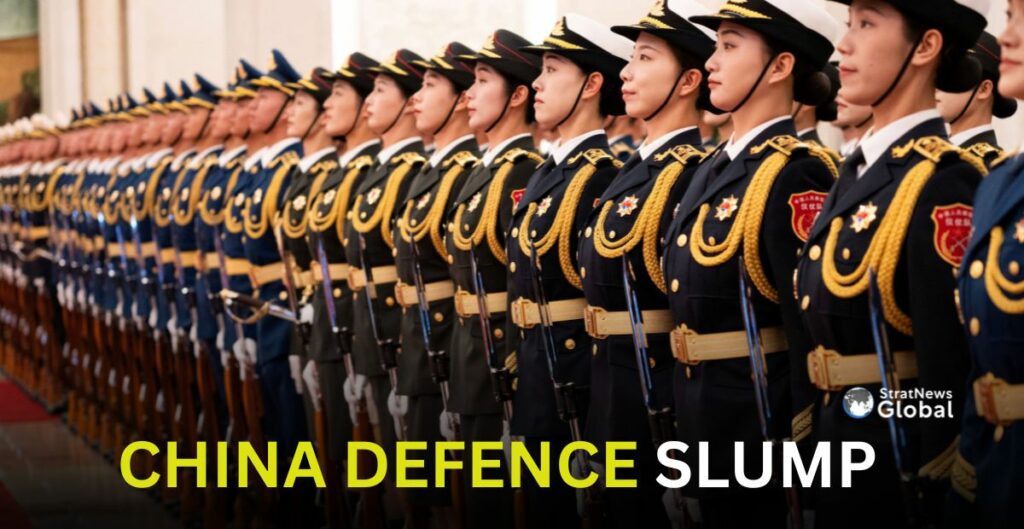
China: Graft Probes Trigger Steep $88 Bn Fall In Arms Revenues
China’s leading defense companies saw revenues decline in 2024, standing in sharp contrast to robust global growth in the arms industry, according to the Stockholm International Peace Research Institute (SIPRI).
The downturn underscores how political turmoil and corruption investigations have disrupted China’s state-owned defense sector despite rising worldwide demand for weapons.
Globally, sales by the 100 largest arms-producing companies rose by nearly 6% in 2024 to about $679 billion. SIPRI attributed the increase to the wars in Ukraine and the Middle East, intensifying geopolitical tensions and higher military spending.
Defense firms across the Indo-Pacific benefited from these trends, with revenues surging roughly 40% in Japan, 31% in South Korea and 8% in India. In the United States, 39 companies in the top 100 recorded a combined revenue increase of 3.8% to $334 billion. Indonesia also entered the ranking for the first time, as state-owned Defend ID posted a strong rise in sales.
The eight Chinese companies included in SIPRI’s top 100 reported a combined revenue decline of around 10%, totaling $88.3 billion. Some of the country’s largest defense manufacturers were particularly affected. Norinco, China’s primary producer of land-based weapons, saw revenue fall by more than 30%.
Sales also dropped at Aviation Industry Corporation of China (AVIC), the nation’s largest arms maker, and at China Aerospace Science and Technology Corporation (CASC), a key supplier of missile and aerospace systems.
SIPRI linked the slump to corruption probes and leadership changes that disrupted arms procurement and slowed project approvals. Investigations into defense contracting led to reviews, delays and the postponement or cancellation of major orders, creating uncertainty across the industry.
The problems facing China’s arms firms mirror a broader political crackdown under President Xi Jinping, who has intensified efforts to root out corruption within the Communist Party and the People’s Liberation Army.
Analysts warn that ongoing disruptions could hinder China’s military modernization plans as it seeks to field advanced capabilities by the PLA’s centenary in 2027.
EU Eases Car Emissions Ban Amid Industry Pressure
The European Commission is preparing to soften the EU’s 2035 ban on new combustion-engine cars, permitting certain non-electric vehicles to remain on sale after facing strong opposition from Germany, Italy, and the wider European automotive industry.
The EU executive appears to have yielded to the call from carmakers to be allowed to keep selling plug-in hybrids and range extenders that burn CO2-neutral biofuel or synthetic fuel as they struggle to compete against Tesla and Chinese electric vehicles.
Under current EU rules, all new cars from 2035 must have zero emissions. But under Tuesday’s proposal, the reduction of CO2 emissions will be reduced by 90% from 2021 levels, instead of 100%.
Manfred Weber – the German president of the EPP, the largest group in the European Parliament – said his understanding was that the 90% level had been agreed upon by the Commission and that the scaled-back reduction still represented progress.
Eu Climate Climb-Down As Ford Kills EVs
The move, which will need approval from EU governments and the European Parliament, would be the EU’s most significant climb-down from its green policies of the past five years.
It comes as U.S. carmaker Ford Motor announced on Monday it would take a $19.5 billion writedown and is killing several electric-vehicle models, in response to the Trump administration’s policies and weakening EV demand.
Eu Lagging China In EV Race
The electric vehicle industry warned that easing EU emissions targets will undermine investment and give China an edge in the EV transition.
The Commission will outline plans to increase EVs in corporate fleets, which make up about 60% of new car sales. Measures may include local content requirements, though the industry prefers incentives over mandates.
It is also expected to propose a new category for small EVs with lower taxes and extra CO2 credits, alongside credits for sustainable production such as using low-carbon steel.
(With inputs from Reuters)
Meta’s $3 Billion Fraud Problem: How Chinese Advertisers Exploited Facebook and Instagram
Meta Platforms has faced mounting scrutiny after internal documents revealed that Chinese advertisers defrauded millions of Facebook, Instagram and WhatsApp users worldwide, even as the company continued to profit from the activity.
$3 Billion in Fraudulent Ads Linked to China
Despite Beijing banning Meta’s platforms domestically, Chinese companies freely advertise to foreign users a lucrative business that generated over $18 billion in revenue for Meta in 2024, accounting for more than 10% of its global income. According to internal documents reviewed by Reuters, around 19% of that revenue roughly $3 billion came from scam ads, illegal gambling, pornography and other prohibited content.
The cache of documents, produced by Meta’s finance, lobbying, engineering and safety divisions, shows executives long understood the scale of abuse and the tension between cleaning up harmful content and protecting profits. Meta’s data indicated that China was responsible for nearly a quarter of all scam or banned ads globally, affecting victims from Taiwan to North America.
“We need to make significant investment to reduce growing harm,” staff warned in an April 2024 presentation. Meta formed a special anti-fraud task force, cutting illicit ads from China by half within six months until CEO Mark Zuckerberg reportedly intervened.
Following what documents described as an “Integrity Strategy pivot,” the team’s work was paused, the task force disbanded and restrictions on new Chinese ad agencies lifted. Within months, fraudulent ads surged again, reaching 16% of Meta’s China ad revenue by mid-2025.
Business Over Integrity
An outside consultancy, Propellerfish, warned Meta that its own policies fostered “systemic corruption” in the Chinese ad market. The report found that Meta’s partner system involving 11 top-tier Chinese ad resellers had created an opaque web of intermediaries that enabled scammers to evade detection.
Internal reports also revealed that Meta’s “whitelisting” process allowed suspect ads from major Chinese partners to remain online pending human review, often for days. “The added time for secondary review is adequate for scammers to accomplish their objectives,” one internal memo noted.
Even after identifying top Chinese advertisers repeatedly breaking its rules including Beijing Tengze Technology Co Ltd Meta continued doing business with them, imposing higher fees rather than termination. Staff later noted that halting such accounts would hurt revenue, with one remarking that enforcement must consider “the revenue impact.”
Meta’s Response and Fallout
Meta spokesperson Andy Stone told Reuters that the China-focused anti-fraud team was always intended as a temporary measure and denied that Zuckerberg ordered its shutdown. He said Meta has removed 46 million Chinese ads and penalised partners who ran too many violations.
“Scams are spiking across the internet,” Stone said, citing sophisticated criminal syndicates. “We are focused on rooting them out globally.”
However, the documents suggest Meta has tolerated persistent misconduct from Chinese advertisers, which internal teams dubbed the “Scam Exporting Nation.” Analysts noted that during China’s national holidays, global scam activity on Meta’s platforms noticeably declines evidence of how central China has become to the fraud ecosystem.
Federal prosecutors in the United States have already tied Chinese-linked ad campaigns to major financial crimes, including a $214 million stock fraud case. Lawmakers in Washington have urged regulators to investigate Meta’s handling of scam advertising, warning of potential consumer and investor harm.
Despite intermittent crackdowns, internal records from early 2025 show Meta ultimately chose to “maintain the percentage of global harm” caused by Chinese advertisers rather than eliminate it effectively accepting a base level of fraud as the cost of doing business.
(with inputs from Reuters)
Taiwan Says Military Can React Instantly to Any Sudden Chinese Attack
Taiwan’s military can swiftly respond to any sudden assault from China under a decentralised command system that allows individual units to act without waiting for top-level approval, the island’s defence ministry said in a report submitted to lawmakers.
Decentralised Command for Rapid Response
The ministry said Taiwan’s armed forces are prepared to shift immediately from regular alert status to combat readiness if Chinese drills suddenly turn into live military operations. “If the enemy suddenly launches an attack, all units are to implement ‘distributed control’ without waiting for orders and, under a ‘decentralised’ mode of command, carry out their combat missions,” the report stated.
Officials did not elaborate on operational specifics but said the mechanism ensures that field units can maintain communication, coordination and continuity of command even if higher-level systems are disrupted during an assault.
The move reflects growing concerns in Taipei that Beijing could exploit the island’s constant vigilance by converting routine military exercises into real attacks without warning.
Escalating Chinese Military Pressure
Beijing, which claims Taiwan as part of its territory, has increased military pressure over the past year through near-daily flights and naval manoeuvres around the island. Taiwan’s defence ministry described these operations as part of a “grey zone” campaign sustained military harassment designed to exhaust Taiwan’s forces and morale without triggering open conflict.
According to the report, the frequency and intensity of China’s “joint combat readiness patrols” continue to rise. The ministry warned that China’s forces have expanded their reach, sending warships deeper into the Pacific and towards Australia and New Zealand as part of joint service drills increasingly focused on real-combat conditions.
“The Chinese communists have never renounced the use of force to annex Taiwan,” the ministry said, adding that the People’s Liberation Army (PLA) has evolved its exercises from symbolic demonstrations to integrated, multi-domain operations.
Beijing Accuses Taipei of “Peddling War Anxiety”
China’s defence ministry dismissed the concerns, accusing Taiwan’s President Lai Ching-te of “hyping up” the threat from the mainland and “peddling war anxiety.” In a statement, Beijing urged “Taiwan compatriots to clearly recognise the extreme danger and harmfulness of the Lai authorities’ frantic ‘preparing for war to seek independence’.”
Taiwan’s government, however, maintains that only its citizens have the right to determine the island’s future, rejecting Beijing’s sovereignty claims. Defence Minister Wellington Koo is scheduled to brief lawmakers further on the report on Wednesday.
As both sides continue their rhetorical and military escalation, Taiwan’s emphasis on decentralised readiness signals an attempt to ensure it can respond instantly even if caught off guard by a sudden shift from drill to war.
(with inputs from Reuters)
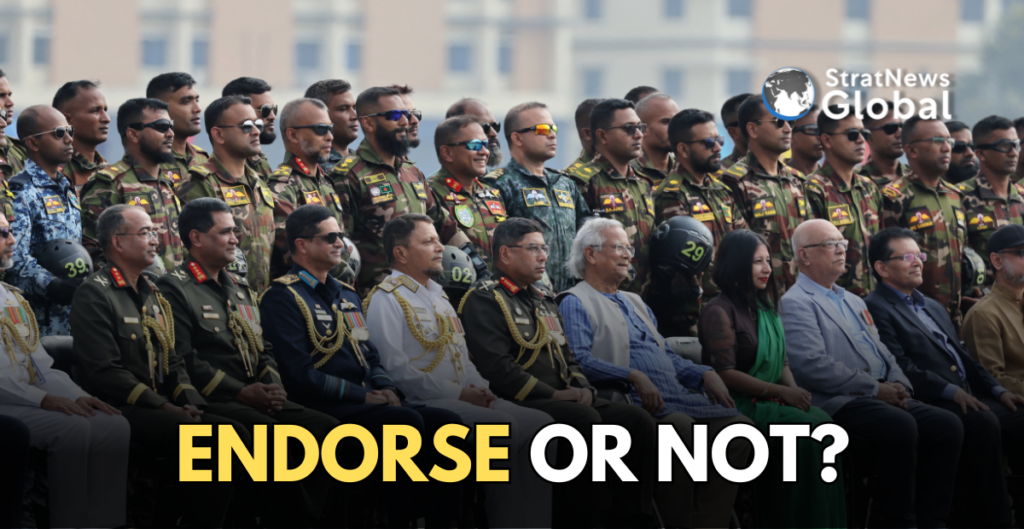
What If India Does Not Endorse Bangladesh’s Election Result?
Should India endorse whatever the result of the elections in Bangladesh next February?
Veena Sikri, former high commissioner to Bangladesh, believes that “India must insist on inclusion of all parties because if there is no transparency, there will be continuing instability, continuing chaos, continuing exodus, as we saw in 1971.”
Sikri was referring to how the Awami League was not being allowed to contest, in effect removing a key political player from the hustings. She was speaking at a dialogue on Bangladesh organised by the ORF.
Another speaker, senior journalist Kanchan Gupta, warned of the possibility of rigging, noting strong support from the US and Europe for Interim Adviser Mohammad Yunus. He said there seemed little doubt of the role of the American establishment in the regime change that led to Hasina’s ouster. He noted continued support for Yunus despite crimes against minorities.
Both Sikri and Gupta felt that Bangladesh was moving into a situation similar to that in 1971, when, despite Mujibur Rahman winning the election in East Pakistan, the result was denied by the army ruling in the West.
Journalist and author Deep Halder struck a note of caution, pointing out that although the BNP is the single largest party in the election, the rise of the Jamaat-e-Islami cannot be ignored. In his view, young people remain vehemently anti-Hasina, but there may come a time when civil society does a rethink, that the Hasina years were better than what came after.
Halder says it is too early to tell whether the next PM will be a BNP leader, a Jamaat leader, or a BNP leader who is actually a Jamaat guy. Everything points to a Jamaat element in the upcoming elections.
As for India, whether it endorses the elections in Bangladesh or not, New Delhi would have to find a way to engage with the next government in Dhaka.
Myanmar: Junta Uses Human-Wave, Drones To Fight Rebels
For seven days, rebel fighter Khant and his comrades held the line as Myanmar junta pounded their positions with artillery and drone strikes.
Khant is a veteran of numerous battles against Myanmar’s junta since it seized power in a 2021 coup, but he had seen nothing like the intensity of the fighting in central Myanmar in October.
The strikes were followed by wave after wave of infantry, according to Khant and Htike, a fellow rebel who was also present at the battle for Pazun Myaung, a village roughly halfway between Myanmar’s largest city and its political capital.
“It was essentially an offensive using all the power they could muster,” Htike said of one particularly tough five-hour period of fighting.
After a week, the rebels’ losses became too painful to bear, and they retreated to a nearby base.
Myanmar’s Rebel Offensive
Two years after a major rebel offensive left much of Myanmar ‘s borderlands in resistance hands, the junta has found its footing on the battlefield, according to Reuters’ interviews with six rebel fighters and three security analysts, including some who interact regularly with the military.
The junta has reshaped its tactics by introducing conscription and expanding its drone fleet, enabling it to reclaim some territory after defeats or stalemates on the battlefield. The generals have also been boosted by the backing of China, which has applied diplomatic and financial pressure on resistance groups to stop fighting.
Three rebel fighters, including Htike and Khant, said they had witnessed the junta using “human wave” manoeuvres to overwhelm rebel defences, reflecting new battlefield tactics in Myanmar that have not previously been reported.
“After one soldier died, another one came up to take his place,” said Khant of the October battle, adding that some appeared to be threatened at gunpoint by their commanders. Junta troops had previously been quick to flee once losses started to mount, two rebel fighters told Reuters.
A spokesperson for Myanmar’s military did not respond to questions about changes in its strategy. The National Unity Government, a parallel anti-junta administration that includes members of Nobel laureate Aung San Suu Kyi’s ousted government, also did not return requests for comment.
The changes have helped the military mount a limited comeback in at least three states, according to a November briefing by the ISEAS-Yusof Ishak Institute in Singapore. But the junta’s battlefield gains are uneven, and it faces various rebel armies that have differing levels of strength, the think-tank said, meaning no single entity dominates frontlines nationwide.
The push by Myanmar’s generals to regain lost territory coincides with a general election scheduled to begin on December 28 that United Nations chief Antonio Guterres and international rights groups have said will be neither free nor fair. Key opposition figures like Suu Kyi remain in detention, and many other anti-junta political groups have said they will boycott the election.
The junta is likely to be further emboldened to seek to reclaim more territory as momentum shifts along the frontline, which stretches hundreds of kilometres from China to the Bay of Bengal, said Min Zaw Oo, executive director of the Myanmar Institute for Peace and Security think-tank.
“We will see more armed clashes and more attempts from the military to retake territories in the coming three years,” he said.
Conscripts And Drones
Myanmar’s junta made military service mandatory for young people in February 2024, just months after it was battered by a coordinated rebel offensive dubbed Operation 1027.
Since the announcement, 70,000 to 80,000 recruits have entered the military, according to two military defectors and an analyst. The junta has announced roughly 16 rounds of conscription and said it will call up some 5,000 people at a time.
The military has a force of about 134,000, according to a 2025 estimate by the International Institute for Strategic Studies think-tank in London, down from 400,000 before the coup.
The reinforced units are increasingly led by seasoned officers, following a shake-up triggered by Operation 1027 when rebels captured around 150 military outposts within a month, said Min Zaw Oo.
“There was a period where officers were promoted without having suitable field experience,” said the analyst, adding that he obtained the information from people with direct knowledge of junta personnel changes. “The military took drastic actions to replace a lot of these officers.”
Maj. Naung Yoe, who left the junta after the coup and now researches the civil war, said people with direct knowledge of the postings had told him that more experienced officers were taking over command positions previously handed out based on favouritism.
Junta’s Dominance
The junta’s use of patronage-based promotion has been documented by researchers, including those at the U.S. Institute of Peace think-tank and the University of Chicago.
Many units now have more time to rest after long battlefront deployments, something a stretched military had been unable to do in the years immediately after the coup, Min Zaw Oo and Naung Yoe said.
The junta has also built up a fleet of unmanned aerial vehicles, including suicide and scouting drones.
The military appears to have access to 19 different UAV models, including fixed-wing and multi-rotor drones made in China, Russia and Iran, according to the Armed Conflict Location & Event Data Project, a coalition of international researchers that tracks the Myanmar civil war.
Conventional airstrikes remain the military’s most frequently used tactic in 2025, ACLED data show, though these are now increasingly guided by intelligence gathered from reconnaissance and surveillance drones, said Su Mon, an analyst with the group.
Junta’s Tactics
This combination of tactics has led to more precise junta aerial attacks, she said, adding that her assessment was based on a review of media reports and interviews with local combatants.
While resistance groups have access to drones, they are vulnerable to junta UAVs due to a lack of jamming technology and air-defence systems, said Su Mon and two rebel fighters.
The military has also started to allow lower-level commanders to directly request air support that previously required senior approval, enabling airstrikes on enemy defences ahead of infantry assaults, according to the three analysts.
Beijing’s Backing
A third element of the junta’s fightback is China.
Beijing has close commercial and cultural ties to some anti-junta resistance groups, but it has historically viewed Myanmar’s generals as guarantors of stability in its backyard.
Chinese officials have helped broker at least two ceasefires in 2024 and 2025, including one that returned to junta control the northeastern town of Lashio, where rebel groups captured the first regional military command in the history of Myanmar.
China has also leaned on armed groups such as the United Wa State Army to choke the flow of weapons to other resistance units, according to international researchers.
“China froze UWSA-linked assets, imposed border restrictions and demanded that the group cut off supply of weapons to other groups,” the International Crisis Group said in a November briefing on Beijing’s actions to support the junta after mid-2024.
China’s Foreign Ministry and UWSA did not return requests for comment.
Chinese Militia
In the ruby-mining mountain town of Mogok, Chinese pressure on the Ta’ang National Liberation Army, another militia with ties to Beijing, has restricted the availability of weapons and led to a complete halt in anti-junta resistance operations, local rebel fighter Sanay told Reuters.
A top TNLA official confirmed in a December Facebook post that the group had been forced into a ceasefire by a lack of ammunition and money, but did not elaborate. A spokesperson for the militia previously told Reuters that TNLA had been subject to pressure by Beijing.
“On the other side, the military council is launching offensives with superior forces,” said Sanay, who fights for a militia allied with the TNLA.
“If you look into the underlying reason why we can’t compete and are losing ground in the offensives, it is ultimately due to pressure from China.”
(with inputs from Reuters)
Bondi Attack: Gunmen Inspired By Islamic State: Australian Police
Two alleged gunmen who attacked a Hanukkah event at Sydney’s Bondi Beach had travelled to the Philippines before the assault, which killed 15 people and appeared to be inspired by the Islamic State, police said on Tuesday.
The attack on Sunday was Australia’s worst mass shooting in nearly 30 years, and is being investigated as an act of terrorism targeting the Jewish community.
The death toll in the Bondi Beach attack stands at 16, including one of the alleged gunmen, identified by police as Sajid Akram, 50, who was shot by police. The man’s 24-year-old son and alleged accomplice, identified by local media as Naveed Akram, was in critical condition in the hospital after also being shot.
Australian police said on Tuesday that both men had travelled to the Philippines last month, and the purpose of the trip is under investigation. The Philippines police have said they are investigating the matter.
Islamic state-linked networks are known to operate in the Philippines and have wielded some influence in the south of the country. They have been reduced to weakened cells operating in the southern Mindanao island in recent years, far from the scale of influence they wielded during the 2017 Marawi siege.
Explosive Devices And ISIS Flags
“Early indications point to a terrorist attack inspired by Islamic State, allegedly committed by a father and son,” Australian Federal Police Commissioner Krissy Barrett said at a news conference.
“These are the alleged actions of those who have aligned themselves with a terrorist organisation, not a religion.”
Police also said the vehicle, which is registered to the younger male, contained improvised explosive devices and two homemade flags associated with ISIS, or Islamic State, a militant group designated by Australia and many other countries as a terrorist organisation.
The gunmen, a father and son duo of Pakistani origin, allegedly fired upon hundreds of people at the festival during a roughly 10-minute attack at Bondi Beach, one of Australia’s top tourist destinations, forcing people to flee and take shelter before both were shot by police.
Some 25 survivors are receiving care in several Sydney hospitals, officials said.
Memorial Of Flowers
Israeli Ambassador Amir Maimon visited Bondi on Tuesday and urged the Australian government to take all required steps to secure the lives of Jews in Australia.
“Only Australians of Jewish faith are forced to worship their gods behind closed doors, CCTV, guards,” Maimon told reporters in Bondi, after laying flowers at the temporary memorial and paying his respects to the victims.
“My heart is torn apart … it is insane.”
A string of antisemitic incidents in Australia has unfolded in the past 16 months, prompting the head of the nation’s main intelligence agency to declare that antisemitism was his top priority in terms of threat to life.
At Bondi, the beach was open on Tuesday but was largely empty under overcast skies, as a growing memorial of flowers was established at the Bondi Pavilion, metres from the location of the shootings.
Bondi is Sydney’s best-known beach, located about 8.2 km (5 miles) from the city centre, and draws hundreds of thousands of international tourists each year.
Ahmed al Ahmed, the 43-year-old Muslim father-of-two who charged at one of the gunmen and seized his rifle, remains in a Sydney hospital with gunshot wounds. He has been hailed as a hero around the world, including by U.S. President Donald Trump.
A GoFundMe campaign set up for Ahmed has raised more than A$1.9 million ($1.26 million).
Tougher Gun Laws
Australia’s gun laws are now being examined by the federal government, after police said Sajid Akram was a licensed gun owner and had six registered weapons. Akram received his gun licence in 2023, not 2015 as had been earlier stated, police said on Tuesday.
Home Affairs Minister Tony Burke said gun laws introduced by the previous conservative Liberal-National coalition government following the Port Arthur massacre needed to be re-examined.
Former Liberal Prime Minister John Howard, who introduced the gun restrictions in 1996, said on Tuesday he didn’t want to see gun law reform become a “diversion” from the need to tackle antisemitism.
Fighting Antisemitism
Albanese had let the Jewish community down, Howard told reporters. “He should have done more to fight antisemitism, a lot more,” he said.
The 15 victims ranged from a rabbi who was a father of five, to a Holocaust survivor, to a 10-year-old girl named Matilda Britvan, according to interviews, officials and media reports. Two police officers remained in critical but stable condition in the hospital, New South Wales police said.
Matilda’s aunt has spoken publicly of her family’s heartbreak, saying they were devastated by her death.
“I am beyond belief that this happened. I look at the phone, and I am hoping it’s like a little big joke, not real,” Lina Chernykh told 7NEWS Australia.
(with inputs from Reuters)
Trump Sues BBC For Defamation, Seeks $10 Bn In Damages
President Donald Trump sued the BBC on Monday for defamation over edited clips of a speech that made it appear he directed supporters to storm the U.S. Capitol, opening an international front in his fight against media coverage he deems untrue or unfair.
Trump accused Britain’s publicly owned broadcaster of defaming him by splicing together parts of a January 6, 2021, speech, including one section where he told supporters to march on the Capitol and another where he said “fight like hell”. It omitted a section in which he called for peaceful protest.
Trump’s lawsuit alleges the BBC defamed him and violated a Florida law that bars deceptive and unfair trade practices. He is seeking $5 billion in damages for each of the lawsuit’s two counts.
The BBC has apologised to Trump, admitted an error of judgment and acknowledged that the edit gave the mistaken impression that he had made a direct call for violent action. But it has been said there is no legal basis to sue.
Trump, in his lawsuit filed Monday in Miami federal court, said the BBC, despite its apology, “has made no showing of actual remorse for its wrongdoing nor meaningful institutional changes to prevent future journalistic abuses.”
The BBC is funded through a mandatory license fee on all TV viewers, which UK lawyers say could make any payout to Trump politically fraught.
A spokesman for Trump’s legal team said in a statement that the BBC “has a long pattern of deceiving its audience in coverage of President Trump, all in service of its own leftist political agenda.”
A BBC spokesperson told Reuters earlier on Monday that it had “no further contact from President Trump’s lawyers at this point. Our position remains the same.” The broadcaster did not immediately respond to a request for comment after the lawsuit was filed.
Resignations At BBC
Facing one of the biggest crises in its 103-year history, the BBC has said it has no plans to rebroadcast the documentary on any of its platforms.
The dispute over the clip, featured on the BBC’s “Panorama” documentary show shortly before the 2024 presidential election, sparked a public relations crisis for the broadcaster, leading to the resignations of its two most senior officials.
Trump’s lawyers say the BBC caused him overwhelming reputational and financial harm.
The documentary drew scrutiny after the leak of a BBC memo by an external standards adviser that raised concerns about how it was edited, part of a wider investigation of political bias at the publicly funded broadcaster.
The documentary was not broadcast in the United States.
Trump may have sued in the U.S. because defamation claims in Britain must be brought within a year of publication, a window that has closed for the “Panorama” episode.
Trump’s Other Suits
To overcome the U.S. Constitution’s legal protections for free speech and the press, Trump will need to prove not only that the edit was false and defamatory but also that the BBC knowingly misled viewers or acted recklessly.
The broadcaster could argue that the documentary was substantially true and its editing decisions did not create a false impression, legal experts said. It could also claim the program did not damage Trump’s reputation.
Other media have settled with Trump, including CBS and ABC, when Trump sued them following his comeback win in the November 2024 election.
Trump has filed lawsuits against the New York Times, the Wall Street Journal and a newspaper in Iowa, all of which have denied wrongdoing.
The attack on the U.S. Capitol in January 2021 was aimed at blocking Congress from certifying Joe Biden’s presidential win over Trump in the 2020 U.S. election.
(with inputs from Reuters)