

Support us by contributing to StratNewsGlobal on the following UPI ID
ultramodern@hdfcbank

Strategic affairs is our game, South Asia and beyond our playground. Put together by an experienced team led by Nitin A. Gokhale. Our focus is on strategic affairs, foreign policy and international relations, with higher quality reportage, analysis and commentary with new tie-ups across the South Asian region.
You can support our endeavours. Visit us at www.stratnewsglobal.com and follow us on YouTube, Twitter, Facebook and Instagram.
र 500 per month
र 1000 per month
र 5000 per year
र 10000 per year
Donate an amount of your choice
र 500 per month
Donate र 500 per month

र 1000 per month
Donate र 1000 per month
र 5000 per year
Donate र 5,000 per year
र 10000 per year
Donate र 10,000 per year
Donate an amount of your choice
Donate an amount of your choice








China Imposes Tax On Condoms, Contraceptives To Spur Birth Rate
China removed a three-decade-old tax exemption on contraceptive drugs and devices from January 1 in new steps to spur a flagging birth rate.
Condoms and contraceptive pills now incur a value-added tax of 13%, the standard rate for most consumer goods.
The move comes as Beijing struggles to boost birth rates in the world’s second-largest economy. China’s population fell for a third consecutive year in 2024, and experts have cautioned that the downturn will continue.
China has now exempted childcare subsidies from personal income tax and rolled out an annual childcare subsidy last year, following a series of “fertility-friendly” measures in 2024, such as urging colleges and universities to provide “love education” to portray marriage, love, fertility, and family in a positive light.
Top leaders again pledged last month at the annual Central Economic Work Conference to promote “positive marriage and childbearing attitudes” to stabilise birth rates.
One-Child Policy
China’s birth rates have been falling for decades as a result of the one-child policy China implemented from 1980 to 2015, and rapid urbanisation.
The high cost of childcare and education, as well as job uncertainty and a slowing economy, have also discouraged many young Chinese from getting married and starting a family.
The CNN reports that January 1 marks 10 years since China scrapped its notorious “one-child” policy, after the government realized that a falling birth rate threatened to derail the growth of the world’s second-largest economy.
But the landmark change – and a raft of other measures to encourage couples to have more kids – have failed to boost the population.
Chinese leader Xi Jinping has evoked the need for “population security” and made the “development of a high-quality population” a national priority. Analysts expect more policies or incentives to support births and marriage in the year ahead.
But many in China say boosting birth rates means addressing core issues like high youth unemployment, the high cost of raising children, and what’s seen as an unfair burden of child-raising on women, reports CNN.
(with inputs from Reuters)
Violence Escalates In Peru As Miners Targeted
On New Year’s Eve, an attack on informal miners in Peru’s northern Pataz district left at least three people dead, according to local officials and a mining company. The incident marks the latest in a string of assaults targeting small-scale gold miners in the Andean country.
Mining firm Poderosa said its security personnel had approached the area after hearing gunshots, and found three people shot dead, adding they had likely entered illegally to extract materials.
The mining company said police had said no one was kidnapped or missing, contradicting earlier statements on TV by Pataz Mayor Aldo Marino, who told local TV that police had reported seven people missing.
Marino said reports from other people nearby suggested the death toll could be higher.
Local prosecutors said on social media they had found 11 shell casings at the scene and launched an investigation. Poderosa said police had arrested two people.
The police did not confirm the attack and government officials were not available to comment.
Gold Mining and Illegal Operations
Pataz has become Peru’s main gold-producing area, thanks mainly to small-scale artisan or informal mines, which operate under temporary government permits called REINFO.
Thousands of permits are however exploited by illegal miners who, according to police and industry sources, steal the output from other miners working together with criminal gangs.
Peru’s government in December extended the REINFO permits for one year, the fifth such extension in a decade. In July, it kicked over 50,000 small-scale miners off the scheme, more than half, keeping just over 30,000 for a formalization process.
Peru exported $15.5 billion worth of gold in 2024, a sharp jump from $11 billion registered the previous year. About 40% is of illegal origin, according to estimates from local industry and the country’s financial watchdog.
Police reported 13 miners killed in the same district in May last year as criminal gangs sought to grow their control in the area.
(With inputs from Reuters)
Drone Data Sparks Clash Over Alleged Attack On Putin
On Thursday, a senior Russian military chief handed to a U.S. military attaché with what he claimed was part of a Ukrainian drone containing data which proved that the Ukrainian military had targeted a Russian presidential residence earlier this week.
Moscow accused Kyiv on Monday of trying to strike a residence of President Vladimir Putin in Russia’s northern Novgorod region with 91 long-range attack drones. It said Russia would review its negotiating position in ongoing talks with the U.S. on ending the Ukraine war.
Ukraine and Western countries have disputed Russia’s account of the alleged attempted strike.
Evidence and Official Statements
A video posted on the Russian Defence Ministry’s Telegram channel showed Admiral Igor Kostyukov, head of the Main Directorate of the General Staff of Russia’s Armed Forces, handing to the U.S. attaché what he described as the controlling mechanism of a drone found among downed fragments.
“The decryption of the content of the memory of the navigation controller of the drones carried out by specialists of Russia’s special services confirms without question that the target of the attack was the complex of buildings of the Russian president’s residence in Novgorod region,” Kostyukov said.
“We presume that this measure will do away with any questions and allow for the truth to be established.”
The Ministry had earlier posted a statement on Telegram saying its findings would be turned over to the United States.
The Wall Street Journal reported on Wednesday that U.S. national security officials had found Ukraine did not target Putin or one of his residences in a drone strike. Reuters could not immediately verify the report.
U.S. and Ukrainian Response
U.S. President Donald Trump initially expressed sympathy for the Russian charge, telling reporters on Monday that Putin had informed him of the alleged incident and that he was “very angry” about it.
By Wednesday, Trump appeared more sceptical, sharing on social media a New York Post editorial accusing Russia of blocking peace in Ukraine.
Ukraine has denied carrying out such an attack and described the accusation as part of a Russian disinformation campaign meant to drive a wedge between Kyiv and Washington after a weekend meeting between Trump and Ukraine’s President Volodymyr Zelenskyy.
(With inputs from Reuters)
China, South Korea Seek Reset As Xi Hosts Lee
Chinese President Xi Jinping is set to welcome South Korean President Lee Jae Myung on a state visit beginning Sunday, underscoring Beijing’s bid to deepen ties with Seoul at a time of heightened tensions with Japan over Taiwan.
The visit marks the second meeting between Xi and Lee in just two months, an unusually short interval that signals China’s keen interest in reinforcing ties with Seoul and boosting economic collaboration and tourism, analysts say.
Xi’s invitation to Lee for a state visit from Sunday is a calculated move aimed at deepening bilateral relations especially before the South Korean leader visits Japan, analysts say.
The pivot follows the two countries’ strained relations under Lee’s predecessor Yoon Suk Yeol, due to his closer alignment with Washington and Tokyo, as well as criticism of China’s handling of Taiwan.
U.S. Alliance And North Korea
Still, China and South Korea face complex issues as China challenges U.S., South Korea’s major ally in the region, and as nuclear-armed North Korea remains unpredictable.
China is North Korea’s major ally and economic lifeline.
U.S. officials have signalled a plan to make those U.S. forces more flexible to respond to other threats, such as defending Taiwan and checking China’s growing military reach.
Lee’s agenda with Xi includes persuading China to facilitate dialogue with North Korea, experts said.
Tech, Supply Chains And K-Pop
Lee’s visit to Beijing is expected to address cooperation in areas including critical minerals, supply chain and green industries, his office said earlier.
The visit may also foster partnerships on artificial intelligence and advanced technologies, experts said.
China’s Huawei Technologies plans to roll out the Ascend 950 AI chips in South Korea next year, aiming to provide an alternative to Nvidia for Korean firms, Huawei’s South Korea CEO Balian Wang told a press conference last month.
Beijing’s ban on K-pop since the 2017 U.S. missile defense deployment looms, with SM Entertainment’s CEO joining Lee’s business delegation, local media report.
(With inputs from Reuters)
The New India Moment: Jobs, Growth And The Road To 2047
India enters 2026 at a pivotal moment. Abject poverty is no longer the defining challenge. Accordingly, India has new problems to solve: Improving livelihoods, productivity and quality of life for a rapidly aspirational population.
But unlike China’s rise in the early 2000s, India must grow in a fragmenting global order where supply chains are political, technology is balkanising, and globalisation is in retreat.
In Capital Calculus‘ special first episode of 2026, StratNewsGlobal.Tech spoke to Dr. Rajiv Kumar, former Vice-Chairman of NITI Aayog, to unpack:
- What defines the “New India”
- How development must evolve beyond poverty reduction
- The jobs and productivity challenge
- Social protection for a middle-income society
- India’s export strategy in a de-globalising world
- The role of states in the next wave of reforms
- India’s biggest constraints — and its biggest opportunities
- The priorities for the upcoming Union Budget.
In several ways, this conversation sets the stage for India’s economic trajectory in 2026 and beyond.
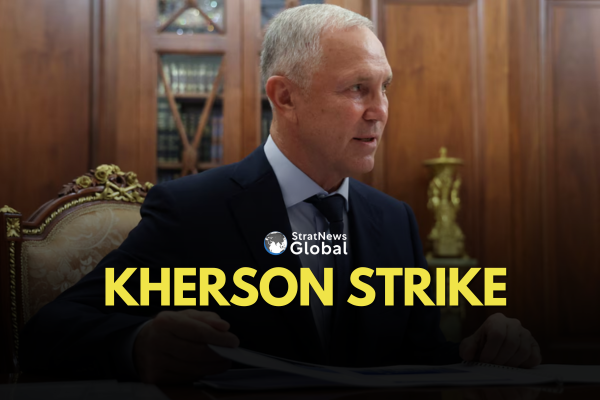
Russia Says 24 Killed in New Year’s Eve Drone Strike in Kherson Region
Russia accused Ukraine on Thursday of killing at least 24 people, including a child, in a drone strike that hit a hotel and café where civilians were celebrating New Year’s Eve in the Russian-controlled part of Ukraine’s southern Kherson region.
Moscow Labels Attack a ‘War Crime’
Vladimir Saldo, the Russian-installed governor of Kherson, said three Ukrainian drones struck a gathering site in the coastal village of Khorly, calling it a “deliberate strike” on civilians. He claimed many victims were burnt alive as fire engulfed the building.
Russia’s Foreign Ministry said preliminary information indicated that 24 people, among them one child, were killed and around 50 others injured, including six minors. The ministry called the incident “a war crime,” asserting that the attack had been “planned in advance” and that drones had “deliberately targeted areas where civilians had gathered to celebrate New Year’s Eve.”
Reuters was unable to verify the Russian claims or photographs released by Saldo’s office showing the alleged aftermath. Images reviewed by Reuters showed a burnt building, apparent blood stains on the ground, and at least one body covered with a white sheet.
Blame and Condemnation
Ukraine’s military, which has repeatedly accused Russia of killing civilians in missile and drone attacks on Ukrainian cities, did not immediately respond to a request for comment.
Russia’s Foreign Ministry spokeswoman Maria Zakharova accused Ukraine’s Western allies of bearing responsibility for the alleged strike. Senior Russian officials, including the speakers of both chambers of parliament, condemned Kyiv and described the incident as an act of terrorism.
“The attack was carried out with Western-supplied equipment and intelligence,” Zakharova said on Telegram, arguing that Ukraine’s backers shared blame for what she called “a barbaric crime.”
Conflict Background
Kherson is one of four regions along with Donetsk, Luhansk and Zaporizhzhia that Russia claimed to have annexed in 2022. Ukraine and most Western nations have rejected those claims as illegal, insisting the territories remain part of sovereign Ukrainian land.
The alleged strike comes amid a period of intensified drone warfare between the two countries. Both sides have targeted infrastructure and settlements far behind the front lines, often trading accusations over attacks that cause civilian casualties.
If confirmed, the incident in Khorly would be one of the deadliest civilian losses reported in Russian-controlled territory in recent months, further fuelling recriminations as the war approaches its third year.
with inputs from Reuters
Jamaat-e-Islami Signals Openness to Unity Government in Bangladesh Election
Bangladesh’s once-banned Islamist party, Jamaat-e-Islami, is preparing for its most competitive national election in nearly two decades and is open to joining a unity government after the 12 February parliamentary vote, its leader said on Wednesday.
Party Poised for Major Comeback
Opinion polls suggest Jamaat-e-Islami could emerge as the second-largest party behind the Bangladesh Nationalist Party (BNP) in what will be its first electoral contest in 17 years. The February vote marks Jamaat’s formal return to mainstream politics in the Muslim-majority country of 175 million people.
Jamaat previously shared power with the BNP between 2001 and 2006 and remains open to another partnership. “We want to see a stable nation for at least five years. If the parties come together, we’ll run the government together,” Jamaat Ameer (President) Shafiqur Rahman told Reuters in Dhaka. His remarks came days after Jamaat drew public attention by securing an alliance with a Gen-Z party.
From Ban to Ballot
The party’s resurgence follows the ousting of long-time Prime Minister Sheikh Hasina in a youth-led uprising in August 2024. Hasina, whose Awami League has since been barred from the election, had been a vocal critic of Jamaat. During her tenure, several senior Jamaat leaders were executed for alleged war crimes linked to Bangladesh’s 1971 independence war, which the party had opposed.
Jamaat was banned from elections in 2013 after a court ruled that its charter violated the secular constitution. The interim government led by Nobel laureate Muhammad Yunus lifted those restrictions last August, paving the way for its political re-entry.
Although the party continues to advocate Islamic governance under sharia law, Rahman said Jamaat is broadening its platform to include anti-corruption measures and national stability. “Anti-corruption must be a shared agenda for any unity government,” he said, adding that the next prime minister should come from the party that wins the most seats.
Diplomatic Balancing and Regional Tensions
Rahman also expressed concern over Sheikh Hasina’s continued stay in India after her flight from Dhaka, noting that relations between the two neighbours have deteriorated since her removal. India, which had built close trade and political ties with Hasina’s government, is now seeking to engage with potential new partners.
Rahman confirmed meeting an Indian diplomat earlier this year, saying the official had requested confidentiality about the encounter. “Why? There are so many diplomats who visited me and it was made public. Where is the problem?” he asked. “We must become open to all and open to each other. There is no alternative to develop our relationship.”
India’s foreign ministry did not respond to a Reuters request for comment. However, an Indian government source confirmed contacts with several Bangladeshi political groups. India’s foreign minister visited Dhaka on Wednesday to offer condolences to the family of BNP chief and former Prime Minister Khaleda Zia, who died the previous day.
Addressing Jamaat’s historical ties with Pakistan, Rahman said the party seeks balanced relations with all nations. “We are never interested in leaning toward any one country. Rather, we respect all and want balanced relations among nations,” he stated.
Rahman added that any government involving Jamaat “would not feel comfortable” with President Mohammed Shahabuddin, who was elected unopposed with Awami League support in 2023. Shahabuddin has previously told Reuters he would be willing to step down midway through his term but declined to comment on Rahman’s latest remarks.
with inputs from Reuters
Progressive Leader Zohran Mamdani Sworn In as New York City Mayor
Zohran Mamdani was sworn in as New York City’s new mayor in the first minutes of the New Year, marking the start of what his supporters have called a transformative era for America’s most populous city. The ceremony took place in the historic City Hall subway station, with his wife, Rama Duwaji, by his side.
Midnight Oath in a Historic Setting
Standing beneath the vaulted ceiling of the century-old station, Mamdani took the oath of office administered by New York State Attorney General Letitia James. “Happy New Year to New Yorkers, both inside this tunnel and above,” he said. “This is truly an honour and a privilege of a lifetime.”
The 34-year-old former state lawmaker, born in Uganda, becomes New York’s first Muslim mayor. His choice of the long-decommissioned City Hall subway stop accessible only through guided tours symbolised his commitment to “the working people who keep our city running every day,” according to his transition team.
New York law dictates that mayoral terms begin on 1 January following elections, and it has become tradition for incoming mayors to hold a private swearing-in shortly after midnight to ensure an unbroken line of leadership.
A Progressive Platform and Political Allies
Mamdani, a democratic socialist, ran on a platform focused on affordability and public welfare. He pledged to freeze rents and introduce free bus travel and childcare, appealing to New Yorkers struggling with the city’s high cost of living. His campaign drew more than two million voters — a record turnout — and secured him 50% of the vote, comfortably ahead of independent candidate Andrew Cuomo and Republican Curtis Sliwa.
Attorney General Letitia James, an early supporter, played a symbolic role at the inauguration. Analysts say her participation signalled Mamdani’s independence from national political figures, including President Donald Trump, whom both have frequently criticised. Grant Reeher, a political science professor at Syracuse University, said the gesture reinforced that “Mamdani is going to be independent of the president.”
Inauguration of a New Era
Mamdani’s formal inauguration, dubbed the “Inauguration of a New Era,” will feature a public ceremony on the steps of City Hall. Senator Bernie Sanders, whom Mamdani calls his political inspiration, will preside over the event, joined by Representative Alexandria Ocasio-Cortez. Around 4,000 guests will attend in person, with tens of thousands expected to watch from public viewing areas along Broadway or via livestream.
The mayor raised $2.6 million for his transition and celebrations from nearly 30,000 contributors more than any New York mayor this century. His supporters include community figures such as Sami Zaman, owner of Sami’s Kabab House in Astoria, where Mamdani filmed a campaign video with Sanders.
After taking office, Mamdani will move from his rent-stabilised apartment in Astoria to Gracie Mansion on Manhattan’s Upper East Side. While some in New York’s financial sector initially expressed concern about his socialist background, many are now exploring ways to cooperate with his administration.
Mamdani follows in the footsteps of David Dinkins, the city’s last mayor with ties to democratic socialism, who served from 1990 to 1993. Supporters believe Mamdani’s leadership could reshape New York’s political landscape, balancing progressive ideals with pragmatic governance.
with inputs from Reuters
Deadly Blast Kills 40 in Crans-Montana New Year’s Eve Tragedy
Around 40 people were killed and 100 others injured, many of them seriously, after an explosion tore through a crowded bar during New Year’s Eve celebrations in the Swiss resort town of Crans-Montana, officials confirmed on Thursday. Authorities believe the blast, which triggered a major fire, was accidental.
Fire Engulfs Popular Nightspot
The blaze broke out at around 1.30 a.m. (0030 GMT) inside Le Constellation, a popular bar in the upscale ski resort in southwestern Switzerland. The cause of the explosion remains under investigation, but prosecutors have ruled out foul play.
“At the moment we are considering this a fire and not an attack,” prosecutor Beatrice Pilloud told a press conference. “A full investigation has been opened.”
Police said the fire spread rapidly through the venue, which was packed with holiday revellers. Many suffered severe burns. The entire area was cordoned off, and a no-fly zone was established over Crans-Montana. Emergency teams deployed 10 helicopters and 40 ambulances to transport victims to hospitals in Sion, Lausanne, Geneva and Zurich.
Country in Mourning
Valais canton’s head of security, Stephane Ganzer, confirmed that some of the victims were foreign nationals. Police chief Frederic Gisler said a helpline had been opened for relatives. “I can’t hide from you that we are all shaken by what happened overnight in Crans,” he said. “Our count is about 100 injured, most seriously, and unfortunately tens of people are presumed dead.”
Although Gisler declined to specify the exact death toll, Italy’s foreign ministry reported information from Swiss police indicating that about 40 people had died.
Swiss Federal President Guy Parmelin expressed condolences on social media platform X, writing, “What was meant to be a moment of joy turned, on the first day of the year in Crans-Montana, into mourning that touches the entire country and far beyond.”
Investigators Examine Possible Fireworks Link
Prosecutor Pilloud said forensic teams were working intensively to identify victims and return their remains to families as quickly as possible. “A lot of resources have been put into forensics to identify the victims,” she said.
Italian Foreign Minister Antonio Tajani told Sky TG24 television that the explosion might have been triggered by fireworks. “It seems to have been an accident caused by a fire, by some explosion, by some firecracker thrown during New Year’s celebrations,” he said.
The incident has cast a shadow over the start of the new year in Switzerland, with residents of the usually serene alpine resort reeling from one of the country’s deadliest peacetime disasters.
with inputs from Reuters
China Enforces 50% Local Equipment Rule for Chipmakers
China is tightening its push for technological self-reliance by requiring semiconductor manufacturers to use at least 50% domestically produced equipment when adding new production capacity, according to people familiar with the policy. The directive, not publicly documented, is part of Beijing’s broader effort to build an independent semiconductor supply chain in response to escalating U.S. export restrictions.
A Strategic Shift Toward Domestic Technology
Chipmakers seeking state approval to build or expand fabrication plants must now prove through procurement tenders that at least half of their equipment is sourced from Chinese suppliers, the sources told Reuters. Proposals that fall short of the threshold are often rejected, although regulators allow some flexibility when domestic supply is limited, particularly for advanced chipmaking processes.
Officials reportedly encourage even higher targets. “Authorities prefer if it is much higher than 50%. Eventually, they are aiming for plants to use 100% domestic equipment,” one source said.
The rule marks one of Beijing’s most ambitious steps to reduce reliance on foreign technology. Since Washington’s 2023 ban on exports of advanced AI chips and semiconductor manufacturing tools to China, domestic producers have turned increasingly to local suppliers even in areas where foreign alternatives remain available.
Building a “Whole Nation” Semiconductor Drive
President Xi Jinping has repeatedly called for a “whole nation” effort to achieve self-sufficiency in semiconductors, mobilising thousands of engineers, researchers and manufacturers. Earlier this month, Reuters reported that Chinese scientists are developing a prototype chipmaking machine capable of producing advanced semiconductors a development the United States has long sought to prevent.
Previously, major chipmakers such as Semiconductor Manufacturing International Corporation (SMIC) preferred U.S. equipment, giving limited opportunities to local firms. However, the 2023 export restrictions forced domestic fabs to collaborate with Chinese suppliers like Naura Technology and Advanced Micro-Fabrication Equipment (AMEC).
State-affiliated entities placed a record 421 orders for local lithography equipment and components in 2025, worth about 850 million yuan. Beijing has also expanded financial support through its “Big Fund,” which launched a third phase in 2024 worth 344 billion yuan ($49 billion) to boost local semiconductor capacity.
Local Firms Emerge as Key Beneficiaries
The new rule is already reshaping the industry. Naura, China’s largest chip equipment maker, is testing its etching tools on SMIC’s 7nm production line after successfully deploying them for 14nm chips. The company’s progress highlights how policy pressure is driving rapid innovation.
Foreign suppliers such as Lam Research and Tokyo Electron, once dominant in China’s etching market, are now being replaced by Naura and AMEC. Naura has also begun producing electrostatic chucks to replace worn components in foreign equipment that can no longer be serviced due to export bans.
Naura filed a record 779 patents in 2025 more than double its total in 2020 and 2021 while AMEC filed 259, according to Anaqua’s AcclaimIP database. Naura’s revenue surged 30% in the first half of 2025 to 16 billion yuan, and AMEC’s rose 44% to 5 billion yuan. Analysts now estimate that China has achieved around 50% self-sufficiency in cleaning and photoresist-removal equipment, markets once dominated by Japanese firms.
Industry observers expect a small number of domestic giants to dominate the equipment market. “The domestic equipment market will be led by two to three major manufacturers, and Naura is definitely one of them,” one source said.
with inputs from Reuters