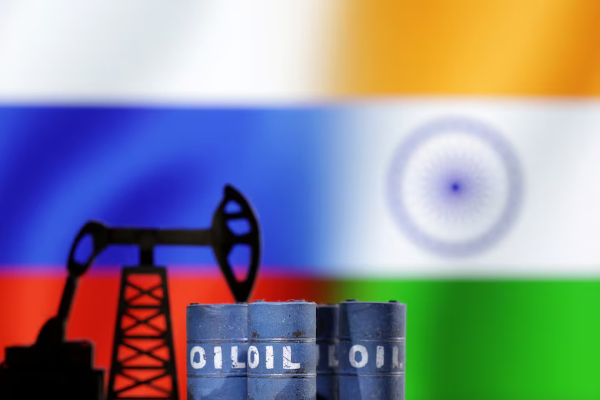
Late on Tuesday night, US President Donald Trump announced that India has agreed to cut back on Russian crude imports, in return for a reduction in US tariffs on Indian goods from as high as 50 percent to 18 percent.
For India, this is a major shift. At its peak, Russian crude accounted for nearly 50 percent of daily imports. The heavy, sour Urals grade suited India’s complex refineries, particularly Jamnagar, and came at a significant discount, around $16 cheaper per barrel than West Asian oil.
According to experts, over the years, Indian companies have invested about $17 billion in Russian crude projects, linking the countries’ energy and economic interests.
Logistic Problem
Due to sanctions imposed by the US and Europe, transporting Russian oil has become increasingly tricky. Insurance companies, mostly US- and Europe-based, refused to cover shipments, forcing refiners to negotiate workarounds or use smaller, riskier insurers.
The new deal with the US pushes India to rethink its crude sourcing, balancing cost, refinery compatibility, and geopolitical considerations.
India has been diversifying its import basket and besides Saudi Arabia, Iraq, Kuwait, and the UAE, the focus has also shifted to Latin America and Caribbean region and also Africa. Incremental supplies are coming in from the US, Venezuela, Brazil, and Mexico.
The US now controls exports following its intervention in Venezuelan politics. Indian refiners will need to navigate regulatory oversight while ensuring supply continuity.
Economic Impact
According to energy analysts, replacing discounted Russian crude with market-priced alternatives could raise India’s annual oil import bill by $3–4 billion. Russian Urals were cheap, heavy, and perfectly suited for India’s refining infrastructure.
Research from the Centre for Research on Energy and Clean Air (CREA) shows India’s Russian oil imports fell below 25 percent of total crude in early 2026, down from nearly 50 percent at the peak. State-run refiners like Indian Oil Corporation and Bharat Petroleum continue selective purchases.
West Asian oil will constitute the backbone of imports, while amounts from the US, Venezuela, Brazil, Mexico, and African suppliers give flexibility. Refiners will weigh commercial feasibility, refinery compatibility, and geopolitical risks rather than making decisions purely on politics.
Though Venezuela’s oil is heavy and sour, in 2024, after China and the US, India was the third-largest importer. Due to years of sanctions and declining infrastructure, over a period of time Venezuela’s production fluctuated. In recent years, output rebounded to around 5.5–6.3 lakh barrels per day.
Analysts see Latin American suppliers as a strategic supplement rather than a full solution.
Kuwait, Iraq, Saudi Arabia, and the UAE remain India’s largest non-Russian sources. While their volumes are stable, prices are higher than discounted Russian crude.
From the African continent countries like Nigeria and Angola also contribute valuable amounts.