Pakistan’s decision to host the first-ever international summit on the Indus Waters Treaty in Islamabad on June 30 was about more than water.
It was an attempt to shape global opinion against India’s decision to place the treaty in abeyance and portray that move as a threat to international norms.
The venue was the Jinnah Convention Centre and the organisers included the Institute of Regional Studies, the Organisation of Islamic Cooperation (OIC) and the Panjwani-Hisaar Water Institute. But despite being promoted as an ‘international’ summit, the event featured few prominent foreign participants.
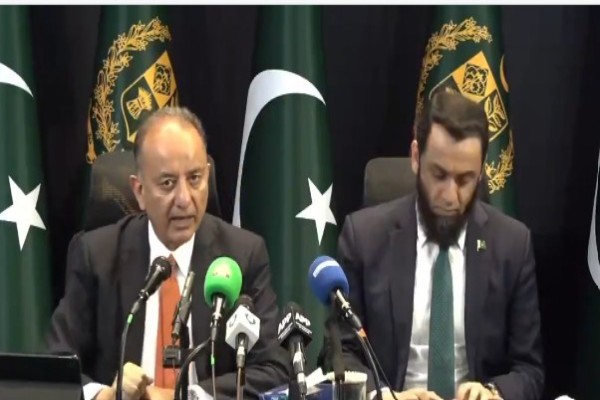
Deputy Prime Minister and Foreign Minister Ishaq Dar delivered the keynote address. Former Foreign Ministers Bilawal Bhutto Zardari and Hina Rabbani Khar were among the principal speakers, alongside Climate Change Minister Musadik Masood Malik and Information Minister Attaullah Tarar.
According to reports, foreign participants included water security and foreign policy experts from the United States and China, including Chinese scholar Victor Gao.
The messaging from the Pakistani leadership was unmistakable.
Islamabad would “cut off those hands” that seek to control the Indus water, declared Pakistan’s Climate Change Minister Musadik Malik, wagging his fingers for effect.
“Pakistan’s Nuclear Bombs are not for ceremonial purposes. If all efforts fail to restore the Indus Water Treaty, Pakistan must explore the Nuclear Option,” warned Bilawal Bhutto, who’s also the chairman of the Pakistan Peoples Party.
“The descent of India into a rogue state is multi dimensional. Claiming to hold in abeyance the robust, enduring, survivor of two wars- Indus Water Treaty- shows that it no more deserves to be sitting in UN General assembly,” added Hina Rabbani Khar.
Yet after listening to the discussions, one question lingered. How many of the speakers had actually examined the treaty in detail or objectively assessed the implications of India’s decision?
The treaty’s own preamble states that it was signed in a spirit of goodwill and friendship. India argues that Pakistan’s continued use of terrorism as an instrument of state policy has eroded that very foundation.
For decades, the treaty survived wars and prolonged political tensions. At the same time, India contends that it came with significant developmental and economic costs. Pakistan repeatedly invoked its provisions to challenge Indian hydroelectric projects, delaying construction and increasing costs, while restrictions on storage and sediment management affected the viability of projects on the western rivers.
Claims that India could weaponise water also overlook the fact that India has maintained substantial storage infrastructure on the eastern rivers for decades without causing downstream flooding in Pakistan. Indian infrastructure has, in fact, helped mitigate flooding in areas around Lahore.
The treaty’s impact has been felt most acutely in Jammu and Kashmir, where irrigation, hydropower and navigation projects faced prolonged delays and unrealised economic potential. Similar constraints also affected development in Ladakh.
With the treaty now in abeyance, India believes it has an opportunity to better utilise water resources for the benefit of people in Jammu and Kashmir, Ladakh, Punjab, Haryana and Rajasthan while remaining within international legal norms.
Pakistan is now attempting to convince the world that India’s decision sets a dangerous precedent for nations sharing transboundary rivers. A few months ago, President Asif Ali Zardari convened a meeting of selected Pakistani influencers and senior bureaucrats to build international support on the issue.
Pakistan has also sought to shape global opinion through institutions such as London’s Chatham House and the Centre for European Policy Studies in Brussels.
The centrepiece of this campaign is the claim that India is “stopping water”. What that narrative leaves out is the event that triggered the present crisis. What it also leaves out is the totally skewed character of the treaty, which grants Pakistan almost 80 per cent of the total water carried by the Indus water system.
Prime Minister Narendra Modi has repeatedly said that “blood and water cannot flow together”, and India finally placed the treaty in abeyance after Pakistani terrorists massacred innocent pilgrims in Pahalgam in April 2025.
India maintains that it continues to act within the framework of the treaty while exercising the rights available to it under its provisions. At present, it is utilising only the waters allocated to it under the treaty.
A clearly rattled Pakistan, however, has portrayed these actions as evidence that India has “stopped all water”, in an attempt to reinforce a clearly warped narrative.