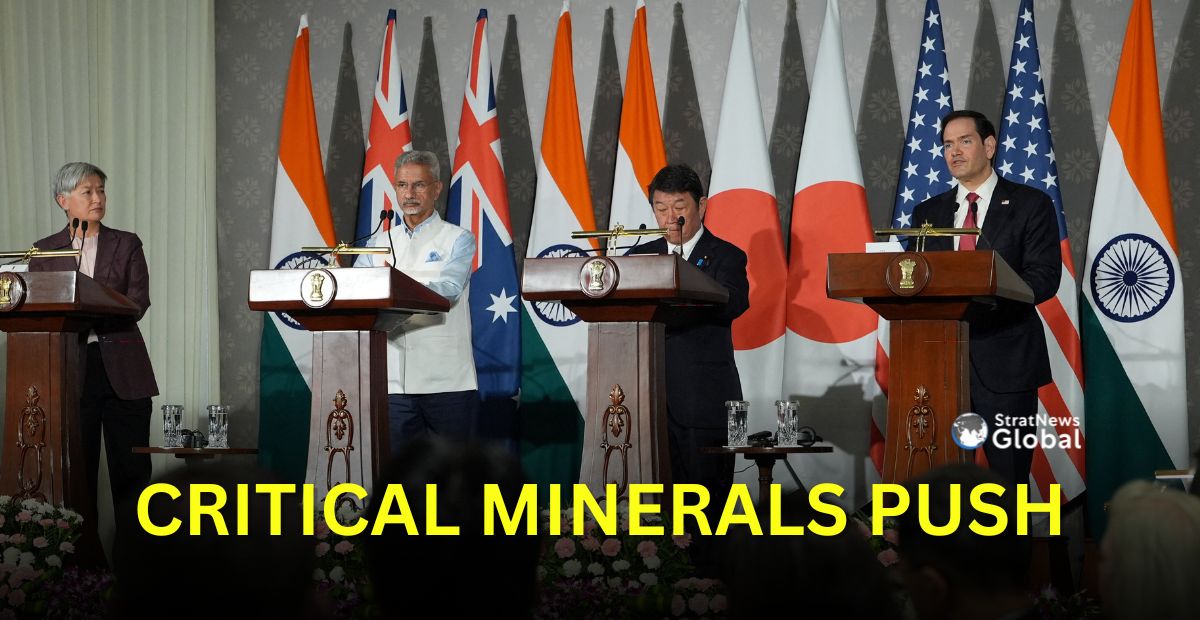
The Quad nations have decided to mobilise up to $20 billion in government and private-sector support for critical mineral supply chains. The four countries announced this at the end of the Quad Foreign Ministers meeting in New Delhi.
This is not simply an economic announcement, it is a coordinated geopolitical response to rising concerns over technological dependence, supply-chain affected and the weaponisation of trade in an increasingly fragmented world order.
The initiative comes at a time when nations are racing to secure the raw materials required for semiconductors, artificial intelligence, electric vehicles, renewable energy systems and advanced defence technologies.
In today’s environment, minerals such as lithium, cobalt, nickel, graphite and rare earth elements are no longer viewed as ordinary commodities. They are now instruments of national security.
The Quad announcement comes alongside a parallel deepening of bilateral cooperation between India and the United States.
The two countries have signed a bilateral Critical Minerals Framework designed to secure trusted supply chains for advanced technologies and energy systems. The agreement builds on discussions initiated earlier this year under the Forum on Resource Geostrategic Engagement (FORGE), launched by U.S. Secretary of State Marco Rubio.
The framework seeks to reduce vulnerabilities arising from single-source monopolies and coercive market practices. Washington has already committed support mechanisms exceeding $30 billion through loans, investments, guarantees and financing tools aimed at strengthening mineral supply chains globally.
Quad & Critical Minerals
A large share of the world’s refining and processing capacity for several critical minerals remains concentrated in one geography, China. This has created concerns across major economies about the risks of supply disruptions, export controls and market manipulation during periods of geopolitical tension.
Artificial intelligence systems, advanced semiconductor manufacturing and clean-energy infrastructure all depend on highly specialised minerals. Without secure access to those resources, ambitions surrounding AI leadership, defence modernisation and energy transition become vulnerable to external pressure.
The Quad’s latest framework goes far beyond mining alone as it focuses simultaneously on extraction, processing, refining, recycling and investment coordination. It seeks to build an alternative supply-chain ecosystem among trusted democratic partners capable of reducing dependence on concentrated markets.
New Delhi has spent the last few years attempting to position itself as both a manufacturing hub and a trusted technology partner for Western economies. However, India’s ambitions in semiconductor manufacturing, electric mobility and advanced electronics require reliable access to critical minerals and processing technologies.
That strategic convergence became more visible earlier this year when India and the United States signed a bilateral Critical Minerals Framework aimed at strengthening trusted supply chains for advanced technologies and energy systems.
The agreement marked a major evolution in India-US strategic ties. Usually centred around defence and security cooperation, the partnership is now increasingly driven by technology, industrial resilience and economic security.
The framework also builds upon the broader U.S.-led Pax Silica initiative, which seeks to create resilient supply chains across semiconductors, strategic minerals and AI-related technologies among like-minded countries.
India’s participation in Pax Silica is especially important because it signals Washington’s growing confidence in India’s role within the emerging technology architecture outside Chinese supply-chain dominance.
Modern AI ecosystems depend on sophisticated semiconductor infrastructure, which in turn requires secure access to gallium, germanium, silicon, graphite and multiple rare earth materials. In effect, the future of AI leadership may depend as much on geology and mineral access as on software innovation.
Each Quad member brings distinct strengths into the partnership.
Australia has some of the world’s largest lithium, cobalt and rare earth mineral reserves and is a cornerstone supplier for clean-energy and battery industries.
The United States brings financing power, advanced processing technologies and leadership in semiconductors and AI innovation.
And, Japan offers high-end materials engineering, battery expertise and advanced recycling technologies despite limited domestic mineral reserves.
India brings a vast industrial base, growing electronics manufacturing capacity, and one of the world’s fastest-growing technology markets.
Together, the four countries are attempting to create a strategic minerals ecosystem that combines resources, technology, manufacturing and capital.
Another notable aspect of the Quad framework is its strong emphasis on recycling and recovery.
The partnership recognises that future mineral security will not rely solely on opening new mines. Increasingly, nations are looking toward urban mining, recovering valuable minerals from electronic waste, industrial scrap and discarded batteries.
This is particularly relevant for India, which is rapidly becoming one of the world’s largest generators of electronic waste. Building advanced recycling infrastructure could allow India to recover strategic materials domestically while reducing import dependence.
The present geopolitical tensions are pushing countries toward resilience, diversification and “friend-shoring”, sourcing critical goods from trusted partners rather than geopolitical competitors. Therefore, critical minerals sit at the centre of that transformation.