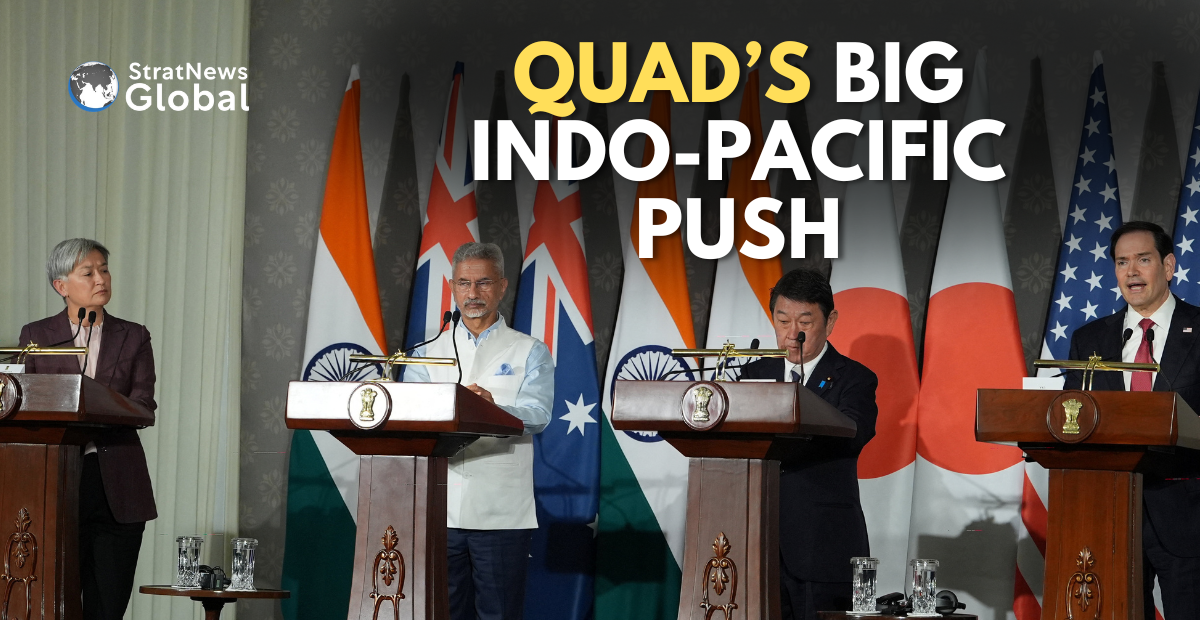
Quad foreign ministers on Tuesday announced sweeping new initiatives on maritime security, port infrastructure, energy resilience and critical minerals, underlining the grouping’s increasing strategic focus on the Indo-Pacific.
Meeting at a time of rising unpredictability in global energy markets and disruptions to maritime commerce, the foreign ministers of India, the United States, Japan and Australia repeatedly stressed the importance of freedom of navigation, secure supply chains and enhanced maritime coordination.
At the joint press conference, External Affairs Minister S Jaishankar said the discussions were focused on the maritime domain and the strategic implications of ongoing global conflicts for the Indo-Pacific.
“We spent some time on the question of safe and unimpeded maritime commerce and reaffirmed the significance of scrupulously observing international law,” Jaishankar said. “The maritime domain has seen a steady expansion of collaboration, including surveillance and domain awareness, logistics networks, undersea cables, training, capacity building and HADR activities.”
“In the coming days, whether it is economic activity, energy trade or maritime commerce, the Indo-Pacific will become even more important to the world. The responsibilities of the Quad will grow commensurately, and we must prepare for that,” he said.
The most important outcome of the meeting was the launch of the Indo-Pacific Maritime Surveillance Collaboration initiative, aimed at integrating the maritime surveillance capabilities of the four Quad nations to improve monitoring and information-sharing across the Indo-Pacific.
US Secretary of State Marco Rubio called it one of the “two big announcements” from the meeting.
“The first is the launch of the Indo-Pacific Maritime Surveillance Collaboration initiative, which is going to leverage each of our countries’ maritime surveillance capabilities in the Indo-Pacific to enhance information sharing,” Rubio said.
The Quad also announced the expansion of the Indo-Pacific Maritime Domain Awareness initiative into the Indian Ocean, enabling partner countries to access near real-time satellite tracking data to tackle illegal fishing, trafficking and support humanitarian disaster response.
Australian Foreign Minister Penny Wong linked the new maritime initiatives directly to rising geopolitical instability and the Strait of Hormuz crisis.
“We know economic volatility is increasing, and we know the consequences for our region of the Iranian closure of the Strait of Hormuz and what that means for our energy security, for our economies and for our people,” Wong said.
“This is the context in which freedom of navigation and strategic stability can be operationalised,” she added, while announcing coordinated maritime surveillance efforts beginning in the Indian Ocean and during Exercise Malabar.
The Australian foreign minister said the maritime domain awareness expansion would “enable partners to access near real-time unclassified satellite tracking data to combat illegal fishing, trafficking, and also enable us to better support humanitarian disaster response.”
The second major initiative unveiled was the Quad Ports of the Future Partnership, under which the four countries will jointly develop resilient port infrastructure projects in the Pacific Islands, beginning with a pilot project in Fiji.
“We are also today announcing the strongest ever commitment from the Quad to the Pacific through the Quad Ports of the Future Partnership, where we are launching a pilot for port infrastructure in Fiji,” Wong said.
“It will be the first time that the Quad partners work together on a port infrastructure project. We believe it will be very successful and that it will serve as a model for other projects in the future,” Rubio said.
Japan Raises Iran, North Korea Concerns
Japanese Foreign Minister Takeshi Motegi also highlighted the impact of the Iran crisis on the Indo-Pacific and broader regional security.
“There has been significant change in the international situation,” Motegi said, adding that “the Iran situation impacted the Indo-Pacific.”
He said the four countries had agreed to “promote various cooperation projects” and also discussed the North Korea situation, for which he received support from the other Quad partners.
On economic security, the Quad announced a new Critical Minerals Framework aimed at strengthening supply chains in mining and processing rare earths and strategic minerals.
“We will announce the Quad Critical Minerals Framework, which will guide each of us to leverage economic policy tools and coordinate investment to strengthen critical mineral supply chains, including in mining and processing,” Rubio said.
The grouping also launched a new Indo-Pacific Energy Security initiative focused on regional energy resilience, technology cooperation, market analysis and emergency response coordination.
On the sidelines of the meeting, Jaishankar and Rubio signed the India-US bilateral framework on securing the supply of critical minerals and rare earths, signalling deeper strategic cooperation between New Delhi and Washington.
The ministers additionally discussed counter-terrorism cooperation, cyber security, undersea cable connectivity, scam centres operating in Southeast Asia and broader efforts to build resilient supply chains and trusted technologies across the Indo-Pacific.
“There must be zero tolerance for terrorism, and nations subject to terrorist attacks have the right to defend themselves,” Jaishankar said.