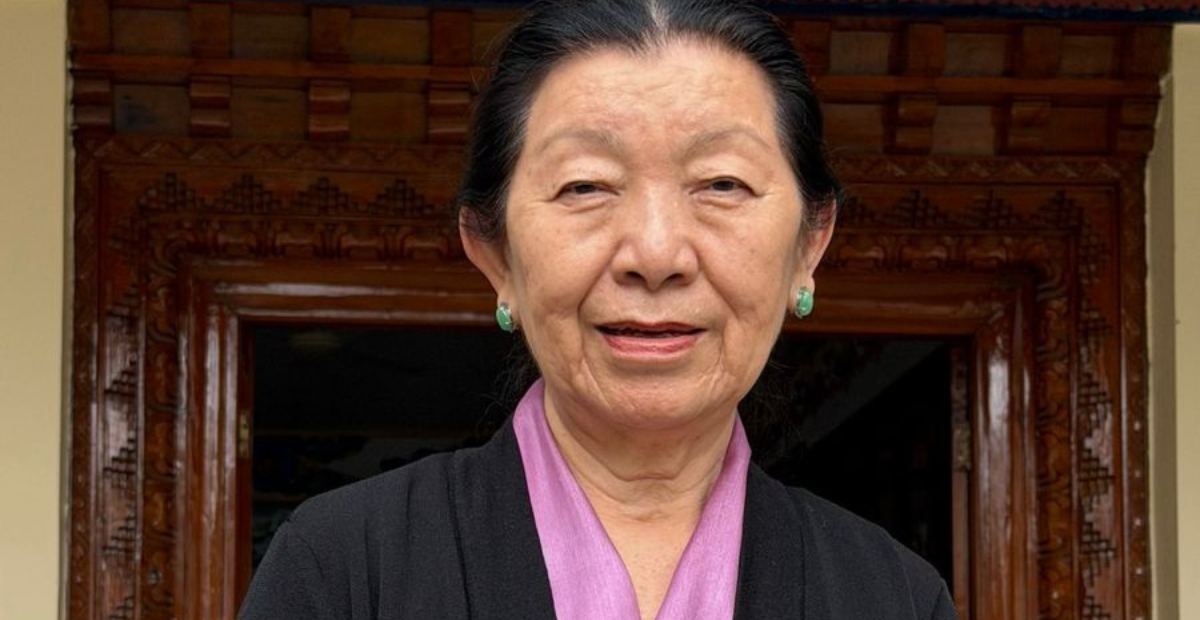
Dolma Tsering Teykhang, former deputy speaker of the Tibetan Parliament, has been elected Speaker of the newly constituted parliament that has just begun its term following the 2026 elections.
She spoke to Nayanima Basu of StratNews Global in McLeod Ganj, Dharamshala on the challenges facing the Tibetans living inside Tibet as well as the exiled community. Edited Excerpts:
Q: What are the challenges facing parliament, the diaspora?
A: I think being living in exile, the challenges are numerous. But on the political front, I think most of the challenges come from the laws being promulgated by the Chinese Communist Party (CCP). The law (passed in March by CCP) is the erasure of the identity of all other nationals who are not Han.
So that is the biggest challenge, I believe, because the Tibetan people who are living inside Tibet, they are losing every space to preserve their culture, to preserve their way of living, to practice their faith, and even parents are losing the contact with their minors as children, as young as four to 18, are being forcefully taken away from their parents, and they are made to forget their own roots.
Q: But how do you get this information?Do you still have your channels there or people are still coming from Tibet who tell you this?
A: The people who could come out of Tibet and come here, they are sharing these stories … There are horrific stories of the impact of colonial boarding schools. Children as young as 4 to 18 are being carried away. And then when they come back after a very long period of time to their homes, kids have really forgotten how to communicate with their grandparents, how to communicate with their parents, because they are just looking at them, staring at them, and then tears are dripping.
So they still tell you how these children are being intimidated, not to speak Tibetan and to speak only in Mandarin, and so when they come home, they are in a dilemma, what to do. The parents don’t know Mandarin, so if I speak in Tibetan, again, I’ll be punished. So that is the state of affairs in Tibet. This is the biggest challenge the world must rise up to.
Q; What about the challenges facing the Tibetan refugees living here in India?
A: Here in India, through the CTA (Central Tibetan Administration) we are trying our best to preserve Tibetan culture, Tibetan religion, Tibetan language. We are passing on the Tibetan way of living, Tibetan values to our children. We have our own schools, we have children’s villages where the means of instruction is in Tibetan.
Q: As Speaker of the Tibetan Parliament-in-Exile what will be your immediate task now?
A: I’m here to work with the deputy speaker in running and conducting parliament, alongside being in a state of exile. I will continue to advocate for the cause of Tibet, reaching out not only to the citizens of India, but also to Europe, America, and to all the democratic citizens who can really empathize and stand up and show solidarity for the cause of Tibet.
Q: Do you want India to enhance its cooperation?
A: Whatever we Tibetans in exile have achieved it’s all thanks to the Government of India and people of India. So I always say that we owe our existence to the government and people of India. And it’s because of the Government of India’s support that we are able to have a CTA which binds the diaspora together and we have a parliament-in-exile where we are learning how to govern ourselves through transparency and accountability. And I think we are flourishing as an exiled community and it’s all thanks to India.
Q: What about the young generation within the Tibetan diaspora? Are they equally determined or motivated as your generation is in taking the movement forward? How are you preparing to keep them as one consolidated entity after His Holiness passes on?
A: Soon after coming into exile, the vision of His Holiness was democratisation of the Tibetan diaspora. That itself is a path for the Tibetan people, to take responsibility for their own well being, of their own cause because His Holiness always says gone are the times when you rely on one person for a cause. It should be the work of the people and it should be through representation. That’s why, even though the democratic system was very new to Tibetans who came from Tibet, yet he was adamant to teach us how to govern through democracy, through representation.
Today we have a charter and along with the charter, we have 27 codified rules and regulations — How we can conduct election, how we can conduct audit, how we can conduct public service commission, and the recruiting of civil servants and when there are any discrepancies within the rules and regulations of CTA, we have Supreme Justice Commission in the center and we have branches in south and north, where you can really have your grievances heard.
Of course, the criminal cases and land-related cases, that are dealt with by the laws of the land. But within our community, whatever discrepancies, the misunderstanding in interpretation of our rules and regulation is all done through the Supreme Justice Commission.
Q: What is your reaction to recent comments by China that CTA is not a recognised body and that the reincarnation of the Dalai Lama is their internal matter?
A: I think it’s very positive that China is watching us. It also shows that they are not comfortable when we are getting a lot of support. When His Holiness’ 90th birthday was celebrated the Chinese got nervous. So it’s a very positive thing that China cannot ignore the cause of Tibet. China cannot ignore the reincarnation of His Holiness. Though they are waiting for the demise of His Holiness because they want to install a proxy Dalai Lama for their own political end. But who will recognize that person? That’s the question.
So when they say that India cannot interfere with their internal affairs. The cause of Tibet itself is an international affair. It is not an internal affair (of China). If it’s an internal affair, the 1914 Simla convention, we took part as a sovereign state. That is a historical fact, we were discussing our own future with China and then British India.
Q: The Resolve Tibet Act passed by the US in July 2024, do you think that will bring any kind of resolution to the Sino-Tibet Conflict?
A: I think passing of the Act was a very important step towards the furthering of the Tibetan cause through the ‘Middle Way’ policy.
Q: But do you think China will ever listen to you?
A: Who cares what they say? They don’t have any legitimacy to rule over Tibet, historically, politically, and ethically. Our struggle will continue and His Holiness has devolved all his political powers to the elected members to make sure that the struggle continues, even if he’s no more on this Earth. That’s the purpose. The young generation within the Tibetan diaspora are very passionate about the cause and taking it forward. The young generation growing up there in Tibet were all born after the occupation, today they are also rising up for the cause.