China is building a large military complex in a remote desert area that experts say could help protect its nuclear weapons from a possible U.S. attack.
China already has nuclear missiles that can reach anywhere in the United States. But new satellite images reviewed by Reuters show Beijing is expanding a network of launch sites, bunkers and communication centres near silos that store its longest-range missiles.
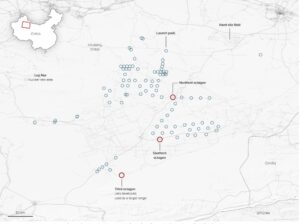
The images reveal more than 80 pads for possible use by China’s expanding fleet of mobile missile launchers and air-defense batteries. They also show facilities that may serve electronic warfare, satellite communications and command operations, according to three security analysts, who assessed the imagery for Reuters.
The large-scale construction indicates a significant expansion of hardened infrastructure to protect and operate China’s land-based nuclear forces. Analysts say it strengthens Beijing’s “second-strike” capability—ensuring it could retaliate after a nuclear attack.
Protecting desert silos is central to China’s goal of a minimal but credible nuclear deterrent. While the PLA also has sea- and air-launched nuclear options, silo fields in Xinjiang and Gansu remain the core of its nuclear arsenal.
Experts say China’s nuclear expansion is closely watched because of concerns over transparency and ongoing tensions with the United States, especially over Taiwan. Some Western diplomats also believe Beijing could use its nuclear capability to pressure other countries during a conflict.
China follows a “no first use” policy. However, some analysts say it could still use nuclear threats to influence a crisis involving Taiwan, which China claims as its territory but Taiwan rejects.
Octagons In the Desert
The new desert infrastructure is centered on two octagon-shaped installations built over the past six years in eastern Xinjiang. Both are southwest of the Hami nuclear silo fields – one is about 140 kilometers away, the other some 230 kilometers.
Satellite images show the octagon structures contain housing for personnel and large military vehicles. They are flanked by armored bunkers and fortified weapons-storage areas, as well as airfields and railheads that link the octagons to the Hami silos.
Exercises involving large military vehicles occurred around the northern octagon this month and during April, the images show. Also evident in recent images are large tents and what two analysts said appear to be camouflaged launch sites cut into the desert, some with air-defense missile batteries.
China’s Expanding Nuclear Capabilities
U.S. officials and arms-control analysts say China is expanding and improving its nuclear weapons capabilities faster than any other nation. The latest Pentagon report on China’s military modernization says the country’s warhead production has slowed but it is on track to field 1,000 warheads by 2030. The December report estimated China is likely to have loaded 100 ICBMs across its three main silo fields.
China has also been strengthening its early-warning system, underpinned by its Huoyan-1 satellites, according to U.S. officials. The system can detect an incoming ICBM within 90 seconds of launch and alert a command center within three to four minutes, according to the Pentagon — sufficient time for China to fire its own silo-based weapons before they are hit.
‘An Extraordinary Effort’
Significantly, each octagon sits at the core of a network of dirt roads and conduits that stretch far into the desert. These routes connect to the concrete pads, which are nestled among rocky outcrops and dry creekbeds.
The pads could be used to deploy mobile air-defense missiles, electronic warfare nodes or, from some of the larger ones, road-mobile ICBM launchers, three security scholars said.
Some researchers suggest the conduits may carry fiber-optic cables for communications, and one site may include space or microwave communications infrastructure, indicated by satellite dishes and towers.
Experts propose the structures could support command, control, communications, maintenance, or storage tied to China’s nuclear operations at the Hami ICBM silo site. Another nearby octagon appears to function as a target range with damaged terrain and mock aircraft.
Analysts note the scale of this network is unusual compared with U.S. and Russian nuclear systems, which rely more on silo hardening and dispersion than layered defensive infrastructure. Some describe the development as unprecedented in scope.
(With inputs from Reuters)