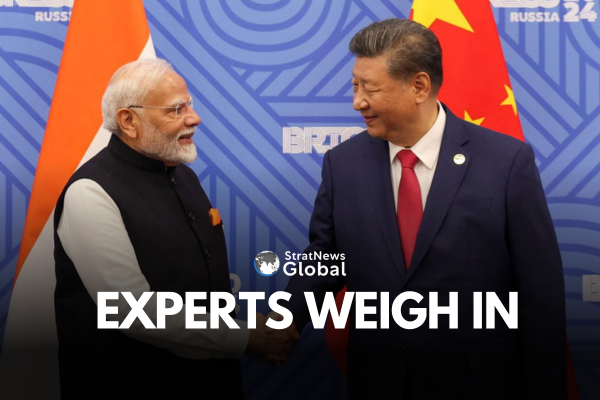
The headline and report featured on the front page of the Global Times: “India reportedly plans to scrap curbs on Chinese firms bidding for government contracts, signfies improvement in ties.”
It was based on reports from New Delhi that the Finance Ministry may ease restrictions on Chinese companies bidding for government contracts, mainly to address delays and shortages in major projects. However, any decision will require clearance from the Prime Minister’s Office and sensitive areas such as telecom, defence and digital infrastructure could remain excluded.
The curbs date back to 2020 after the Galwan clash, when India halted several China-linked projects, banned around 59 Chinese apps, and barred Chinese firms from sectors including highways.
Experts StratNews Global spoke to were divided:
Jabin Jacob, Associate Professor of International Relations at Shiv Nadar University, said the decisions show a lack of clear thinking and long-term planning, noting that if security was the main concern in 2020, those risks have not reduced and have in fact increased since then. It reflects India’s failure over the past five years to build alternatives to Chinese inputs.
“Indian industry has neither fully embraced the Atmanirbhar push nor adequately considered the long-term security costs of continued dependence on China,” he warned, “while the government has failed to create conditions that would help industry make that shift. Allowing Chinese firms back into government contracts could also encourage the perception that Indian policy can be reversed under pressure from industry or Beijing.”
Suyash Desai, a researcher focused on China’s military, warned that allowing China-linked firms into government contracts risks embedding supply-chain choke points, increasing data and surveillance vulnerabilities, and weakening India’s strategic signalling against Beijing. Others were positive although with caveats.
Senior jouralist and researcher Atul Aneja argued that closer engagement with China and Russia particularly through an RIC or broader Eurasian framework could strengthen India’s leverage in future dealings with the United States.
Anushka Saxena, a geopolitics and political economy analyst, said easing curbs could boost competition and growth, adding that building interdependence with China and then leveraging it during crises has strategic value, though she stressed that de-risking must continue in sensitive sectors and that transparency on what India deems “open” or “restricted” is essential.
China expert Manoj Kewalramani, called the approach “sensible if carefully calibrated”, supporting greater openness in areas like transport and energy while insisting on rigorous security reviews for technology, data-linked and socially sensitive investments.
Amit Kumar, research fellow at the Takshashila Institution, said a blanket ban had outlived its political utility and imposed real economic costs, citing stalled infrastructure projects such as the Bengaluru Metro due to the unavailability of Chinese machinery, while arguing that curbs can still be retained for critical sectors.