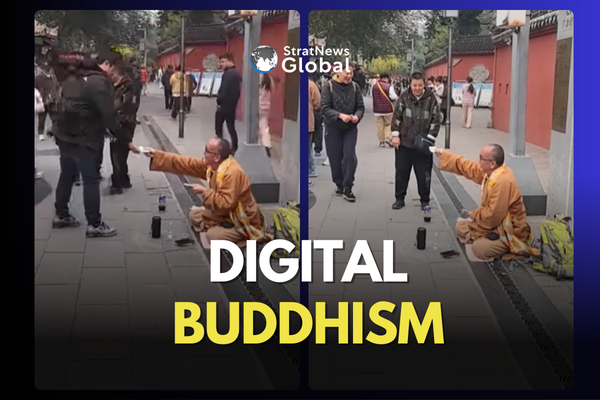
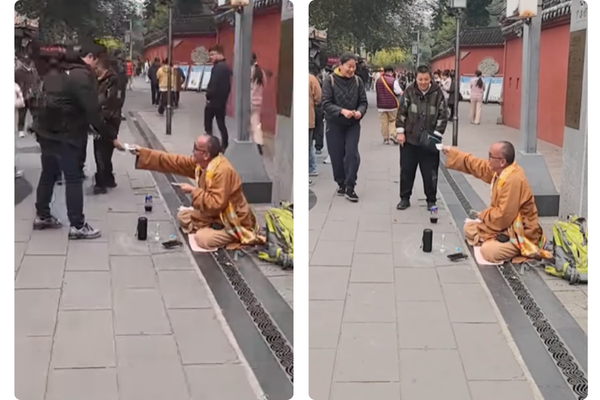
A video that recently (screenshot below) went viral on China’s social media, showed a Buddhist monk outside Chengdu’s Wenshu Monastery, handing out cash to passers-by. There was no bowl, no appeal, no sermon. Some online users jokingly called him a “reverse beggar”, but the monk was only practising “dana” or to give without expecting anything in return, which is what Buddhism preaches.
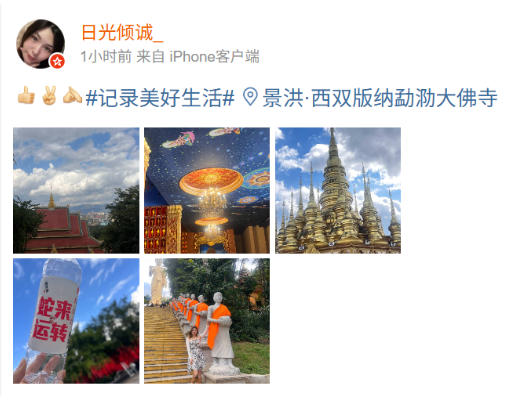
The video reflected a trend across Chinese digital platforms, where hashtags #中国佛教 (#Chinese Buddhism) , #禅修 (#Zen meditation)#寺庙生活 (#temple life) are frequent, suggesting that Buddhism is acquiring a profile among Chinese but less as a religion and more as a lifestyle, wellness and emotional refuge.
Buddhism resonates particularly among the youth and a search on Weibo yielded thousands of posts, ranging from personal prayer rituals and temple “check-ins” to reflections on inner peace, wellbeing and everyday spirituality.
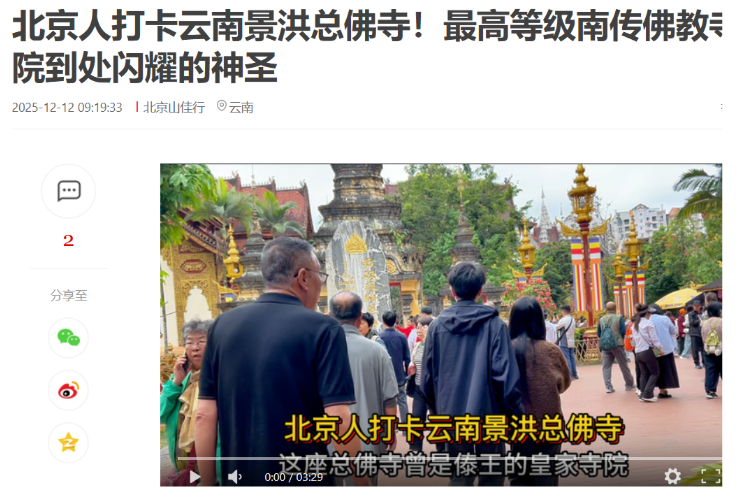
Last week, clips of Beijing residents “checking in” at Jinghong’s General Buddhist Temple in Yunnan, China’s highest-ranking Theravada Buddhist monastery, went viral, drawing attention to its sacred architecture and serene atmosphere.
Faith Meets the Market
According to a report in the online Sixth Tone, which focuses on content reflecting contemporary trends in China, temples across China are quietly transforming into hubs of lifestyle consumption.
Cafés, vegetarian restaurants, branded souvenirs, wellness services and even venture capital-linked projects now form what some describe as a growing “temple economy”. Sacred spaces are increasingly intertwined with consumer culture, reshaping both visitor experiences and the social role of religious institutions.
As economic pressures and social uncertainty grow, many young Chinese are turning to mysticism, ritual and spiritual symbolism in search of fortune, calm and meaning. Buddhist temples and Taoist shrines have seen a rise in footfalls, but as always there are political boundaries.
Influencer Crackdown
In 2021, Chinese social media platforms cracked down on so-called “foyuan”, or “Buddhist lifestyle” influencers. These users often shared stylised images of prayer, meditation and temple visits, sometimes accompanied by subtle commercial promotion or product recommendations.
According to Sixth Tone, authorities were uncomfortable with Buddhism being packaged as a monetisable personal brand. State media criticised the trend as profiteering under the guise of religion, and platforms such as Douyin and Xiaohongshu removed dozens of related accounts and posts. The action was framed as enforcement of existing bans on commercial religious promotion.
The crackdown did not signal hostility towards Buddhism itself. Instead, it reflected a broader regulatory push against unregulated online religious expression. Faith was permitted, but not as an influencer-driven, independently scalable enterprise beyond state oversight.
Senior Chinese officials visiting Labrang Monastery, one of Tibetan Buddhism’s most influential institutions, called for intensified “sinicisation”. Monastic leaders were urged to align religious practice with political loyalty, Chinese national identity and socialist values, embedding Party ideology into monastic life.
Rinzin Namgyal, a Tibetan scholar and Research Associate at the Foundation for Non-Violent Alternatives, argues that this approach carries deeper implications. When Buddhism is stripped of its moral and spiritual authority, he told StratNewsGlobal, it risks being reduced to an aesthetic shell.

Research Associate at StratNewsGlobal, A keen observer of #China and Foreign Affairs. Writer, Weibo Trends, Analyst.
Twitter: @resham_sng