Sometimes it’s hard to imagine why a vast nation with a $19 trillion GDP should see red when two neighbours get together. Witness the official reaction over Japanese Prime Minister Sanae Takaichi’s visit to Delhi.
Chinese foreign ministry spokesperson Guo Jiakun warned against creating “small blocs” or increasing confrontation under the guise of cooperation, and called for an open and inclusive approach to global supply chains.
If increasing confrontation is a worry for Beijing, what explains more than 600 transgressions by Chinese navy and coast guard vessels into the waters of the Senkaku islands last year. The Senkakus are Japanese territory, recognised by China since the 19th century. They began claiming it in the 1990s amid reports of oil and gas in the region.
Also, what explains the squeeze China is putting on the critical minerals supply chain?
Chinese Social Media’s Reaction to Takaichi’s visit
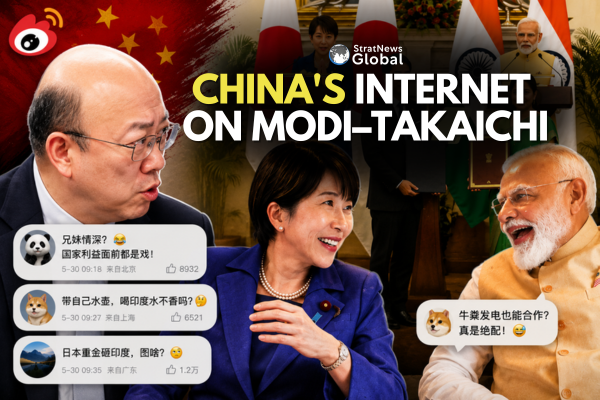
Chinese social media’s reaction to Takaichi’s visit was even more interesting. Trending hashtags such as # Why Is Japan Spending Big Money On India and # Modi And Takaichi Call Each Other Brother And Sister questioned Japan’s growing ties with India, with one popular comment saying, “Brother-sister diplomacy can solve nothing. National interests decide everything.”
Reports that Takaichi’s delegation brought bottled water from Japan also went viral under the hashtags # Sanae Takaichi Refused To Drink Indian Water During Visit and # Takaichi’s Government Aircraft Was Loaded With Bottled Water, fuelling memes targeting the Japanese leader.
But beyond the online humour, the visit also sparked a more serious geopolitical debate.
Qiao Lujing, Editor-in-Chief of the Chinese journal International Review, argued that the public display of warmth was political theatre designed to disguise a deeper strategic alignment between New Delhi and Tokyo.
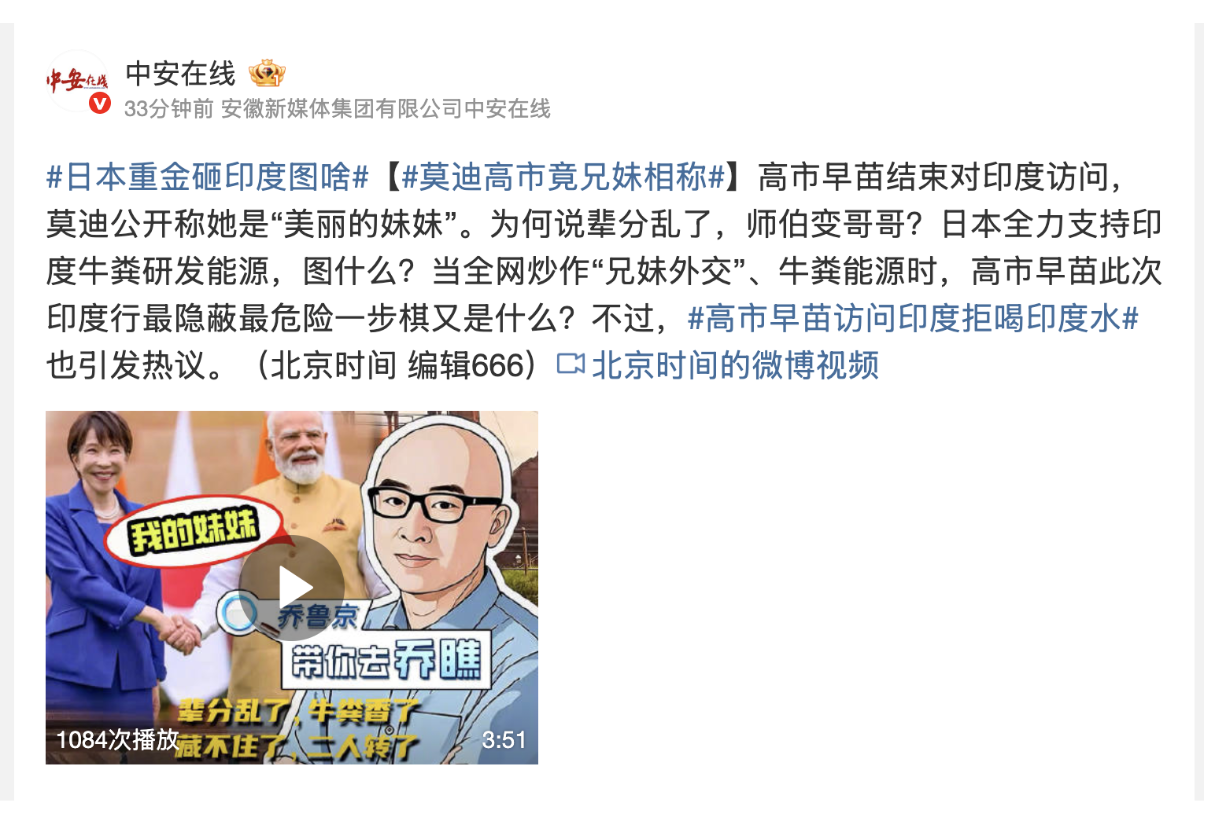
He claimed Japan’s support for India’s biogas projects was about positioning Japan inside India’s future clean-energy supply chains. He said Tokyo sees India’s vast agricultural waste resources as an opportunity to establish long-term technological and industrial influence.
But his real concern soon manifested itself. Japan’s commitment to infrastructure and industrial projects in India’s northeast, a region bordering China, Myanmar and Bangladesh, was in his view, Tokyo quietly establishing a strategic foothold along China’s southwestern periphery while strengthening India’s regional connectivity.
In his view, the 120 business agreements, the Japanese commitment to invest billions of dollars along with plans covering semiconductors and critical minerals, made it clear that a strategic alignment was in the offing.
He pointed to plans for an India–Japan “2+2” foreign and defence ministers’ dialogue, which he said, intended to balance China.
There was also speculation about a Japan-Philippines-India trilateral. Was this intended to draw India into the Pacific? Was it to shore up the naval sinews of Japan and the Philippines with India’s growing but muscular navy?
The intensity of China’s reaction was hardly surprising. Takaichi has long been a controversial figure in Chinese public discourse because of her outspoken positions on Taiwan and security issues. Previous visits to Taiwan have frequently made her the target of memes, cartoons and nationalist criticism on Chinese social media, and her India trip reignited much of that hostility.
For India and Japan, however, the visit represented another step in an expanding strategic partnership built around resilient supply chains, critical technologies and infrastructure cooperation.
Yet the reaction on Chinese social media underscored how closely Beijing’s online ecosystem is watching every move in the growing India-Japan relationship. What New Delhi and Tokyo presented as economic cooperation and strategic convergence was interpreted by many Chinese commentators not as routine diplomacy, but as another chapter in an increasingly competitive geopolitical contest across the Indo-Pacific.