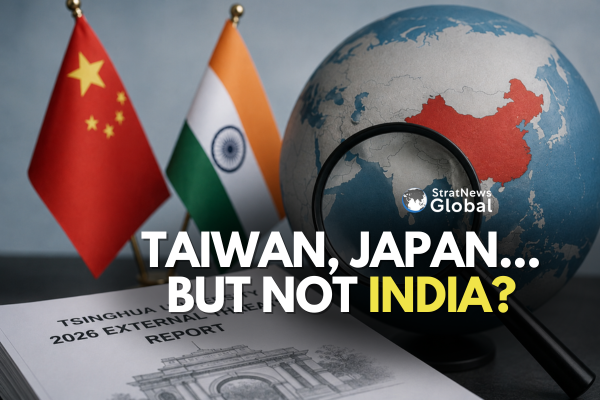
When an institution like China’s Tsinghua University, often compared to Harvard in the US with a budget to match, comes out with a list of external threats, it bears close study.
The 2026 study, released in June 2026, lists 10 threats with Taiwan, Japan and the tech battle with the US as Beijing’s top three priorities.
At fourth place is the South China Sea, which the study describes as a “major flashpoint”, followed by “Global Economic Shocks”, and the Russia-Ukraine war with its fallout on China’s ties with Europe, the US and, of course, Moscow.
Europe’s moves towards lessening dependence on China are described as a “long-term challenge”, followed by AI-powered cyber attacks on critical infrastructure. There is also a reference to Chinese investments coming under pressure overseas, while the study says “the final concern is North Korea” with its nuclear and missile programmes.
Interestingly, India does not feature among the report’s principal external threats, nor has it been listed among the major threats in the previous four editions. However, the report does briefly mention India in the context of the United States, suggesting that Washington and New Delhi could engage in proxy efforts against China. In the background of the Galwan clash in 2020 and China’s role in support of Pakistan during Operation Sindoor, India’s absence from the main list of threats may come as a relief for some, and an insult for others.
Atul Aneja, who was The Hindu‘s correspondent in Beijing (2014–20), told SNG that if a publication from Tsinghua University does not place India among its key threats, it may reflect the thinking of a section of the Chinese establishment. It could also be a signal to India at a time when President Trump’s policies have upended several geopolitical relationships.
A Washington-Delhi trade deal has seen little movement. Instead, India is in the crosshairs over its purchase of Russian oil, the Quad appears to have weakened, and the emphasis is no longer on the Indo-Pacific.
Manoj Kewalramani, who heads the Indo-Pacific Studies Programme at the Takshashila Institution, told SNG that, “I think the lack of mention of India reflects an assessment of the current state of the relationship. Both countries are tending towards easing engagement. There is a mechanism by which boundary tensions are being talked about. In contrast, the risks for Beijing are evidently along its eastern and southern seas, the Western Pacific and in West Asia.”
He further added that, “None of this, of course, means that the relationship with India is not difficult. It remains a challenge, but not an immediate, pressing concern for Beijing.”
Former R&AW officer and China expert Jayadeva Ranade, however, cautioned against concluding that China does not see India as a challenge. He pointed out that while India is not discussed as one of the report’s major threats, it is mentioned alongside the United States, suggesting that the two countries could engage in proxy efforts against China. According to Ranade, this reflects Beijing’s tendency to view India through the prism of its strategic competition with Washington.
Also, while India may not be an existential threat to Beijing, it is certainly a challenge, a problem and more than just an irritant. In his assessment, China’s perception of India changed around 2017-18, eventually leading to the military confrontation in eastern Ladakh in 2020.
He said China’s actions on the ground tell a different story from what the report suggests. If Beijing did not consider India a challenge, there would have been little reason to maintain its military deployments along the Line of Actual Control or delay de-escalation. Instead, China has continued to strengthen its posture by bringing advanced technologies and new weapon systems into the Tibetan Plateau and the Western Theatre Command, signalling that it is preparing for a more high-tech military competition with India.
Ranade believes another reason China avoids describing India as a direct threat is because it wants to keep the door open for better ties. According to him, Beijing hopes that sustained diplomatic, economic and military pressure could eventually persuade India to move away from its close partnership with the United States. China, he said, wants access to the Indian market while simultaneously applying pressure until New Delhi becomes more accommodating to its interests.
He also sees China’s repeated warnings against closer India-US and India-Japan cooperation as part of the same strategy. Beijing remains concerned that deeper collaboration between India and Japan, particularly in defence manufacturing, technology and strategic cooperation, could create a significant challenge for China. According to Ranade, this explains why Chinese commentary frequently urges India not to align itself too closely with Washington or Tokyo.