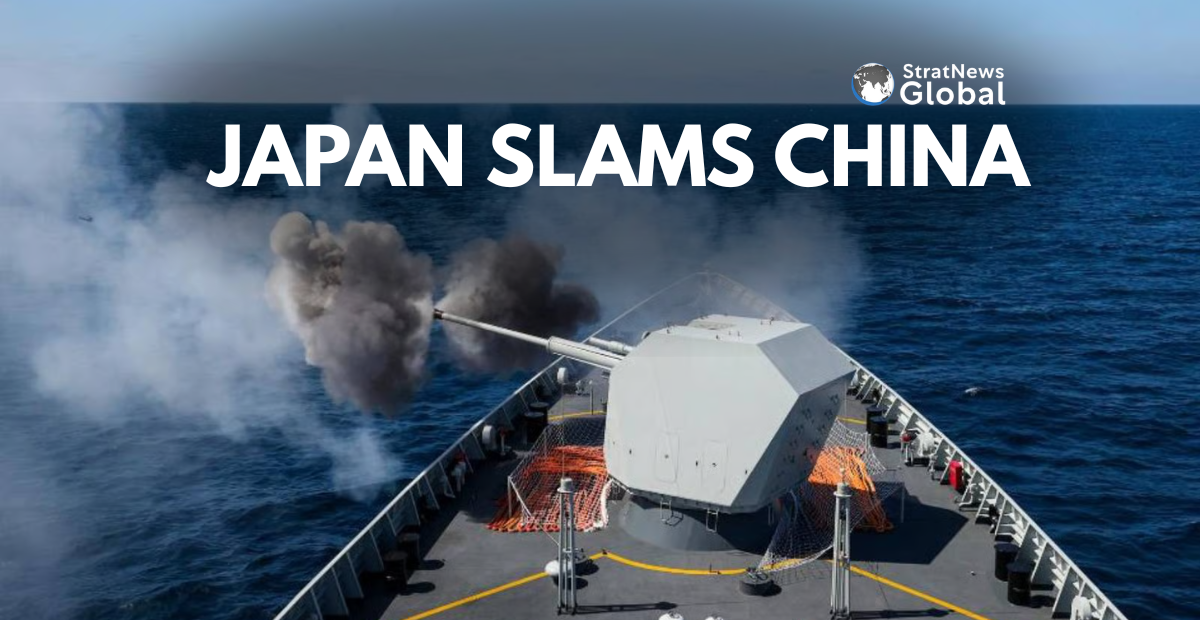
Japan has lodged a formal diplomatic protest with China after Chinese naval vessels conducted live-fire exercises inside what Tokyo considers its Exclusive Economic Zone (EEZ), marking another flashpoint in the increasingly strained relationship between the two Asian powers.
According to Japan’s Defence Ministry, the drills took place early Sunday around 180 kilometres southwest of Okinotori Island and involved both Chinese and Russian warships. Tokyo said the exercises prompted concerns over the safety of commercial shipping in the area.
Chief Cabinet Secretary Minoru Kihara said Japan protested through diplomatic channels, arguing that the military activity posed potential risks to vessels navigating nearby waters.
“The Japanese government lodged a protest with China through diplomatic channels, on the grounds that such activities could pose a danger to the navigation of nearby vessels,” Kihara told reporters.
Dispute Over Okinotori’s Status
The incident also revives a long-running legal dispute over Okinotori, a tiny atoll in the western Pacific.
Japan classifies Okinotori as an island under international law, allowing it to claim a 200-nautical-mile Exclusive Economic Zone around it. China, however, argues that Okinotori is merely a rock and therefore does not generate an EEZ under the United Nations Convention on the Law of the Sea (UNCLOS).
Beijing did not immediately comment on Japan’s latest protest.
First Publicly Disclosed Incident
A spokesperson for Japan’s Self-Defense Forces said this was the first time Tokyo had publicly revealed that China had conducted live-fire drills inside its claimed EEZ.
However, Japanese officials also acknowledged that the drills themselves did not violate international maritime law because nearby vessels had been warned via radio before the live firing began.
China-Russia Naval Cooperation Expands
Japanese surveillance aircraft tracked four warships approaching the area before the exercise.
The flotilla included:
A Chinese Renhai-class guided-missile destroyer
A Luyang III-class guided-missile destroyer
A Fuchi-class replenishment vessel
A Russian Steregushchiy-class frigate
The joint exercise reflects growing military cooperation between Beijing and Moscow, which have expanded coordinated naval and air patrols around Japan in recent years.
Relations Continue to Deteriorate
The latest incident comes amid worsening political ties between Tokyo and Beijing.
Relations have remained tense since Japanese Prime Minister Sanae Takaichi made remarks supporting Taiwan late last year, triggering strong criticism from Beijing and leading to a series of Chinese economic countermeasures.
China has also stepped up military operations around Japan and Taiwan, while Tokyo has responded by strengthening surveillance and reinforcing military deployments across its southwestern island chain.
Tensions escalated further in December when Japan accused Chinese fighter aircraft of locking radar onto Japanese military planes near Okinawa—an allegation Beijing denied.
The latest naval confrontation underscores the increasingly contested security environment in the Western Pacific, where territorial disputes, military manoeuvres and strategic rivalry continue to test regional stability.
(with inputs from Reuters)