The Lobito Corridor is emerging as a key front in the global competition for Africa’s critical minerals, as the United States steps up efforts to secure strategic resources while reducing dependence on China-dominated supply chains.
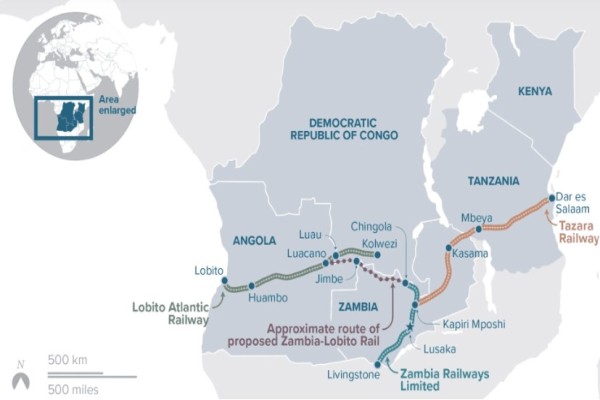
The transport network links Angola’s Atlantic port of Lobito with the copper- and cobalt-rich regions of the Democratic Republic of Congo (DRC) and Zambia, providing an alternative export route to global markets.
Washington has committed a $553 million loan through the US International Development Finance Corporation (DFC) to modernise Angola’s Benguela Railway and expand freight capacity along the corridor.
The project is expected to improve the movement of copper, cobalt and other critical minerals used in electric vehicles, renewable energy technologies, semiconductors and defence manufacturing.
For the United States, the corridor is more than an infrastructure project. It is part of a broader strategy to build resilient supply chains for critical minerals and reduce China’s influence over global processing and distribution networks.
The initiative complements the US-DRC Strategic Partnership on critical minerals, which aims to deepen cooperation on the production and supply of cobalt and copper.
While the project gained momentum under the Biden administration as part of a wider G7-backed infrastructure push, the current US approach places greater emphasis on securing long-term access to strategic resources.
Supporters say the corridor could boost regional trade, improve connectivity and create jobs across Angola, Zambia and the DRC. Critics, however, argue that it risks prioritising Western strategic interests over African development.
Human rights groups have also warned that railway expansion could displace communities unless adequate safeguards are implemented, while development experts say greater investment in local processing and manufacturing is needed if African countries are to capture more value from their mineral resources.
The DRC is balancing ties with multiple partners rather than aligning exclusively with either Washington or Beijing. Earlier this year, Kinshasa expanded mining cooperation with China through agreements covering investment protection, data sharing and support for major mining projects, while also encouraging greater domestic mineral processing.
At the same time, it continues to work with the United States on infrastructure and critical mineral partnerships, reflecting a strategy aimed at attracting investment from competing powers.
Despite increased Western investment, China remains the dominant player in the global critical minerals ecosystem. Beyond mining, it controls much of the world’s processing capacity for rare earths and battery minerals and has spent years financing African railways, ports, processing facilities and long-term mining concessions, creating supply chains that are difficult to replicate.
Russia is also expanding cooperation with African countries on lithium and rare earths, while India is accelerating efforts to diversify critical mineral supplies through partnerships with Russia, Australia, Argentina, Japan and several African nations.
For New Delhi, access to Africa’s reserves of cobalt, copper, lithium, graphite, manganese and platinum group metals is central to its ambitions in electric mobility, renewable energy, semiconductors and defence manufacturing.
As competition intensifies, control over transport infrastructure such as the Lobito Corridor is becoming as strategically important as access to the minerals themselves.