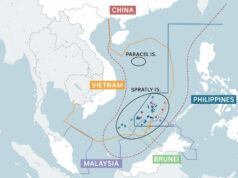
On July 6, roughly around the time Prime Minister Modi landed in Jakarta on an official visit, China test-fired what is believed to be a JL-3 ICBM from a submerged submarine deployed well within the First Island Chain.
The missile test also coincided with Australia and Fiji signing the Ocean of Peace Alliance that commits each to the defence of the other.
Was Beijing signalling its displeasure to Delhi and Jakarta amid reports that the latter was buying the Brahmos cruise missile made by the former? In hostile hands, the Brahmos could be a potent weapon in the contested waters of the South China Sea.
The Philippines has already bought it, Vietnam is reportedly in the market and if Indonesia also invests, China may have to prepare for a time when its territorial claims in the region will face far greater challenges.
In the case of Fiji, since the election of Prime Minister Sitiveni Rabuka in 2022, there’s been a push back against China’s growing influence and the deal with Australia is a reminder of that.
China’s Bigger Game
But strategic experts warn that for China, the missile test represents a bigger game of showcasing capabilities. Historically, China has lagged behind the US (and Russia) when it comes to submarines, but this test suggests it is getting there.
As mentioned earlier, the test was done from a submerged submarine stationed well within the First Island Chain.
“This is important because until now, it was widely accepted that China’s submarine launched JL-2 missile lacked sufficient range to target the continental US,” said Brig Arun Sahgal, (Retd), Director of the Forum for Security Initiatives in Delhi.
“With the JL-2, PLAN submarines had to transit the First Island Chain into the open Pacific where they get exposed to the formidable US and allied anti-submarine warfare assets. But the JL-3’s range is estimated to exceed 10,000-km, with that PLA submarines can now reliably target most of the US mainland while remaining safely within protected bastions of the South China Sea or the Bohai Sea,” he said.
In their own waters, PLA submarines are shielded by land-based air defences and coastal networks. This has enabled them to test the JL-3 missile to its full range and operational conditions, verify atmospheric re-entry, terminal guidance accuracy and the performance of its solid fuel rockets.
The JL-3 is believed to support Multiple Independently Targetable Reentry Vehicles (MIRVs), allowing a single missile to deploy multiple nuclear warheads to distinct targets. Testing it across a realistic trajectory validates the complex post-boost release mechanisms necessary to penetrate modern ballistic missile defense systems.
“By demonstrating an undeniable sea-based capability to strike the U.S. mainland, Beijing is seeking to increase the strategic cost for Washington should it choose to militarily intervene in Taiwan or the South China Sea,” Sahgal warned.
Implications for India
There are implications for India too. China no longer needs to commit so many attack submarines to the defence of its Pacific deterrent, rather it can now focus on the Indian Ocean Region and project its conventional power there.
This drastically increases India’s “two-front” strategic dilemma, extending the threat from the Himalayas down into India’s maritime backyard. It underscores the widening capability gap between the two navies, China’s JL-3 with its 10,000-km range vs India’s K-4 of 3,500-km and K-5 of 5,000-km (under development).
“China can act with far greater risk-tolerance and assertiveness on its land borders with India, confident that its strategic rear is bulletproof,” Sahgal told StratNewsGlobal, “also expect an influx of Chinese dual-use ‘oceanographic research’ vessels into the Bay of Bengal and the Arabian Sea.These vessels map the hydro-acoustic and thermal profiles of the Indian Ocean—vital data required for PLAN submarines to hide and for their assets to hunt India’s Arihant-class submarines.”
It explains India trying to fast track theatre commands and integrating them with space-based tracking (using NavIC and military satellites), cyber defence, and naval assets into a unified grid. India is also boosting anti-submarine warfare assets, expanding the fleet of P8I maritime reconnaissance aircraft, deploying sensors at choke points like the Malacca Straits and modernising the submarine fleet.