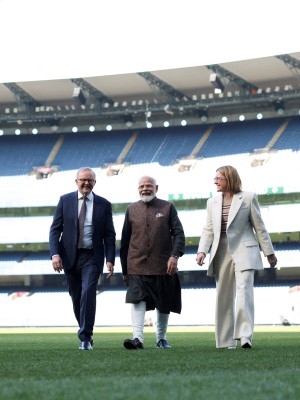
Prime Minister Narendra Modi and Australian Prime Minister Anthony Albanese on Friday launched the India-Australia Sports Collaboration Roadmap at the Melbourne Cricket Ground (MCG), positioning sports as a new pillar of the two countries’ Comprehensive Strategic Partnership.
The roadmap expands bilateral cooperation beyond defence, trade and education into sports science, athlete development, technology, infrastructure, investment and youth engagement, as both countries prepare to host major international sporting events over the next decade.
Launching the initiative alongside Albanese, Modi said sports had become a powerful force connecting the people of India and Australia and that the new partnership would extend well beyond cricket.
Speaking at the MCG, Modi said the roadmap would promote collaboration in sports training, coaching, sports science, technology and institutional partnerships, creating opportunities for both countries to share expertise and build stronger sporting ecosystems.
He also highlighted India’s Khelo India programme, saying talent is increasingly emerging from small towns and rural areas, opening new avenues for international cooperation.
The roadmap establishes a framework for cooperation across high-performance sports centres, coach education, sports science research, athlete performance analytics, injury prevention, sports technology, anti-doping initiatives and partnerships between Indian and Australian universities.
It also commits both countries to expanding cooperation in para-sports, women’s sports, physical education exchanges and youth development. A proposed India-Australia Youth Sports Festival is expected to strengthen grassroots participation and deepen people-to-people ties.
The agreement encourages sporting bodies, universities, businesses and state governments to work together through long-term, project-based partnerships to implement the roadmap.
Both leaders said the next decade presents a significant opportunity for collaboration as India and Australia prepare to host some of the world’s biggest sporting events.
India is due to host the 2030 Commonwealth Games and is pursuing its bid for the 2036 Olympic Games, while Brisbane will stage the 2032 Olympic and Paralympic Games.
Modi said preparations for these events would require large-scale investment in sporting infrastructure, creating opportunities for knowledge sharing, technology transfer and institutional cooperation.
Albanese said the roadmap would also strengthen collaboration in hosting major sporting events while generating broader opportunities in tourism, trade, investment and the sports industry.
Among the major announcements, Albanese revealed that the opening match of the upcoming Big Bash League season will be played in Chennai on December 12, making it the tournament’s first-ever fixture in India.
The match between the Melbourne Renegades and Perth Scorchers will launch the week-long ‘G’day Namaste’ Festival of Australian Sport, Culture and Business Engagement, bringing together sporting competitions, business leaders and cultural exchanges.
The roadmap also encourages Cricket Australia and the Board of Control for Cricket in India (BCCI) to explore staging Big Bash League matches in India on a regular basis.
While cricket remains the strongest sporting link between the two countries, the roadmap broadens cooperation into sports equipment manufacturing, broadcasting, event management, sports start-ups, high-performance coaching, athlete wellbeing, nutrition and sports psychology. It also aims to increase India’s exports of sporting goods to Australia while encouraging greater Australian investment in India’s expanding sports sector.
The agreement places particular emphasis on promoting women’s participation and leadership in sport through joint tournaments, leadership programmes and initiatives focused on health, inclusion and high performance.
The event at the MCG was attended by Victoria Premier Jacinta Allan, former Australia captain Steve Waugh and former Australia international Lisa Sthalekar, reflecting the importance both governments have attached to sports diplomacy.
Modi and Albanese also met young athletes participating in exhibition matches of cricket, football and kabaddi, highlighting the growing sporting exchanges between India and Australia.