Nearly three years after the killing of Khalistani activist Hardeep Singh Nijjar plunged India-Canada ties into their worst diplomatic crisis in decades, the investigation has taken a dramatic turn.
The focus has shifted from allegations of Indian state involvement to a sprawling transnational organised crime network allegedly led by jailed gangster Lawrence Bishnoi.
The shift is significant, though not absolute.
When then Canadian Prime Minister Justin Trudeau told Parliament in September 2023 that there were “credible allegations” linking Indian agents to Nijjar’s murder, relations between Ottawa and New Delhi deteriorated sharply. Diplomats were expelled, trade talks stalled and intelligence cooperation suffered.
Now, following a multinational investigation codenamed Operation Hard Ball, US prosecutors have charged Lawrence Bishnoi and his close associate Satinderjeet Singh with directing Nijjar’s assassination.
The charges are part of sweeping indictments against 37 individuals linked to three India-based crime syndicates accused of murder, extortion, drug trafficking, firearms offences and racketeering across several countries.
While announcing the indictments alongside the FBI and US prosecutors, the Royal Canadian Mounted Police (RCMP) did not repeat earlier public allegations pointing to Indian state involvement. But nor did it declare the Government of India exonerated. Instead, investigators publicly identified organised crime figures as the alleged architects of the killing, while making clear that broader investigations remain ongoing.
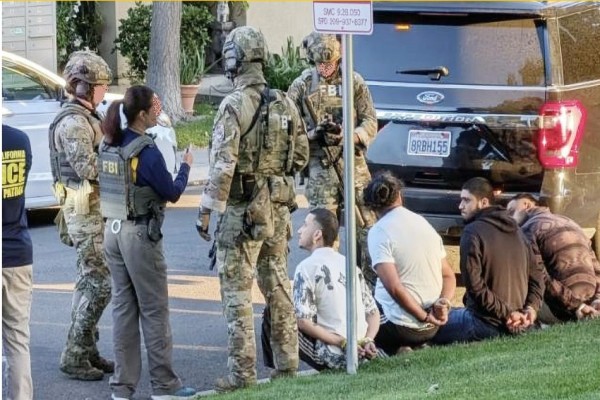
Operation Hard Ball is among the largest coordinated actions ever mounted against Indian organised crime overseas. More than 50 raids across the United States, Canada and Europe resulted in around two dozen arrests, along with seizures of drugs, firearms and cash. Authorities described the operation as the culmination of a two-year investigation involving law enforcement agencies across North America, Europe and Asia.
Prosecutors allege Bishnoi, despite being imprisoned in India, continued directing criminal operations through an international network. They accuse him and Satinderjeet Singh of ordering Nijjar’s assassination outside the Guru Nanak Sikh Gurdwara in Surrey, British Columbia, in June 2023.
The indictments portray the Bishnoi organisation as a global criminal enterprise operating across the United States, Canada, the United Kingdom, Portugal, Australia and New Zealand through extortion, narcotics trafficking, contract killings and money laundering.
The developments also intersect with another unresolved case involving alleged Indian links to overseas plots.
In the United States, prosecutors have charged Indian national Nikhil Gupta with participating in an alleged murder-for-hire conspiracy targeting Sikh separatist Gurpatwant Singh Pannun in New York.
According to US prosecutors, Gupta claimed he was acting at the direction of an Indian government official, an allegation India has denied. New Delhi has set up a high-level inquiry into the case and said it will act on its findings. Unlike the Nijjar investigation, however, the Pannun case remains before US courts.
For India, the latest indictments offer measured diplomatic relief without amounting to complete vindication.
New Delhi has consistently rejected allegations that it was involved in Nijjar’s killing, arguing that Canada produced no publicly available evidence to support its accusations. The new charges strengthen India’s long-standing contention that organised criminal networks deserve closer scrutiny. At the same time, Canadian authorities have not withdrawn earlier allegations or announced that investigations into possible government links have concluded.
That distinction means the diplomatic story is still unfinished, but the narrative has unmistakably changed. The Nijjar case is now being driven less by political allegations and more by criminal indictments naming specific gang leaders, operational networks and financial links.
For Canada, Operation Hard Ball reinforces concerns about the reach of transnational criminal organisations within the South Asian diaspora. Investigators allege these syndicates use extortion, intimidation and targeted violence while coordinating operations across multiple countries through encrypted communications and international financial networks.
The implications extend well beyond India and Canada. The operation illustrates how organised crime increasingly overlaps with political violence and diaspora activism, creating security challenges that transcend national borders. It also underscores the growing reliance on multinational investigations, intelligence sharing and coordinated prosecutions to dismantle criminal enterprises operating across jurisdictions.
Whether the latest developments help repair India-Canada relations remains uncertain. The diplomatic damage caused by the Nijjar affair runs deep, and trust between the two governments will take time to rebuild.
What Operation Hard Ball has done, however, is fundamentally recast one of the most contentious international investigations in recent years.
The case that once centred almost exclusively on allegations of state-sponsored assassination is now increasingly defined by the global reach of organised crime.
Political questions have not disappeared, but the centre of gravity has shifted—from diplomacy to the transnational criminal networks that investigators now say orchestrated the killing.