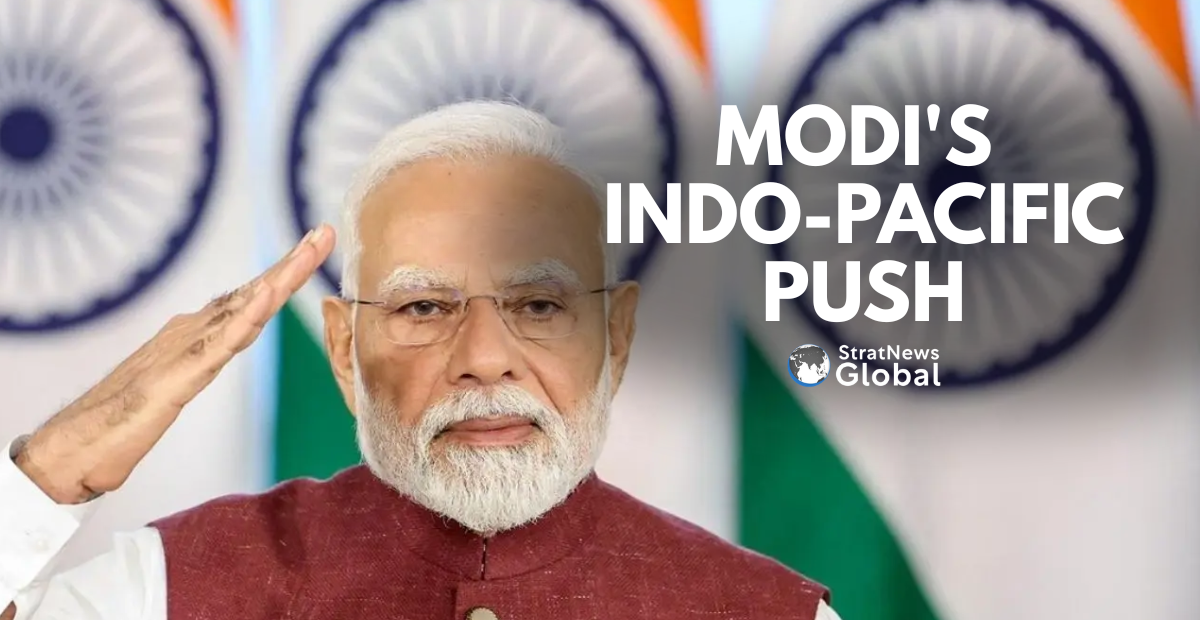
Prime Minister Narendra Modi will embark on a three-nation tour of Indonesia, Australia and New Zealand from July 6 to 11. This visit is expected to reinforce India’s Act East policy while deepening strategic, economic and people-centric partnerships across the Indo-Pacific.
The visit comes on the heels of Modi’s engagements in Mauritius, Seychelles and Japan, reflecting what officials describe as a calibrated expansion of India’s maritime outreach, from the Western Indian Ocean to the eastern maritime region.
“Over the last two weeks, the Prime Minister has been very focused on the Western Indian Ocean region. Now, with the visits to Japan, Indonesia, Australia and New Zealand, the focus has shifted to the eastern maritime zones of the Indian Ocean and our Act East engagement,” Secretary (East) Rudrendra Tandon said while briefing the media ahead of the visit.
The first leg of the tour will take Prime Minister Modi to Indonesia from July 6 to 8 at the invitation of President Prabowo Subianto. This will be his fourth visit to Indonesia and the first bilateral visit since the relationship was elevated to a Comprehensive Strategic Partnership in 2018.
The two leaders are expected to review progress across the bilateral relationship, with discussions likely to span maritime cooperation, defence, trade, economic engagement and cultural exchanges.
Describing Indonesia as a cornerstone of India’s Indo-Pacific engagement, Tandon said the partnership has become “a major building block of India’s Act East Policy and the MAHASAGAR vision” since its elevation eight years ago.
“Given its size and geography, Indonesia has always played an important role for the security and stability of the Malacca Straits maritime zone. It represents one of the most important sea lanes of communication for India, and indeed for the global economy,” he said.
A key highlight of the visit will be the Prime Minister’s trip to Yogyakarta, where he will visit the UNESCO World Heritage-listed Prambanan Temple complex. India and Indonesia are expected to collaborate on conservation work at the historic site, with the Archaeological Survey of India likely to play a leading role, although officials said discussions on the framework are still underway.
He also indicated that connectivity projects, including cooperation around Sabang Port, remain under active consideration. While no major announcement is expected during this visit, India and Indonesia continue to work through a bilateral task force to strengthen maritime connectivity.
On the trade front, Tandon said discussions on the review of the ASEAN-India Trade in Goods Agreement (AITIGA) would continue, but stressed that the process remains a multilateral negotiation involving all ten ASEAN member states.
“We discuss with all our ASEAN partners the importance of reviewing the agreement, which is now quite old and no longer reflects the present-day structures of the economies in India and ASEAN,” he noted.
From Indonesia, Prime Minister Modi will travel to Melbourne from July 8 to 10 for the third India-Australia Annual Summit with Prime Minister Anthony Albanese.
The summit, the highest-level institutional dialogue under the India-Australia Comprehensive Strategic Partnership established in 2020, is expected to review progress across defence, trade, technology and strategic cooperation.
According to Joint Secretary (Oceania and Indo-Pacific) Vishwesh Negi, the leaders are expected to discuss emerging sectors such as critical minerals, cybersecurity, resilient supply chains and advanced technologies.
Trade negotiations will also figure prominently. India and Australia are currently working towards concluding a balanced Comprehensive Economic Cooperation Agreement (CECA), building on the Economic Cooperation and Trade Agreement signed in 2022.
“Our teams are closely engaged. We are expecting a balanced document to be adopted by both sides, and further rounds of negotiations between the chief negotiators will take place soon,” Negi said.
The current visit is intended to inject fresh momentum into the CECA negotiations. Once concluded, the agreement is expected to include a dedicated chapter on agricultural cooperation, agricultural technology and bilateral trade in agricultural products.
Defence cooperation is also expected to feature prominently.
“Defence has emerged as one of the key sectors of our bilateral cooperation over the last few years. The scale and frequency of engagements between our militaries have risen exponentially, and we expect the leaders to further expand cooperation into newer areas,” Negi said.
Responding to questions on uranium supplies, Negi noted that while the bilateral nuclear supply agreement has not been operationalised in recent years, discussions have gathered pace.
“There have been very substantive forward-looking conversations between the two sides, and we hope these discussions reach a logical conclusion,” he said.
Student mobility is also likely to be discussed, amid concerns over visa processing delays affecting Indian applicants.
the final leg of the tour will take the Prime Minister to Auckland from July 10 to 11, marking the first visit by an Indian Prime Minister to New Zealand in nearly 40 years. The last such visit was undertaken by former Prime Minister Rajiv Gandhi.
Modi will hold talks with New Zealand Prime Minister Christopher Luxon, whose 2025 visit to India, including participation in the Raisina Dialogue, gave new momentum to bilateral ties.
Since then, both countries have rapidly expanded cooperation, culminating in the signing of a bilateral Free Trade Agreement.
“The relationship has seen an inflection since Prime Minister Luxon’s visit. We now hope to impart even greater content to this partnership in line with the importance India attaches to the Pacific region,” Tandon said.
The discussions are expected to cover trade, defence, business cooperation and people-to-people exchanges. Modi will also engage with business leaders, sports personalities and members of the Indian diaspora.
On concerns regarding immigration measures under discussion in New Zealand, Tandon said India’s priority remains facilitating mobility for skilled professionals rather than focusing solely on migration.
“This issue has also been addressed in the recently signed India-New Zealand FTA,” he said.
While each bilateral relationship has its own priorities, Tandon said a common thread runs through India’s engagement across the region.
“We look at trade, defence and security cooperation, and the cultural connect. Alongside these, we are increasingly working on emerging areas such as energy, renewables and critical minerals depending on the strengths of each partner,” he said.
He also stressed that preserving a rules-based maritime order remains central to India’s regional approach.
The Secretary added that India will continue to raise the issue of terrorism during all high-level engagements.