On the evening of March 21, 2026, tens of thousands of fans packed Gwanghwamun Square in central Seoul. BTS, the famous K-pop group that had gone quiet for nearly three years while its members served South Korea’s mandatory military service, was back.
The concert marked the return of the world’s biggest K-pop group after all seven members completed South Korea’s mandatory military service. For fans, it was an emotional reunion. For South Korea, it was the return of one of its most valuable economic assets.
Within days, ‘BTS ARMY’ had mobilised across continents. K-pop merchandise sales surged by 190% week-on-week, according to data published by Seoul Economic Daily. Yonhap News Agency says, South Korea recorded 1.1 million foreign arrivals in the first 18 days of March, a 32.7% increase over the previous year. The concert itself reportedly cost less than $300,000 to stage.
The question arises, can a pop group become an economic asset of national importance? In the case of South Korea, the answer is yes.
A 2019 Hyundai Research Institute (HRI) report put BTS’s annual contribution to South Korea’s economy at over $4.65 billion, equivalent to the output of nearly half a million average Korean workers, and comparable, in GDP terms, to Korean Air.
HRI also projected a ten-year economic impact of 56.2 trillion won (~$49.8 billion), surpassing the 2018 PyeongChang Winter Olympics. In 2017, one in every 13 foreign tourists visited South Korea specifically because of BTS. The group accounted for 1.7% of total Korean consumer goods exports that year.
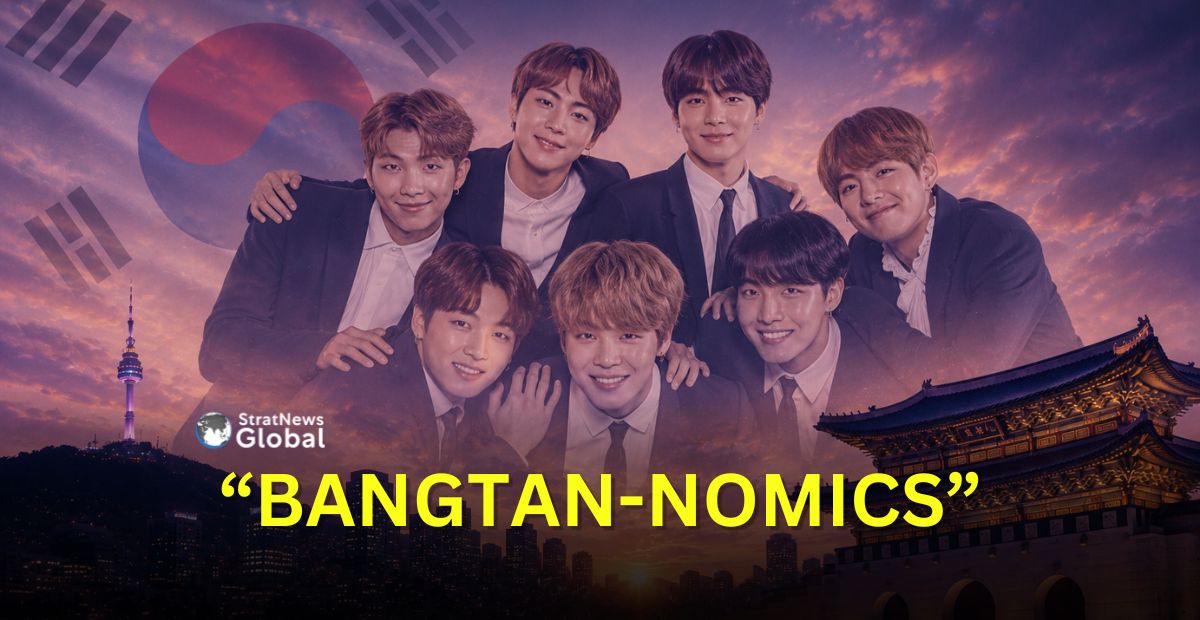
South Korean brokerage NH Securities coined the term “Bangtan-nomics” to describe the ripple effect created by BTS.
The scale of that influence became even clearer during the group’s military hiatus. When all seven members were in uniform by late 2023, BTS’s parent company, HYBE’s stock, nearly halved. HRI estimated the absence cost South Korea approximately $3.6 billion annually.
The group’s influence has grown so large that it has even found its way into diplomacy. Earlier this year, Mexican President Claudia Sheinbaum asked South Korean President Lee Jae Myung if more BTS concerts could be held in Mexico after tickets sold out within minutes. While Seoul said the decision rested with the band and its agency, the exchange underscored BTS’s growing role as a cultural and economic asset.
Their ongoing Arirang World Tour is projected to generate between $1.3 and $1.87 billion, rivalling Taylor Swift’s ‘Eras Tour’ in per-show efficiency despite fewer than half the number of performances. Global markets have already shown the economic impact of major concert tours. Taylor Swift’s international tour generated substantial consumer spending in every host city, leading to the popularization of the term “Tayloronomics.”
The Korea Culture and Tourism Institute estimates that a single BTS concert in Seoul generates up to $920 million in overall economic impact. The Goyang leg of the Arirang tour in April 2026 saw a 3,377% increase in foreign tourist arrivals.
This influence is also evident in India.
When the group released its Permission to Dance on Stage, Seoul concert broadcast in theatres, the event earned over ₹1.6 crore at the Indian box office in a single weekend, highlighting the scale of demand among Indian fans.
HYBE’s estimates suggest that the group contributes significantly to India’s entertainment economy through multiple channels, including music streaming, cinema screenings, brand collaborations, and merchandise sales.
Recognising the growing commercial potential of the Indian market, HYBE’s move towards establishing an India-focused subsidiary signals a shift from treating India as a fan market to viewing it as a long-term business opportunity.
In BTS, South Korea has built more than just a global music phenomenon, it has created a powerful engine for tourism, trade and soft power.