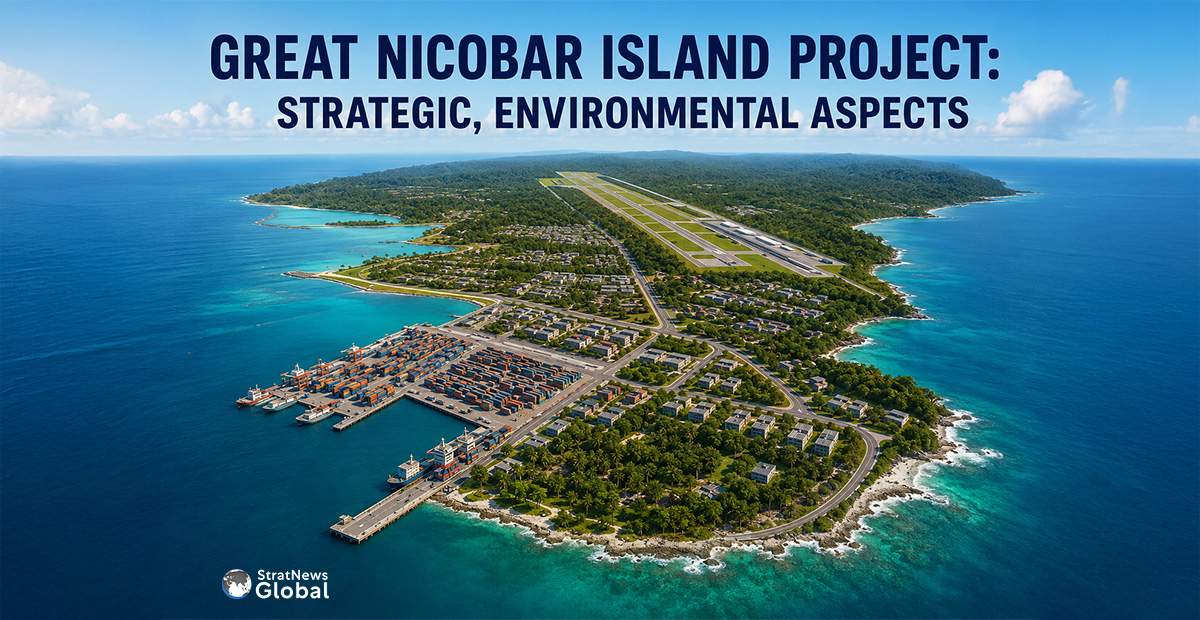
When it comes to the Great Nicobar Island project, two key aspects that dominate the discourse are the strategic significance of the location and the environmental impact, other than the creation of a deep-water port and associated infrastructure.
The Strategic Aspect
Since Independence, India’s defence forces have operated out of the Andaman and Nicobar Islands. More significantly, since 2001, there has been an Integrated Tri-Services Command.
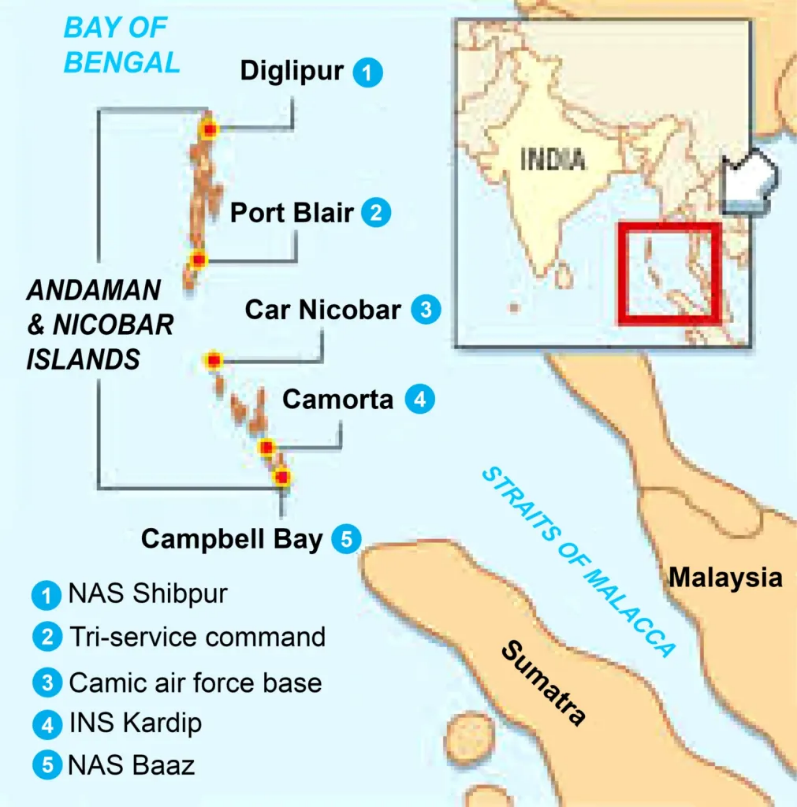
The usage of the word ‘strategic’ with the Great Nicobar Island project has caused consternation in certain quarters within India, including in political circles. One of the reasons for this feeling is that the project is an infrastructure project and should not be connected to the island’s ‘strategic’ location or the security consequences for India, which are widely known. But it is important to remember that the term ‘strategic’ has meanings beyond security. For example, the Public Sector Enterprise (PSE) policy for Atmanirbhar Bharat of February 2021 (for disinvestments) identifies important sectors, such as transportation and defence, based on critical infrastructure and national security. One of the sub-groups of the Great Nicobar Island project is an airport. Everyone agrees on the site and its military importance. Therefore, it is not only wise but also essential to classify the Great Nicobar Island project as ‘strategic’ in this perspective.
Watch our exclusive documentary series from the Andaman & Nicobar Command: Arc Of Power
The Environmental Impact
The environmental dimension is perhaps the most debated aspect of the Great Nicobar Island project and one that is generating the most controversy.
To assuage any apprehensions, the Government of India has put out comprehensive Frequently Asked Questions (FAQ) about the project through the Press Information Bureau (PIB) on May 01, 2026. Great Nicobar is one of the largest islands in the Andaman and Nicobar Island chain, with an area of 910 sq. km. The Lieutenant Governor of Andaman and Nicobar Islands, who is also the Vice-Chairman of the Islands Development Agency highlighted in a recent opinion column in The Indian Express: “The total project area of 166.10 sq km is only about 2 per cent of the total area of the Andaman and Nicobar Islands, of which 130.75 sq. km, approximately 1.82 per cent of the total forest area of the islands, is proposed for diversion”.
Watch an exclusive with Admiral D.K.Joshi (Retd), the Lt Governor, Andaman & Nicobar Islands, in conversation with our Editor-in-Chief Nitin A. Gokhale.
The Right Balance
The Great Nicobar Island project has incorporated a comprehensive environmental protection framework aimed at balancing large-scale infrastructure development with rigorous ecological conservation. Before receiving clearance, the project underwent a detailed Environmental Impact Assessment (EIA) process under the EIA Notification, 2006, encompassing screening, scoping, public consultation and multi-stage expert appraisal. Clearance was additionally obtained under the ICRZ Notification, 2019, reflecting the island’s sensitive coastal ecology. The resultant environmental clearance is subject to 42 specific compliance conditions covering air and water quality, noise control, waste management, marine ecology, human health and disaster management, underpinned by a robust Environmental Management Plan (EMP) addressing both the construction and operational phases of the project. Several of India’s premier scientific institutions were engaged in environmental studies and assessments prior to the clearance.
Independent Assessment
The Zoological Survey of India (ZSI), Wildlife Institute of India (WII), Salim Ali Centre for Ornithology and Natural History (SACON) and the Indian Institute of Science (IISc) each conducted independent evaluations, with ZSI concluding that the project can proceed with appropriate safeguards in place. To ensure continuous oversight during implementation, three independent monitoring committees have been constituted—covering pollution control, biodiversity conservation and the welfare of the Shompen and Nicobarese tribal communities, respectively. An overarching committee, chaired by the Chief Secretary of the Andaman and Nicobar Administration, coordinates compliance across all stakeholders and serves as the central mechanism for inter-institutional oversight.
Safeguarding The Ecology
On forest conservation, critically, 65.99 sq. km within the project footprint will remain designated as green zones with no tree felling, ensuring a meaningful ecological buffer. The project also incorporates dedicated disaster preparedness measures, given the island’s location in a seismically sensitive and cyclone-prone zone. A comprehensive risk assessment covering tsunamis, earthquakes, cyclones and industrial hazards has been conducted, with a vulnerability and disaster management plan prepared accordingly. The project’s hybrid gas-solar power system further enhances operational resilience while reducing carbon emissions relative to the diesel-dependent energy infrastructure currently prevalent across the Andaman and Nicobar Islands. Taken together, these measures reflect a deliberate effort to ensure that the Great Nicobar Island project’s strategic and economic imperatives do not come at the cost of the island’s exceptional ecological heritage.
These views have been contested in the recent years by environmentalists who highlight likely irreversible damage to the island, including the Nicobar Megapode. The National Green Tribunal has accorded clearance to the project, while directing the agencies involved in executing the project to “ensure full and strict compliance with the environmental conditions”.
A cursory look around the globe highlights that there is always bound to be some impact (however limited), and justified opposition too, when large infrastructure projects are executed; Dakota Access Pipeline and Mountain Valley Pipeline in USA, Trans Mountain Pipeline Expansion, Coastal GasLink Pipeline in Canada, HS2 High-Speed Railway in the UK, the Carmichael Coal Mine and Snowy 2.0 Pumped Hydro project in Australia, Three Gorges Dam in China.
A Project Of Consequence
India, in the Preamble to its Constitution has enshrined “to secure to all its citizens JUSTICE, social, economic and political; EQUALITY of status and of opportunity”. The Great Nicobar Island project has strategic and economic ramifications for India since it aims to safeguard a future that is explicitly outlined in the Constitution as it determines its path towards 100 years of independence. As a thriving democracy, India will always have informed debates, discussions and deliberations since the Indian Constitution guarantees this. It is necessary to strike a delicate balance between environmental protection and development/strategic consequences. Ultimately, policymakers must balance environmental stewardship with India’s long-term economic and national security imperatives.
This is the concluding part of a two-part series. Read the first part here.
(The author holds a Ph.D. from the University of Mumbai and four master’s degrees. His areas of interest include geopolitics, geo-strategy, geo-economics, and their influence on national security and economic development, with India’s growth and security at its core. Views expressed here are personal.)