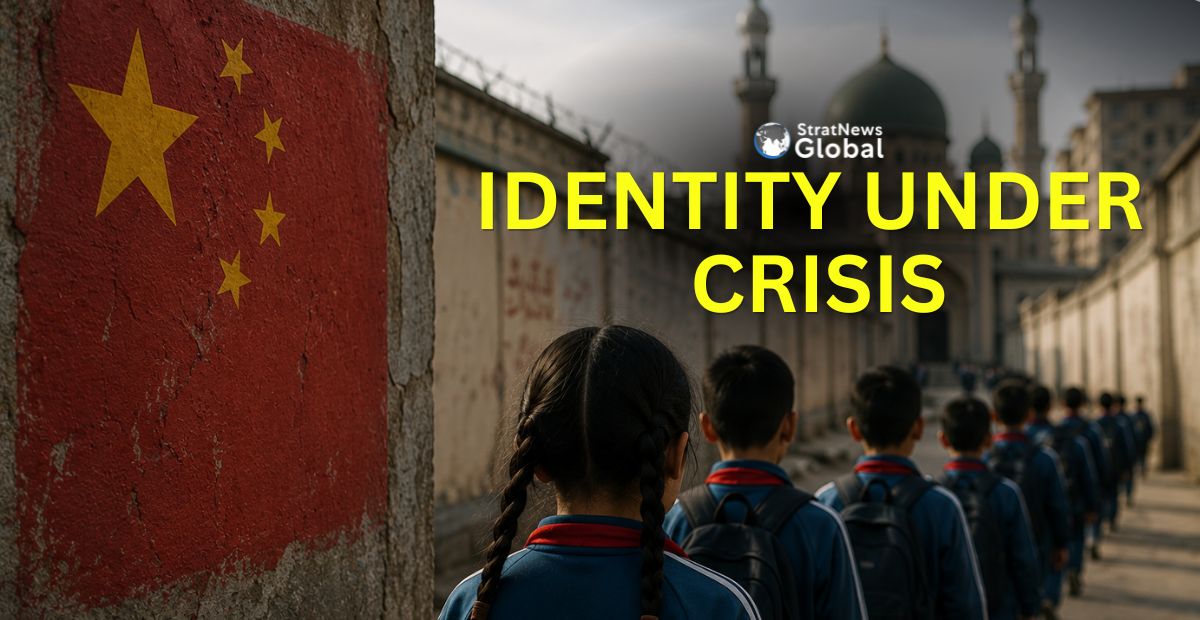
As China’s new Ethnic Unity Law came into force on July 1, Beijing described it as a step towards strengthening national unity and building what President Xi Jinping has called a “shared community of the Chinese nation.” But for many, the legislation marks the latest phase in a broader campaign to reshape the identity of ethnic minorities.
The law further strengthens state’s policies of promoting Mandarin as the dominant language of education while encouraging greater integration through state-run schooling.
Concern of gradually replacing the cultural identity of minorities in China has gained fresh momentum following a recent video circulated by Dao Zhonghua, an official media platform under China’s National Ethnic Affairs Commission.
Analysed by Kashgar Times, the video presents a controversial interpretation of Uyghur history, claiming that the ancient Turkic peoples disappeared by the eighth century and suggesting that modern Uyghurs developed separately within the broader Chinese civilisation. It also argues that speaking a Turkic language does not necessarily make the Uyghurs ethnically Turkic.
The historical narrative closely mirrors developments in Xinjiang’s education system.
Under Xi Jinping’s emphasis on building a unified national identity, rooted in his September 2019 speech on “one big family”, Beijing has steadily expanded policies promoting linguistic standardisation across minority regions, including Xinjiang, Tibet and Inner Mongolia.
State directives introduced in 2017 and expanded in 2021 accelerated the transition away from minority-language education.
Over the past decade, Mandarin has steadily replaced Uyghur as the principal language of instruction in many schools. PEN International has documented what it describes as severe restrictions on Uyghur-language publishing, literature and intellectual life, arguing that language has become a central arena of political control.
Beijing maintains that the policy improves educational outcomes and gives minority students better access to higher education and employment across China.
Critics, however, argue that language is more than a classroom tool. It is how communities preserve literature, oral traditions, religious learning and collective memory. When children stop learning in their mother tongue, culture begins to fade away.
PEN International highlights that even benign expressions of Uyghur identity have been treated as suspicious, while many people have faced punishment for attempts to preserve their culture. The organisation has also noted that more than one million Uyghurs and other Muslim minorities have reportedly been held in extra-judicial “re-education” camps, with language and literature becoming targets of the wider campaign.
Language is only one part of the debate. Recent reports also suggested a Pakistani vlogger’s visit to Xinjiang, where he found several mosques locked or converted for other uses, reflecting the region’s cultural and religious identity steadily being reshaped.
This language imposition no longer aims to simply promote Mandarin proficiency but to shape how future generations of ethnic minorities in China understand language, culture and its place within China.
Beijing rejects accusations of cultural assimilation, insisting its policies promote equality, development and national cohesion. Yet for many Uyghurs and international observers, the debate is no longer just about which language children speak in school, it is about whether a people can preserve their identity while being asked to redefine it.