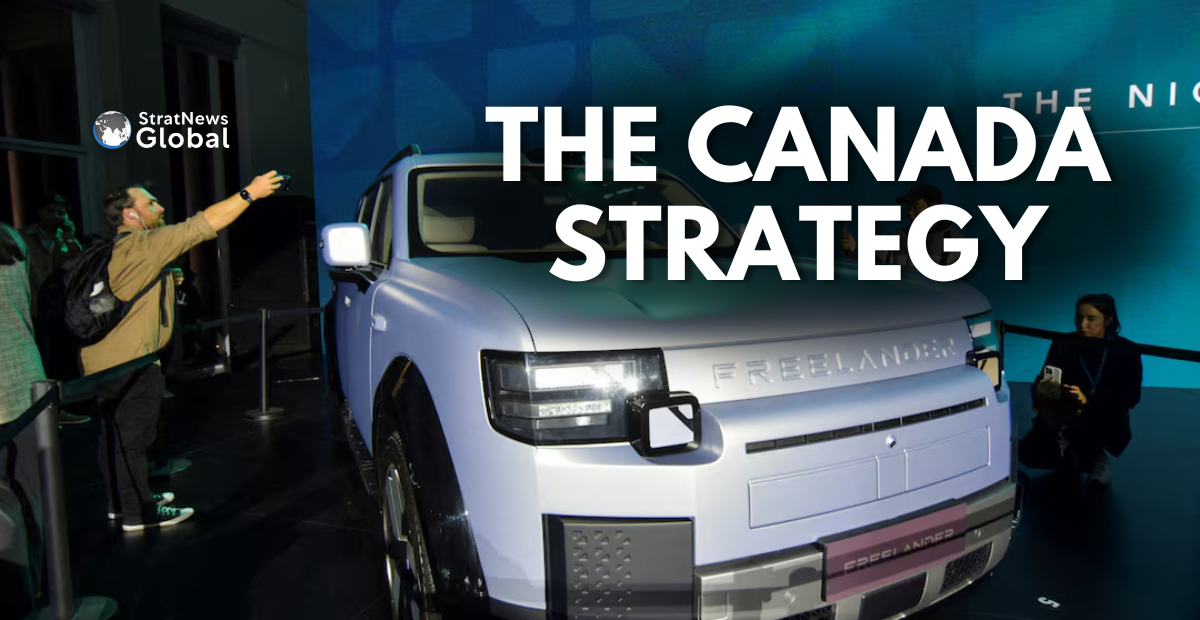
Just weeks after Canadian Prime Minister Mark Carney announced in January that Canada would allow limited imports of Chinese electric vehicles, some of China’s biggest automakers began laying the groundwork for expansion.
Chery, China’s largest vehicle exporter, held its first meetings with Canadian dealers shortly after the policy change.
Meanwhile, BYD, the world’s biggest EV maker, is planning to open six dealerships across Canada, according to an advisory firm helping identify locations. Regulatory records also show the company has begun compliance procedures to import two passenger vehicles into the country.
Luxury sports car manufacturer Lotus, owned by Geely, plans to launch around six dealerships in Canada this year, while state-owned automaker Changan is also preparing for a Canadian market entry.
Small Market, Bigger Ambitions
The moves come despite Canada’s limited market access for Chinese vehicles.
Ottawa currently allows imports of only 49,000 vehicles annually at a reduced tariff rate of 6.1%, with the quota increasing gradually to 70,000 vehicles over five years.
Industry observers say the real attraction is not Canada itself, but its similarities to the United States.
Canada’s vehicle regulations and consumer preferences closely mirror those south of the border, making it an ideal testing ground for Chinese manufacturers hoping to eventually enter the US market.
“Canada is the practice run for the US,” said Robert Kerwal, director of automotive solutions at JD Power Canada.
US Market Remains the Ultimate Prize
Chinese automakers have long viewed the United States as a key target market.
“We definitely have the idea of selling cars in the United States,” Chery International president Zhang Guibing said in May.
However, steep tariffs and restrictions on Chinese connected-car technology currently block most Chinese brands from entering the American market.
Some US lawmakers are also seeking to permanently codify those restrictions amid concerns over national security and growing Chinese competition.
Industry Concerns Grow
The prospect of Chinese brands gaining a foothold in North America has alarmed parts of the US auto industry.
The Alliance for Automotive Innovation warned that Canada’s trade arrangement with China could create a potential “backdoor” for Chinese vehicles to reach American consumers.
The group argues that Chinese vehicles pose both economic and national security concerns, whether they are imported directly or manufactured locally.
Canada Balances Trade and Politics
Canada’s decision to allow limited Chinese vehicle imports reflects its increasingly strained relationship with Washington.
Prime Minister Mark Carney has sought to reduce Canada’s economic dependence on the United States following trade disputes and political tensions with President Donald Trump.
At the same time, Canada continues to market itself to international investors as a gateway to North America.
Analysts note that while Canada’s market is relatively small and less profitable than many global markets, it offers Chinese manufacturers valuable experience, dealer networks and brand recognition ahead of any future expansion into the United States.
For companies such as BYD, Chery and Changan, Canada may be less about immediate sales and more about preparing for a much larger opportunity when the doors to America eventually open.
(with inputs from Reuters)