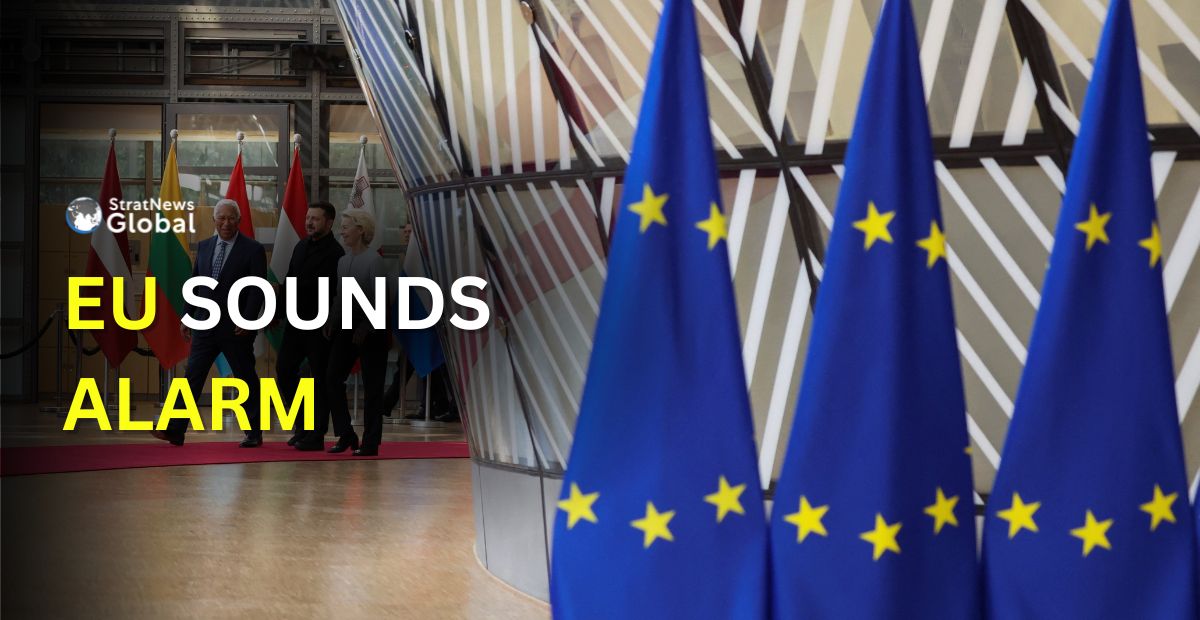
European Union leaders on Thursday discussed the need for stronger and more stringent measures to address the bloc’s widening trade imbalance with China and its significant dependence on the world’s second-largest economy for rare earths and other critical materials.
According to EU diplomats, the 27 member states are increasingly aligned in their view that the growing trade deficit with China, now estimated at around €1 billion ($1.15 billion) every day, has become a serious concern. The issue has gained added urgency as transatlantic tariff disputes continue to limit European access to the U.S. market.
Luxembourg Prime Minister Luc Frieden said he favoured dialogue with China, while insisting that trade relations had to be fair and not “a one-way street”.
Rare Earth Leverage
China’s goods trade surplus with the EU hit €360.6 billion in 2025, a 15% increase on 2024, and has expanded by 10% in the first four months of this year as Chinese firms have sold more to the EU and imported less.
Beijing has also exploited its dominance in processing of critical minerals by placing export restrictions on rare earths in April 2025, a response to U.S. President Donald Trump’s tariffs that has also hit EU companies.
Agreement On EU’s China Problem, Splits Over Response
To reduce its dependence on China, the EU has signed mineral partnerships and free trade agreements with Australia, India and Indonesia. At a summit in Brussels, leaders agreed that diversification efforts must go further and urged the European Commission to strengthen the bloc’s trade defences.
However, member states remain divided on the approach. France supports tougher measures, while Germany and Spain favour caution. The split surfaced when France, Italy, the Netherlands and Lithuania proposed new tools, including duties or quotas, to curb reliance on single foreign suppliers, though Spain later withdrew its support.
The EU has already intensified scrutiny of China, with 18 of 21 ongoing anti-dumping and anti-subsidy investigations targeting Chinese firms. Additional tariffs on Chinese electric vehicles have prompted retaliation from Beijing, while critics argue current trade defence measures remain too slow and limited.
The European Commission is expected to review its trade toolkit later this year, including possible new rules to reduce dependence on suppliers such as China.
(With inputs from Reuters)