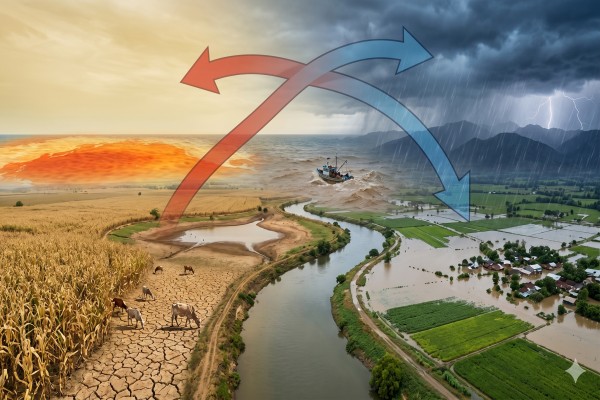
A climate phenomenon linked to some of the world’s worst droughts, floods and food crises is strengthening in the Pacific Ocean, raising concerns that the coming years could be be shaped by a rare and powerful “super” El Niño.
Scientists have long tracked El Niño because of its ability to alter weather patterns across vast parts of the globe. In its simplest form, El Niño occurs when surface waters in the central and eastern Pacific Ocean become unusually warm.
Those warmer waters affect atmospheric circulation, shifting rainfall patterns and temperatures far beyond the Pacific itself.
A “super” El Niño is the strongest version of the phenomenon. While definitions vary, scientists generally use the term for exceptionally intense events in which Pacific Ocean temperatures rise far above normal levels. Such episodes are uncommon. The last widely recognised super El Niño occurred in 2015-16, while another major event struck in 1997-98.
The concern is not merely meteorological. Strong El Niño events have historically been associated with lower agricultural output, higher food prices, water shortages, heatwaves, wildfires and economic losses across multiple continents.
Some researchers now believe the world could be entering another such cycle. If those projections prove correct, the effects could extend well beyond weather forecasts and into food markets, energy systems and national economies.
For India, the monsoon is the central concern.
The southwest monsoon delivers nearly three-quarters of the country’s annual rainfall and remains critical for agriculture, reservoirs, groundwater recharge and rural livelihoods. Although the relationship is not perfect, El Niño years have often coincided with weaker monsoon seasons.
India has become less vulnerable to monsoon fluctuations than it was decades ago. Irrigation coverage has expanded, crop varieties have improved and food stocks are larger. Yet agriculture still remains heavily dependent on rainfall in many regions.
That dependence is why policymakers are watching developments in the Pacific closely.
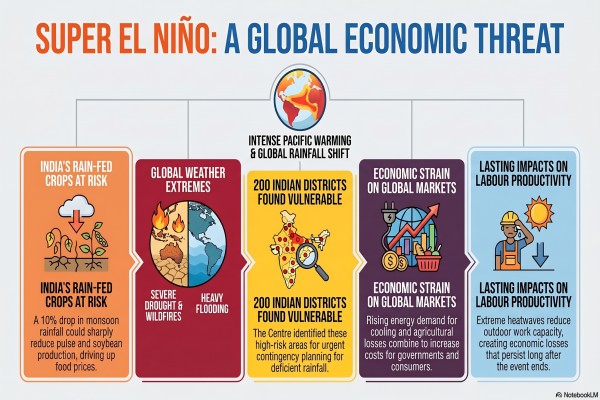
According to a Moneycontrol report citing government officials, there are concerns that pulses and soybean production could decline sharply during the 2026-27 crop year if monsoon rainfall ends up around 10 per cent below normal. Pulses are particularly sensitive because large parts of the crop are cultivated in rain-fed regions.
Any significant decline in production would have consequences beyond the farm sector. India is the world’s largest consumer of pulses and already imports substantial quantities to stabilise domestic supplies. Lower domestic output could increase import requirements and place upward pressure on food prices.
Soybean production could face similar challenges. The crop plays a critical role in the edible oil sector, where India remains heavily dependent on imports. Reduced harvests could add to concerns about food inflation at a time when governments around the world are already grappling with climate-related disruptions to agricultural production.
The risks extend beyond crop yields.
Below-normal monsoon rainfall can reduce reservoir levels, affect hydroelectric generation and place additional stress on groundwater resources. States that depend heavily on rain-fed agriculture often experience broader economic effects, from weaker rural demand to lower farm incomes.
Recognising these risks, the Centre has reportedly identified nearly 200 districts as particularly vulnerable to a deficient monsoon and has begun preparing contingency plans. Officials have also pointed to improved irrigation infrastructure compared with previous El Niño episodes as a factor that could help limit the damage.
Yet even if India avoids a severe drought, a super El Niño could still affect the country through global markets.
That is because the phenomenon influences weather conditions across much of the world.
Australia often experiences drought and elevated wildfire risk during strong El Niño years. Parts of Southeast Asia can see below-normal rainfall and agricultural stress. Southern Africa has historically faced drought conditions during major El Niño episodes, affecting maize production and food security.
Elsewhere, the impacts can be very different. Parts of North and South America often experience heavier rainfall, flooding and storm-related disruptions. Fisheries along the Pacific coast of South America can also be affected as warmer waters disrupt nutrient-rich ocean currents that sustain marine ecosystems.
The result is a climate event with global economic consequences.
A recent analysis in The Guardian argued that a super El Niño could place additional strain on an already fragile global economy.
Agricultural losses, infrastructure damage and rising energy demand could combine to increase costs for governments, businesses and consumers. The analysis pointed to research suggesting that major El Niño events can leave economic scars that persist for years after the weather pattern itself has faded.
Higher temperatures can also affect labour productivity, particularly in countries where large numbers of people work outdoors. Heatwaves increase demand for cooling, putting pressure on electricity grids and energy supplies. Droughts can reduce hydropower generation, forcing countries to rely on more expensive alternatives.
Research examining past major El Niño episodes has found that economic effects can linger long after the event itself. Lower agricultural output, inflationary pressures and disaster-recovery costs can weigh on growth and public finances for years.
Scientists caution that forecasts remain forecasts. Not every El Niño evolves into a super El Niño, and not every strong El Niño produces identical outcomes. Local weather conditions, ocean temperatures in other regions and broader climate trends can all influence the eventual impact.
Yet the timing is difficult to ignore. The prospect of a super El Niño comes as the global economy is already navigating a period of unusual strain.
Conflicts in West Asia continue to threaten energy markets and shipping routes. Supply chains remain vulnerable after years of disruption. Governments across both developed and developing economies are grappling with high debt, inflationary pressures, political polarisation and growing social discontent.
Against that backdrop, a powerful El Niño would not be creating a crisis from scratch. Rather, it could act as a force multiplier, worsening existing vulnerabilities. Poor harvests could drive food prices higher, droughts could intensify water stress, and extreme weather events could impose fresh costs on governments already facing fiscal pressures.
The warming waters of the Pacific may seem far removed from India’s farms or Europe’s energy markets. But history suggests that major El Niño events have a way of connecting distant crises.
If the current system develops into a super El Niño, it will arrive at a moment when the world’s economic, political and social resilience is already being tested.