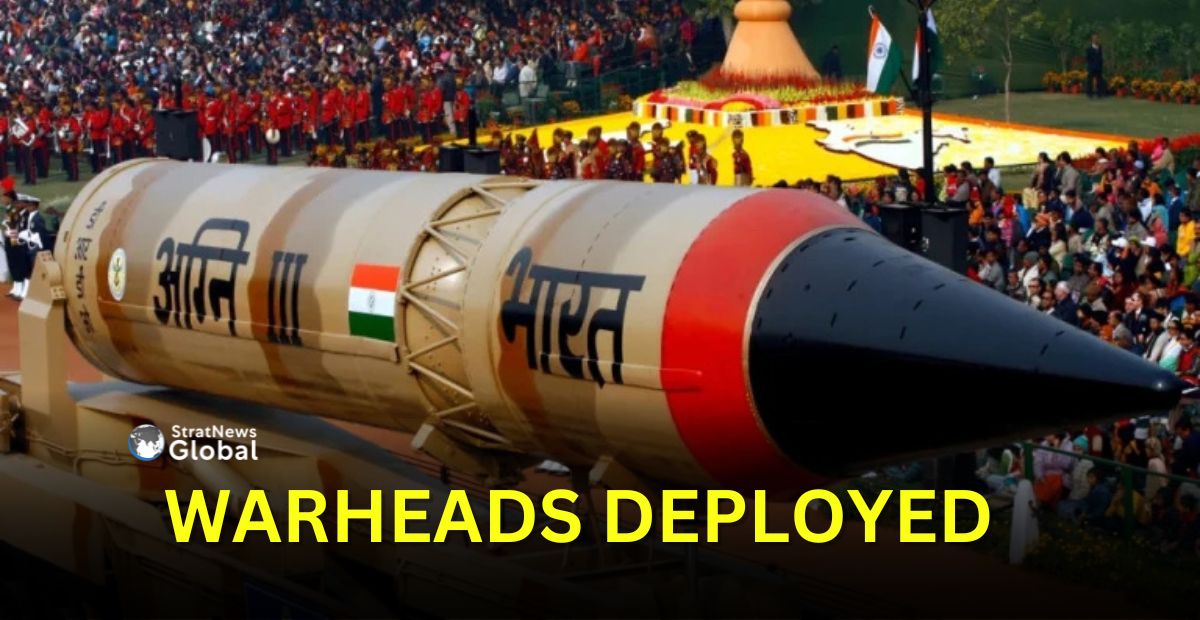
The Stockholm International Peace Research Institute released its annual yearbook on June 9. One finding stood apart from everything else. For the first time in its history of assessments, SIPRI classified a portion of India’s nuclear arsenal as operationally deployed, not stockpiled.
Twelve warheads are assessed to be deployed with operational forces, almost certainly aboard a nuclear-powered ballistic missile submarine on a deterrence patrol. India holds 190 nuclear weapons in total. The other 178 remain in storage. The number is modest but the shift it represents is not.
What Changed, Why It Matters
India’s nuclear posture has always rested on one premise. Warheads and delivery systems are kept physically separate during peacetime, stored in different locations, under different chains of custody.
This de-mated arrangement was deliberately chosen to reduce the risk of accidental use, lower operational readiness, and reinforce the “No First Use” doctrine. SIPRI says that has changed.
The move toward canistered missiles, where a warhead and launch system are pre-integrated inside a sealed container, combined with regular sea-based deterrence patrols, suggests some warheads are now riding deployed launchers.
Dr. Manpreet Sethi, India’s most widely published nuclear scholar, has long argued that the sea-based leg carries the heaviest strategic burden under a ‘No First Use’ posture. Unless submarine-launched missiles have sufficient range to keep the boat out of harm’s way, the submarine becomes a liability rather than an asset.
The K-4 missile, tested twice from INS Arighaat with a range of 3,500 km, directly addresses that constraint. The newer boats with larger launch tubes address it further.
SIPRI notes its assessment carries “considerable uncertainty.” India has confirmed nothing.
The Fleet That Made This Possible
India currently operates three nuclear-powered ballistic missile submarines. INS Arihant was commissioned in 2016. INS Arighaat joined in August 2024. INS Aridhaman, significantly larger than the previous two and equipped with eight launch tubes, entered service in April 2026.
A fourth boat, INS Arisudan, is completing sea trials, expected to be commissioned in 2027.
These submarines do not operate under the Indian Navy. They come under the Strategic Forces Command, a tri-service body that manages all nuclear assets separately from the regular defence budget.
The current SFC chief is Lieutenant General Dinesh Singh Rana. The SFC seeks command from the NCA (Nuclear Command Authority) which has two layers. The Executive Council, chaired by the National Security Adviser, handles operational advisory functions.
The Political Council, chaired by the prime minister, is the only body authorised to give the order. In short, his finger is on the button, the SFC executes it and the navy crew sails.
Commodore Anil Jai Singh (Retd), a submarine specialist, explained in April 2026 why reaching three boats is operationally decisive: “For any second-strike capability to be credible, it is very essential to have at least one submarine continuously at sea. With three SSBNs we will be able to keep one submarine on patrol at any given time.”
That is precisely what SIPRI has now recognised. One boat on patrol. Warheads aboard. That is what deployed means at sea.
Pakistan Reacts. China Stays Quiet
Zahir Kazmi, an Arms Control Advisor at Pakistan’s own Strategic Plans Division, posted a nine-part thread within hours of the report. His opening line:
“SIPRI Yearbook 2026 now vindicates what I have been documenting for years. India has moved from a so-called recessed, de-mated posture toward operational nuclear warhead deployment and peacetime mating with launchers. The reliable minimum deterrent narrative just took a hit.”
Pakistan’s Centre for International Strategic Studies convened an emergency seminar for June 10, the very next morning, titled “Pakistan’s Nuclear Weapon Programme: Guarantor of Peace and Stability in South Asia.”
Speakers included an advisor to Pakistan’s National Command Authority and the former chairman of its Atomic Energy Commission. The timing was not coincidental.
Pakistan has long wanted what India now has. Based on a December 2025 report by US independent outlet Drop Site News, Sandeep Unnithan in May 2026 reported that Pakistan asked China in 2024 for submarine-based nuclear second-strike capability in exchange for allowing China to have a permanent military base at Gwadar port.
China saw the demand as unreasonable. The talks stalled. And Pakistan to date has zero deployed warheads and no submarine leg to its nuclear triad.
China, on the other hand, said nothing. Global Times remains silent. Hu Xijin, the state media editor who comments on most India security developments, posted nothing.
Beijing holds 620 nuclear warheads, with deployed counts rising from 24 to 34 in one year. SIPRI states explicitly that India’s modernisation is focused on reaching targets across China. Publicly reacting to India’s deployment would invite an unwarranted spotlight on Beijing’s own rapidly expanding arsenal.
The Numbers As They Now Stand. Pakistan has zero deployed warheads, China 34, and India now has 12.
The doctrine has not changed. “No First Use” stands. But as Manpreet Sethi has argued for years, and as the fleet expansion and canistered missiles make plain, the infrastructure that makes retaliation credible has been quietly maturing.
SIPRI has just put a number on it.