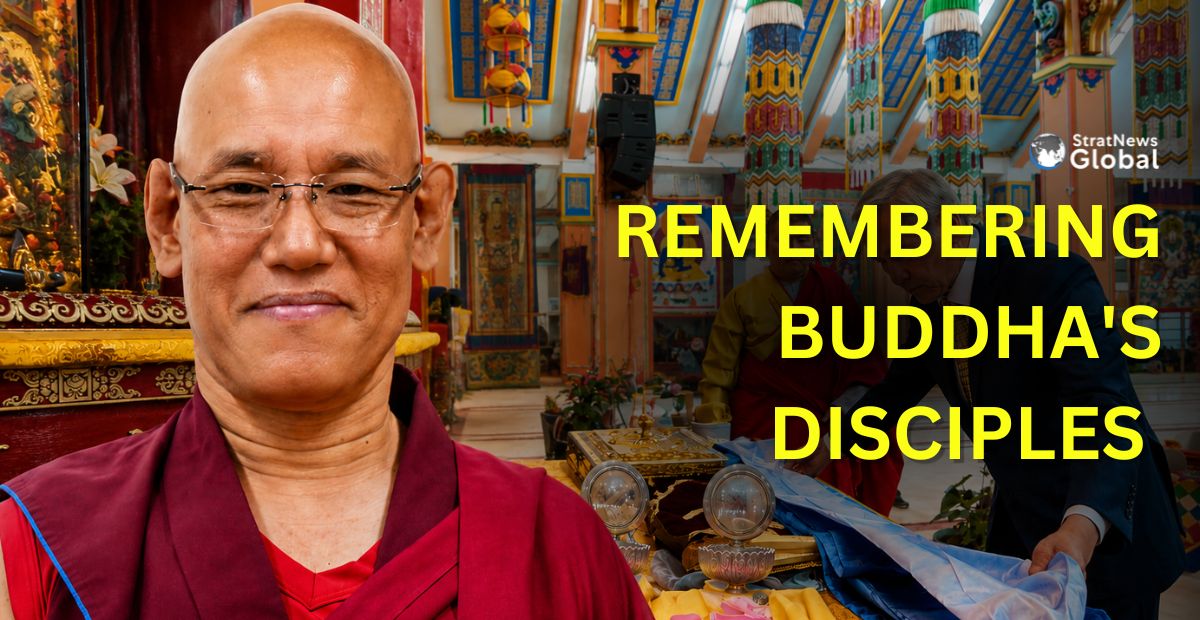
An exposition of the Holy Relics of the chief disciples of the Buddha—Arahant Sariputta and Arahant Mahamoggallana— is being organised in Mongolia from 1 to 10 June by the Ministry of Culture, Government of India, the International Buddhist Confederation (IBC), and the National Museum, New Delhi. Anukriti of StratNewsGlobal spoke to the Secretary General of the IBC, Shartse Khensur Jangchup Choeden Rinpoche who is accompanying the Relics to Mongolia.
Q: What is the spiritual significance of the Holy Relics of the Buddha?
A: According to Buddhist literature, the Buddha’s Relics have great significance. The Relics include the physical remains of the Buddha and texts tell us that when the devote pays their respect and veneration to the Holy remains, they accumulate merit, which will also trigger faith in them and lead to their spiritual growth.
Q: This is the first time that the relics of Arahant Sariputta and Arahant Moggallana are being taken to Mongolia. Why are they important?
A: While the Buddha had thousands of disciples during his lifetime, Sariputta and Moggallana were his chief disciples. Sariputta is known for his wisdom and intelligence, and Moggallana is known to be powerful, with psychic powers and the ability to perform miracles. The Buddha gave them roles according to their unique capabilities. In later depictions of the Buddha’s statues and paintings, Sariputta and Moggallana are seen to accompany the Buddha everywhere, Sariputta on his right, and Moggallana on his left.
Q: I understand they were Hindu Brahmins?
A: Yes. They were Brahmins, well established scholars in Brahmin tradition and the Vedas. Something about the Buddha inspired them to follow in his path. They were not the first to follow the Buddha. In fact they came relatively later. But they grew rapidly in that ranking system and became the Buddha’s chief disciples.
Q: Do you think taking the relics to different nations has contributed to Dhamma, and to promoting Buddhism? Do we need to promote Buddhism?
A: Buddhism is very unique. It is not an organised religion, and in fact in some countries it is badly fragmented and disorganized. In others, like Thailand and Burma, it is quite well organised, but at the global level it is very deeply fragmented. There is no central administration unlike in Christianity or Islam. Yet Buddhism appeared to be attractive and inspiring to the educated class, which is why there is a resizable interest in Buddhism in Europe and America. So from that point of view, some might think it is not necessary to promote Buddhism because it is naturally growing. Some feel that other religions are doing so and Buddhism also has the right. As an individual and a Buddhist monk, my thinking is very simple: if Buddhism is capable of contributing to global peace, harmony and brotherhood, then it should be promoted.
Q: So you are saying that Relics are playing a part in this?
A: Definitely. When the relics are brought to the public there is a sudden interest to come to see them. This might arouse curiosity and they may go back and learn about Sariputta and Moggallana, study their history, and get inspired by them. This could provoke them to do further research. This is one way of bringing people towards Buddhism and towards Buddhist values and teachings.
Q: Why are the relics being taken to Mongolia?
A: Roughly 90 to 95 per cent of Mongolia’s population is Buddhist. They have a very strong devotion towards the Buddha and towards the two chief disciples. The Buddha’s Relics have been taken to Mongolia twice in the past, so the Mongolian political leadership requested Prime Minister Shri Narendra Modi to bring the relics of his closest disciples to Mongolia. I am happy that we have been able to fulfil this request and also the wish of Mongolian Buddhist devotees and lay followers of the Buddha. It is a great opportunity in life to view the Holy Relics of Sariputta and Moggallana. Recalling their exceptional history will inspire people to dedicate more of their time in spirituality and spiritual values that are enshrined in Buddhist teachings.