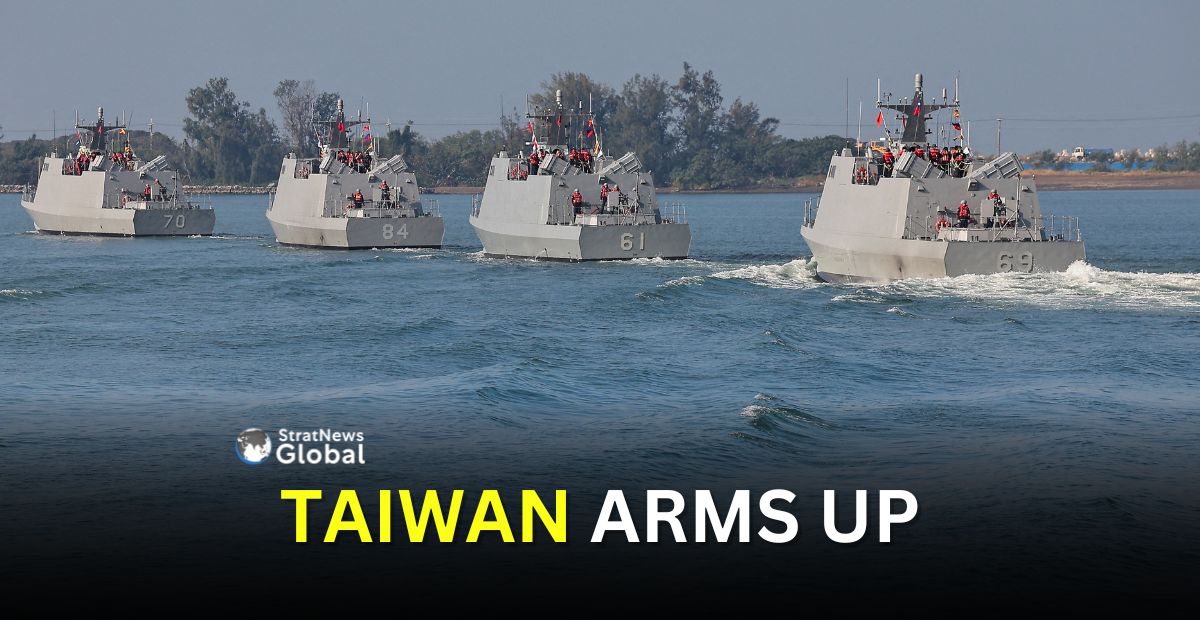
Taiwan is set to significantly expand its stockpile of advanced anti-ship missiles to more than 1,800 by early 2029, according to a Reuters analysis, as it works to strengthen its ability to deter or respond to a potential Chinese blockade or invasion.
Taiwan’s expanding anti-ship missile arsenal is central to its asymmetric defense strategy, which relies on large numbers of affordable, high-impact weapons—including missiles and drones—to counter China’s superior military power. The goal is to maintain a survivable force capable of withstanding an initial Chinese strike and targeting invasion or blockade fleets.
Asymmetric Strategy To Counter China
According to Reuters, Taiwan’s anti-ship missile inventory is expected to exceed 1,800 by 2029, led by U.S.-supplied Harpoon missiles and domestically produced Hsiung Feng systems. Defense experts say these weapons could create a “kill zone” in the Taiwan Strait, raising the cost and difficulty of any Chinese invasion attempt.
Taiwan is also increasing defense spending and pursuing additional U.S. arms purchases to strengthen its deterrence capabilities.
Learning From Ukraine And Iran
Military analysts cite Ukraine’s use of missiles and drones against Russian naval forces, and Iran’s ability to continue striking targets despite sustained attacks, as evidence that a weaker power can impose significant costs on a stronger adversary. Taiwan hopes to apply a similar strategy by dispersing mobile anti-ship missile launchers across the island, making them harder for China to target.
However, some experts warn that many of Taiwan’s missiles remain deployed on warships and fixed sites vulnerable to pre-emptive strikes. Taiwan says its missile forces are mobile, dispersed, and equipped with survivability measures.
Reuters estimates Taiwan’s anti-ship missile arsenal could exceed 1,850 by 2029, including about 850 U.S.-supplied Harpoon missiles and more than 1,000 domestically produced Hsiung Feng missiles. To improve coordination, Taiwan will establish a new Littoral Combat Command integrating coastal radars, anti-ship missiles, and drones. The buildup is aimed at deterring invasion and sustaining resistance long enough for allied support to arrive.
(With inputs from Reuters)