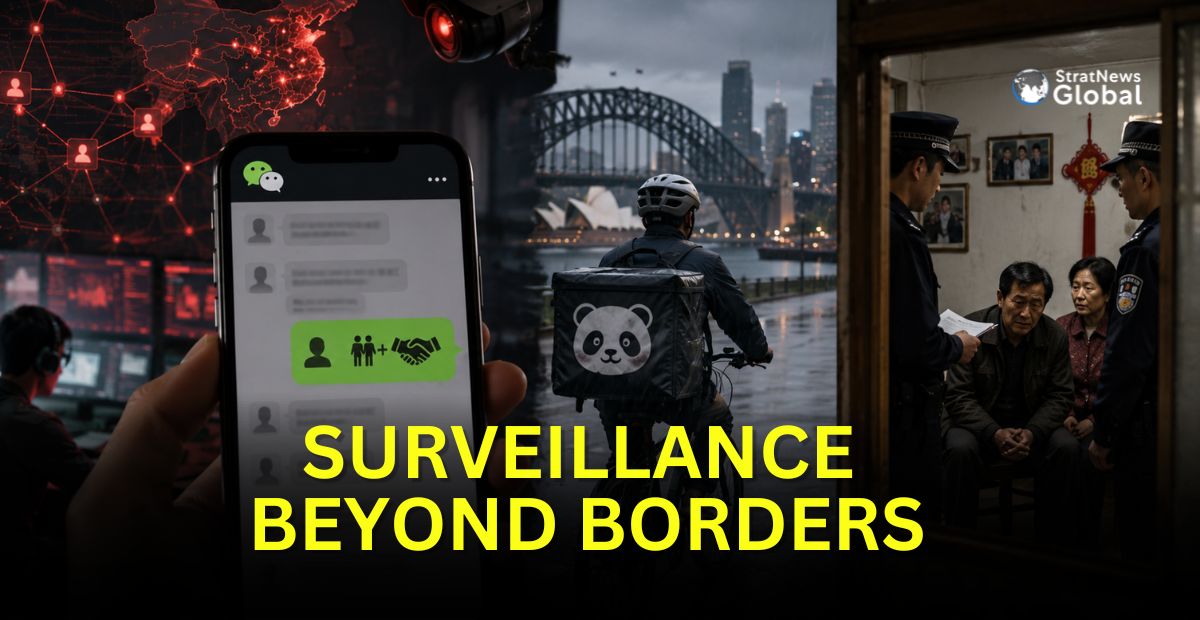
You are a Chinese citizen and a food delivery rider in Sydney with temporary visa earning a livelihood riding a bicycle, not a protester, not a dissident. In early February 2026, one word, “together”, typed in a WeChat group with fellow riders, was the code for you want better pay during the Chinese New Year. That’s it.
Within hours, police officers in Henan and Zhejiang provinces, thousands of miles away in your home country, are walking into your parents’ homes. Your father is summoned to the local station.
You have broken no Australian law, no strike, nothing. The word was enough. WeChat is not just a messaging app. It is a surveillance pipeline running directly into the Chinese state. Every group, every keyword, every conversation is monitored in real time.
Global food delivery giant HungryPanda’s riders in Sydney, Australia, discovered what that means. The CCP does not distinguish between a dissident fleeing persecution and a gig worker negotiating wages. Any collective action, any word linked to labour unrest, is a threat to the narrative. And the apparatus built to protect that narrative has no borders.
Every year, thousands of people who left China discover that leaving was not enough. Their phones buzz with threats. Their relatives back home lose jobs, benefits, or freedom.
Agents knock on doors in Toronto, Madrid, and Amsterdam. This is not a spy thriller. It is a documented, systematic campaign by the Chinese Communist Party to control its citizens and their narrative no matter where they live.
The name for it is “Transnational Repression”. And China does it better, wider, and more aggressively than any other government on earth. China’s preferred method is not kidnapping. It is more cruel and cheaper.
Local governments publicly warn overseas citizens to return or watch their families suffer. Children are barred from schools. Parents lose health insurance. Homes are spray-painted with the words “House of Telecom Fraud.” Bank accounts of relatives are frozen.
Between April 2021 and July 2022 alone, China claims 230,000 people were “persuaded to return.” That word, persuaded, covers a wide range of acts. In documented cases from Canada, methods included online surveillance, repeated visits to family members, threats, and agents harassing targets on foreign soil.
Operation Fox Hunt launched in 2014, tracks dissidents, economic fugitives and missing officials and returns them to China, while Operation Sky Net does the same for corrupt officials and of course political dissidents.
According to Safeguard Defenders’, an NGO that monitors disappearances in China, at least 12,000 people from 120 countries were forcibly returned to China over the following decade. Of 283 individual cases publicly confirmed by the Chinese government itself, 27 involved people living in Canada.
Hackers Follow Where Agents Cannot
When physical pressure fails, China sends code. The Citizen Lab at the University of Toronto documented two hacker groups, GLITTER CARP and SEQUIN CARP, running phishing campaigns against Uyghur activists, Tibetan groups, Hong Kong democracy advocates, and journalists from the International Consortium of Investigative Journalists.
The attacks began shortly after the ICIJ published its “China Targets” investigation into Chinese transnational repression.
Targets received fake emails from people they trusted, including impersonated colleagues, fabricated whistleblowers, and spoofed security alerts.
Democracies Push Back
In March 2026, Italy expelled eight Chinese nationals on national security grounds after years of harassment against a prominent dissident known as “Teacher Li.”
In May 2026, the United Kingdom, the United States, and Norway each acted against CCP-linked agents on the same day.
In Canada, the RCMP is investigating Chinese police stations identified in Toronto, Vancouver, and Montreal.
A new anonymous reporting database, 海外黑手档 (Overseas Black Hand Files), launched in May 2026 to collect and document cases from ordinary overseas Chinese who would otherwise suffer in silence.
The message from Beijing has always been simple: you can leave but cannot escape us. The message from democracies is finally beginning to catch up with it.